
Where to Walk
Mana Pools Walking Safari Guide
On the Zambezi floodplain at Mana Pools, open woodland and long sightlines make walking the natural way to see the park.
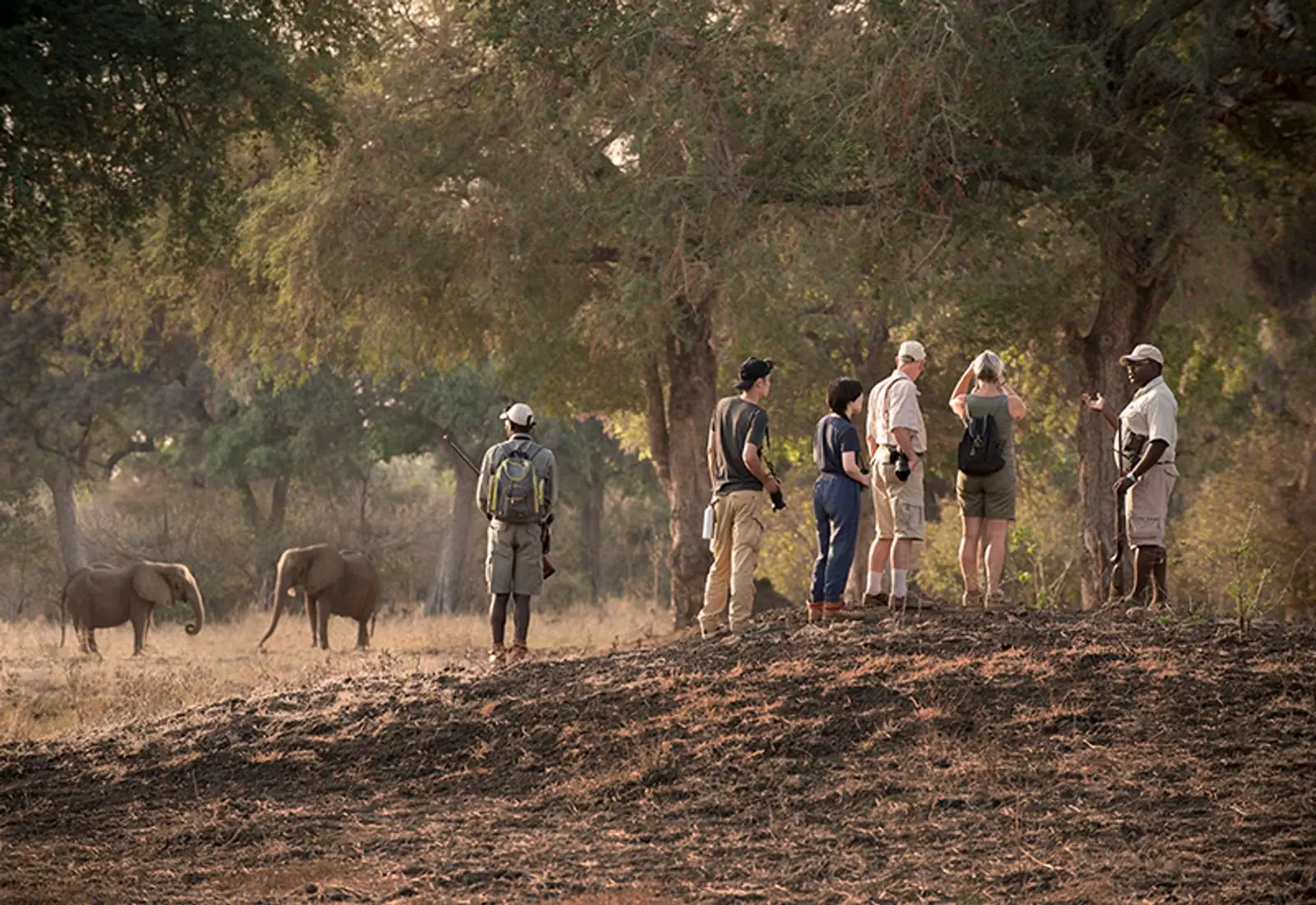 Photo: Mana Pools Expeditions Company
The landscape
The heart of Mana Pools is the Zambezi floodplain: old river terraces under open woodland of Ana trees (Faidherbia albida, also called apple-ring acacia or winter thorn), with mahogany, wild figs, ebony and baobab. The ground beneath is open, and that matters on foot. You can see a long way, and so can the animals.
Late in the dry season the Ana trees drop their pods, and elephants come to feed on them. Several Mana bulls have learned to stand on their hind legs to reach the branches. Famous bulls such as Boswell have drawn photographers for years.
Inland, the country changes. Away from the river there is thicker bush, mopane and seasonal pans. Mana is also one of the better places in Africa to look for wild dogs, and top guides regularly track wild dogs and lions on foot.
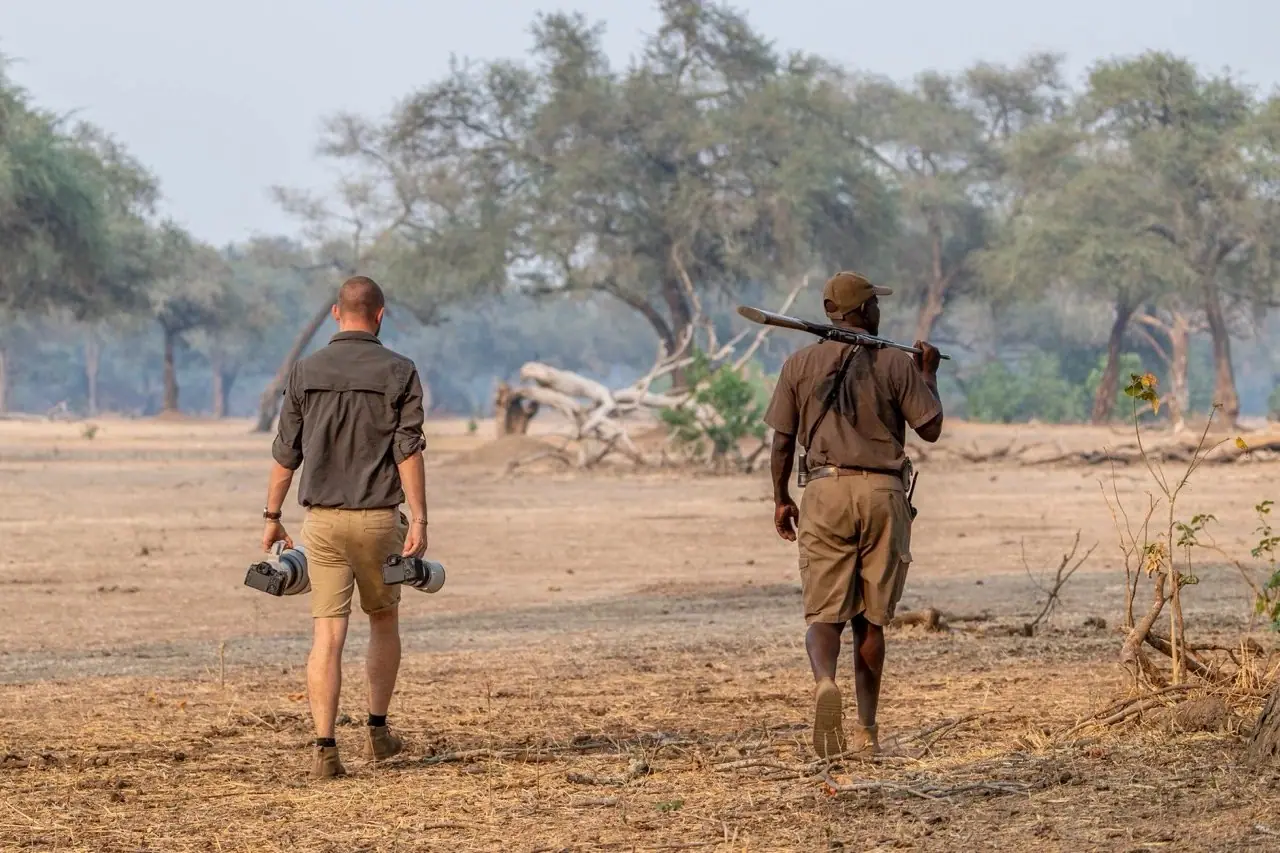 Photo: Mana Pools Expeditions Company
Why walking is so central here
Walking has a long tradition at Mana Pools. The 1984 UNESCO documentation already noted that tourists were permitted to walk through the riparian woodlands. Because people have walked here for decades, many animals, particularly the floodplain elephant bulls, are relatively tolerant of people on foot. Tolerant is not tame, and every guided walk is still led by an armed guide.
Counted on the same criteria we use everywhere, walking is a daily core activity at roughly two-thirds to three-quarters of Mana's commercial camps. South Luangwa in Zambia has more walking camps in total; Mana has the higher share.
Walking on your own, and why most people don't
Mana Pools is one of very few big-game parks in Africa where visitors may walk without a guide. In May 2015 the park authority banned unguided walking. The ban was lifted in August 2015 and replaced with a daily walking permit. Visitors may walk at their own risk, or hire an armed park scout. The park's 2023 visitor code restricts unguided walking to the floodplain, with no riverine or thick-bush walks, keeps walkers at least 30 meters from elephants, lions, painted dogs and dens, and asks walkers not to tag onto (shadow) other walking groups.
Most visitors, and nearly all first-time walkers, go with an armed Professional Guide instead. The reasons are simple. These are elephant, buffalo and lion on open ground, and judging distance, wind and an animal's mood takes years to learn. The guide also finds and interprets far more than you would alone. Even independent sources that describe the permit recommend unguided walking only to people with significant bush experience.
The Zimbabwe Professional Guide
Zimbabwe's Professional Guide license is widely regarded as one of the most demanding guide qualifications in Africa. Candidates pass written exams, serve an apprenticeship of at least two years under a fully licensed guide, often much longer, and pass a dangerous-game shooting proficiency test, an oral board and a seven-day practical exam. Many take five years or more to qualify.
In practice, this means the person leading your walk is both your naturalist and the person responsible for your safety, with the rifle and the license to carry it.
Chitake Spring
Chitake Spring lies inland, in the remote south of the park, roughly 50 km from the Zambezi as the crow flies. It is a spring that flows year-round in an otherwise dry riverbed. In the late dry season, buffalo and elephant must come to drink beneath its banks, and lions wait for them. Close encounters on foot are common. This is rugged, intense walking country, best suited to people who have walked before.
Camps by format
Almost no Mana camp publishes a daily walking schedule, so these formats rest on how each operator describes its activities. Statuses change from season to season; confirm with the camp before you plan around it.
Walking Expedition
- Natureways Safaris, Camp Chitake. A temporary camp set up at Chitake Spring for each group and removed when they leave. Walking is the purpose.
Walking Camps on the Zambezi floodplain
- Stretch Ferreira Safaris. A semi-permanent tented camp inside the park, with daily morning walks plus drives and canoeing.
- Vundu and Little Vundu (owner-run). Seasonal camps in a private area of the park, with walking, drives and canoeing.
- John's Camp (Robin Pope Safaris). A semi-permanent camp of Meru-style tents near park headquarters, with walks, drives, fishing and canoeing.
- Camp Mana (Sunpath Safaris). An owner-run camp where walking is the main focus.
- Mana River Camp (Machaba Safaris). A six-tent seasonal camp with walks and drives.
- Nyamatusi (African Bush Camps). A camp in a private wilderness concession in the east of the park, with walks for ages 16 and up.
Inland Walking Camps
- Kanga Expeditions (African Bush Camps). On a pan about 15 km from the river, near the Chitake area. Pan-front viewing is a highlight, and walks with armed guides are part of the program, for ages 16 and up.
- Ingwe Pan (Machaba Safaris). An inland pan camp in a private concession, where walking is described as the main activity.
- Hideaways Mhara River Camp (Hideaways). A six-tent camp above the Chitake River, open all year, with guided morning walks, exploration of Chitake Gorge and evening drives.
Walking Camps on the boundary
- Ruckomechi and Chikwenya (Wilderness). Ruckomechi sits on a concession straddling the western boundary; Chikwenya is on a private conservation area at the eastern boundary, where walking is described as the core activity. Both offer day and night drives.
Walks Offered
- Several camps on the private reserves and concessions around the park, including Tembo Plains, Kavinga and Molori Mashuma, offer walks alongside drives, boating or hides.
Night drives
Self-drive visitors may not drive after dark or off-road. Night drives run where camps advertise them, mostly on private concessions on or around the park boundary, such as Ruckomechi and Chikwenya. If a night drive matters to you, confirm it with the camp.
When to go
Camps generally open from April to November and close from December to March, when the rains make roads and airstrips unreliable. August and September are the classic months; October is very good but very hot, often above 40°C (104°F). Late in the dry season, game concentrates on the floodplain and the Ana trees drop their pods.
Planning notes
- Most operators set 16 as the minimum age for walking; a few accept younger children on shorter walks.
- Motorboats are not permitted in the park. Canoeing is offered by several camps.
- Self-drivers should check road conditions with ZimParks before traveling. In March 2026, after floods, ZimParks advised self-drive visitors to avoid the park until further notice.
Sources
- UNESCO World Heritage Centre, Mana Pools nomination documentation — https://whc.unesco.org/document/153141
- Wikipedia, Mana Pools National Park — https://en.wikipedia.org/wiki/Mana_Pools_National_Park
- Zimbabwe Field Guide, Mana Pools — https://www.zimfieldguide.com/node/19
- Expert Africa, Mana Pools — https://www.expertafrica.com/zimbabwe/mana-pools-national-park
- Expert Africa blog, Elephants in Mana Pools (Sept 2024) — https://blog.expertafrica.com/wildlife/an-unforgettable-encounter-with-elephants-in-mana-pools-zimbabwe/
- Tourism Update, Mana Pools bans unguided walks (2015) — https://www.tourismupdate.com/article/mana-pools-bans-unguided-walks
- Mana Pools Code of Conduct — https://www.manapools.com/wp-content/uploads/2022/04/Mana-Pools-Code-of-Conduct.pdf
- ZimParks, Mana Pools Code of Conduct for Visitors (revised January 2023) — https://www.zamsoc.org/s/Mana-Pools-Code-of-Conduct-for-Visitors-revised-2023.pdf
- 4x4 Afrika, Mana Pools safari guide (Jan 2026) — https://4x4afrika.com/2026/01/19/mana-pools-zimbabwe-safari-guide/
- Zimbabwe Professional Guides Association, Education — https://zpga.org/areas-of-focus/education/
- Expert Africa, Zimbabwe safari guides — https://www.expertafrica.com/zimbabwe/info/zimbabwe-safari-guides
- Africa Geographic, Chitake Springs — https://travel.africageographic.com/destinations/zimbabwe/chitake-springs
- Go2Africa, Why go to Mana Pools — https://www.go2africa.com/destinations/mana-pools/why-go
- Safari Frank, Camp Chitake — https://safarifrank.com/accommodation/camp-chitake/
- Safari Frank, Camp Mana — https://safarifrank.com/accommodation/camp-mana/
- Expert Africa, Stretch Ferreira Safaris — https://www.expertafrica.com/zimbabwe/mana-pools-national-park/goliath-safaris/in-detail
- Expert Africa, Vundu Camp — https://www.expertafrica.com/zimbabwe/mana-pools-national-park/vundu-camp/in-detail
- Expert Africa, John's Camp — https://www.expertafrica.com/zimbabwe/mana-pools-national-park/johns-camp
- Tourism Update, New tented camp comes to Zim's Mana Pools — https://www.tourismupdate.com/article/new-tented-camp-comes-to-zims-mana-pools
- African Bush Camps, Kanga Camp — https://africanbushcamps.com/camps/kanga-camp
- African Bush Camps, Nyamatusi factsheet — https://b-cdn.springnest.com/media/doc/xc/abc-nyamatusi-camps-factsheetpdf.pdf
- Yellow Zebra Safaris, Ingwe Pan Camp — https://yellowzebrasafaris.com/zimbabwe/accommodation/ingwe-pan-camp/
- Timbuktu, Hideaways Mhara River Camp — https://www.timbuktutravel.com/hotel/hideaways-mhara-river-camp
- Wilderness, Mana Pools safari season 2026 — https://www.wildernessdestinations.com/press-room/wilderness-mana-pools-safari-season-2026
- Expert Africa, Ruckomechi — https://www.expertafrica.com/zimbabwe/mana-pools-national-park/ruckomechi-camp
- Wilderness, Chikwenya Camp — https://wildernessdestinations.com/africa/zimbabwe/mana-pools-national-park/chikwenya-camp
- Yellow Zebra Safaris, Mana Sands (night-drive rule) — https://yellowzebrasafaris.com/zimbabwe/accommodation/mana-sands/
- AllAfrica, Mana Pools flood advisory (Mar 29, 2026) — https://allafrica.com/stories/202603300136.html
Spotted an error? Tell us. How we classify camps: our methodology.