
Where to Walk
Where Walking Really Matters: Walking Share by Park
Counting the camps that walk every day, as a share of all the camps in a park, shows where walking is the way of life and where it is an extra.
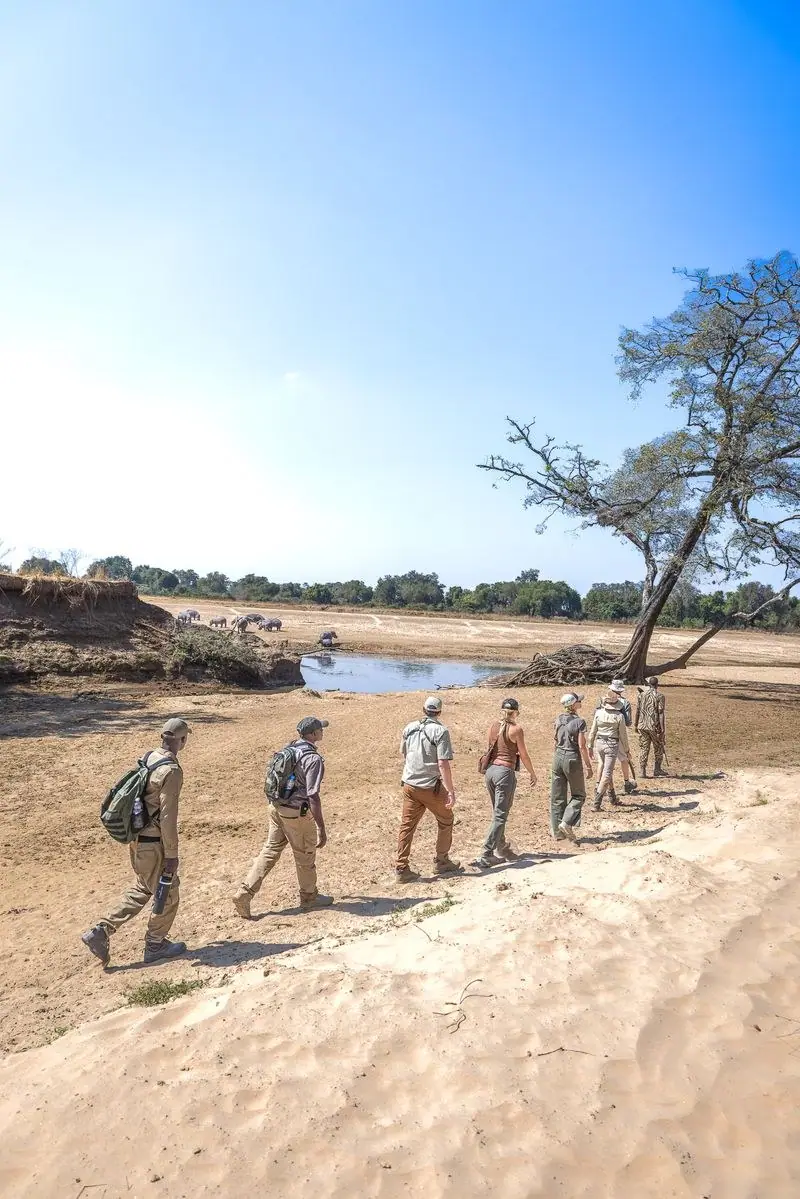 Photo: Chibembe Wildlife Reserve
Almost every safari park in Africa has somewhere you can take a walk. That tells you little about what your trip will feel like. A more useful question is how many of a park's camps make walking a daily core activity. Where that share is high, guides, schedules and the rhythm of camp life are built around being on foot.
We call this the walking share. Here is how four leading parks compare.
How we measured it
The numerator is the number of walking-led camps: camps classified as a Walking Expedition or a Walking Camp under our published methodology. These are camps where walking is either the whole trip or a daily activity offered on equal terms with the game drive.
The denominator is every commercial, bookable camp or lodge in the same area, meaning places where guests book rooms or tents with an operator. We left out state-run rest camps, self-catering units, campsites, standalone activities such as village stays and sleep-outs, and closed properties. We applied the same rule to every park.
The caveats
These figures are careful estimates, and they should be read that way.
- They are ranges. No official list of lodges was available for any of these parks or reserves, so each total was built from specialist travel agents' and tour operators' listings. Those listings have gaps and sometimes contradict each other, so each total is a range rather than a single number.
- They count camps, not guests. A small six-bed bushcamp and a large lodge each count once. No source we found records what share of guests actually walk, in any park.
- Format calls are judgments. Few camps publish walking schedules, particularly in Zimbabwe. Our classifications rest on the best evidence available and will be updated as operators confirm details.
- They reflect the 2026 season. Camps open, close and change what they offer.
Mana Pools: the highest share
In Mana Pools and its boundary concessions, about two-thirds to three-quarters of commercial camps are walking-led. Walking is close to universal here. The open floodplain woodland of Ana trees (Faidherbia albida) along the Zambezi gives walkers unusually good sightlines, and Chitake Spring, a perennial spring in the remote south of the park, draws wildlife in the late dry season. Walks are led by armed, licensed Zimbabwe Professional Guides, holders of a license widely regarded as one of the most demanding in Africa.
Mana Pools is also one of very few big-game parks where visitors may walk without a guide. A ban on unguided walking introduced in May 2015 was lifted in August 2015, and walking now requires a park permit. The share is high, but it rests on a smaller base of camps than South Luangwa.
South Luangwa: the most walking camps
In South Luangwa, about half of commercial camps (49–62%) make walking a daily core activity. That share is lower than Mana Pools', but South Luangwa has 24 walking-led camps, the most of any park we assessed. They span several operators, including Time + Tide, Robin Pope Safaris, Remote Africa and The Bushcamp Company, as well as smaller owner-run camps.
The Zambian model shapes the experience. A licensed guide and an armed government scout from the Department of National Parks and Wildlife go on every walk in the national park, and night drives are permitted inside South Luangwa. The walking season runs roughly June to October, and walking stops in the rains. Roughly every second camp offers walking as an equal daily choice alongside the game drive.
Hwange: good walking, mainly a drive park
In Hwange, three Walking Camps make up about 10–13% of commercial camps. Walking there takes place mainly in private concessions, with licensed Zimbabwean guides. For most Hwange camps the game drive is the main activity, but the walking that is offered is led to the same national licensing standard as Mana Pools.
Greater Kruger: walking-only depth, low share
Across Kruger's private concessions and the open private reserves alongside the park, 8 commercial camps are walking-led. Against roughly 120 to 170 commercial lodges and camps, that is 5–7%, or fewer than one camp in ten. At most lodges walking is optional and secondary to the drive. In Sabi Sand, we found no lodge that schedules daily walks as its primary activity.
That low share is only part of Kruger's walking story. Greater Kruger has more commercial Walking Expedition camps than South Luangwa, typically capped at eight walkers. Kruger also has seven state-run SANParks wilderness trails,* which offer three-night trails of up to 20 km a day year-round. For walk-all-day trips, Kruger has real depth.
What it means for you
A high walking share tells you that walking is the norm rather than an extra. In those parks, more camps will walk you every day, and more guides spend their working lives on foot.
- If you want a daily walk alongside game drives, South Luangwa offers the widest choice of camps, and Mana Pools offers the highest concentration.
- If you want to walk all day, look at Walking Expeditions in South Luangwa and North Luangwa, Mana Pools, and Kruger's trail camps and wilderness trails.
- If walking is a one-off extra, a lodge in any of these parks may suit you, but ask how often walks actually run.
Whichever park you choose, the questions that matter are the same: how many walks run each day, who leads them, and how many people walk together.
* Kruger's seven SANParks wilderness trails are run by South African National Parks, a state agency, and are excluded from the commercial counts above. Adding them to both sides would raise Greater Kruger's walking share to about 8–12%.
Publisher's note. WalkingSafaris.com is published by The Safari Heritage Collection, custodians of Chibembe and owners of Lion Camp and The Bushcamp Company. Some of our camps appear in this article, and they are assessed on exactly the same published criteria as every other camp in Africa. Who we are
Sources
- Expert Africa, South Luangwa lodges and camps: https://www.expertafrica.com/zambia/south-luangwa-national-park
- Expert Africa, Mana Pools lodges and camps: https://www.expertafrica.com/zimbabwe/mana-pools-national-park
- Expert Africa, Hwange lodges and camps: https://www.expertafrica.com/zimbabwe/hwange-national-park
- krugerpark.co.za, Kruger private concession lodging: https://www.krugerpark.co.za/Kruger-Park-Private-Concession-Lodging/
- safari.com reserve listings (Timbavati, Klaserie, Manyeleti, Thornybush): https://www.safari.com/timbavati
- sabisandsgamereserve.com, Sabi Sand lodge guide (unofficial aggregator): https://sabisandsgamereserve.com/best-lodges-in-sabi-sands-game-reserve-expert-ranked-guide-for-2026/
- Singita, Guided safari walks: https://singita.com/lodge/singita-boulders-lodge/experience-guided-safari-walks
- SANParks, Kruger Wilderness Trails: https://www.sanparks.org/parks/kruger/what-to-do/activities/wilderness-trails
- Tourism Update, Mana Pools bans unguided walks (2015): https://www.tourismupdate.com/article/mana-pools-bans-unguided-walks
- Mana Pools Code of Conduct (manapools.com): https://www.manapools.com/wp-content/uploads/2022/04/Mana-Pools-Code-of-Conduct.pdf
- Africa Geographic, Chitake Springs: https://travel.africageographic.com/destinations/zimbabwe/chitake-springs
- Zimbabwe Professional Guides Association, Education: https://zpga.org/areas-of-focus/education/
- Kafunta Safaris, Walking safari Zambia: https://kafuntasafaris.com/walking-safari-zambia-what-to-know/
- Tribes, Hwange National Park: https://www.tribes.co.uk/places/hwange-national-park/
Spotted an error? Tell us. How we classify camps: our methodology.