
Where to Walk
The Birthplace of the Walking Safari – South Luangwa Walking Safari Guide
In South Luangwa, a morning on foot is not an extra; it is one of two equal ways to spend each day in the park.
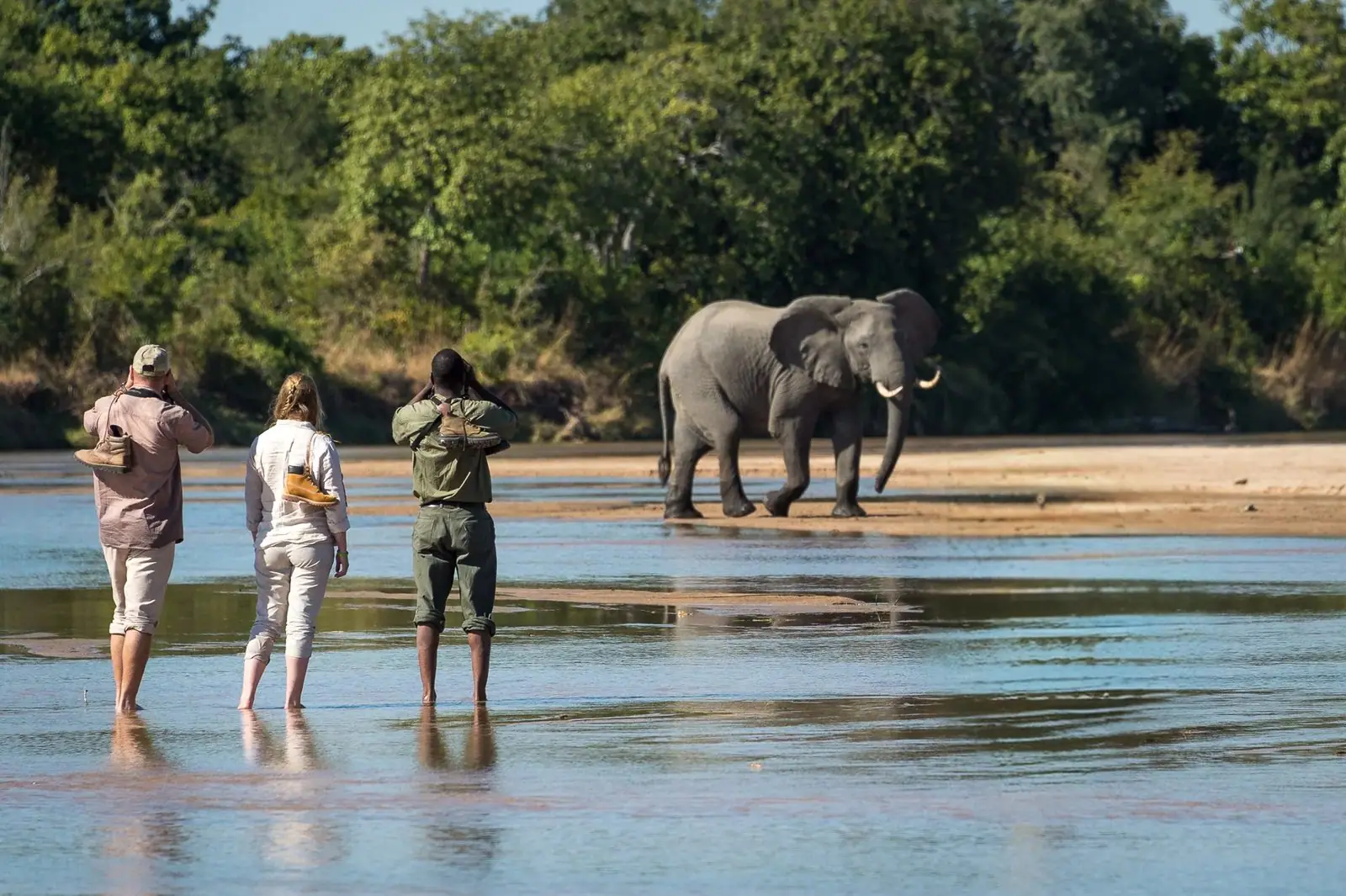 Photo: The Bushcamp Company
Why walking is central here
In many safari areas, a walk is something you arrange as a change from the vehicle. In South Luangwa it is the other half of the day. At most walking camps, guests choose a walk or a drive for each activity. A common pattern is a morning walk, a rest through the midday heat, then an afternoon drive that carries on into a night drive with a spotlight.
That pattern runs across the whole park rather than in a single reserve or one operator's concession. Counted on the same criteria we use everywhere, walking is a daily core activity at roughly every second commercial camp in South Luangwa. In Greater Kruger the figure is under one in ten. Mana Pools in Zimbabwe has a higher share, on a smaller base of camps.
Most of the walking-led camps here are Walking Camps in our terms: walks every day, offered as an equal choice with drives. A handful are Walking Expeditions, where walking is the whole trip. Both work well. For most first-time walkers, the Walking Camp is the better fit, because walks must end before dark and the evening belongs to the drive and the sundowner.
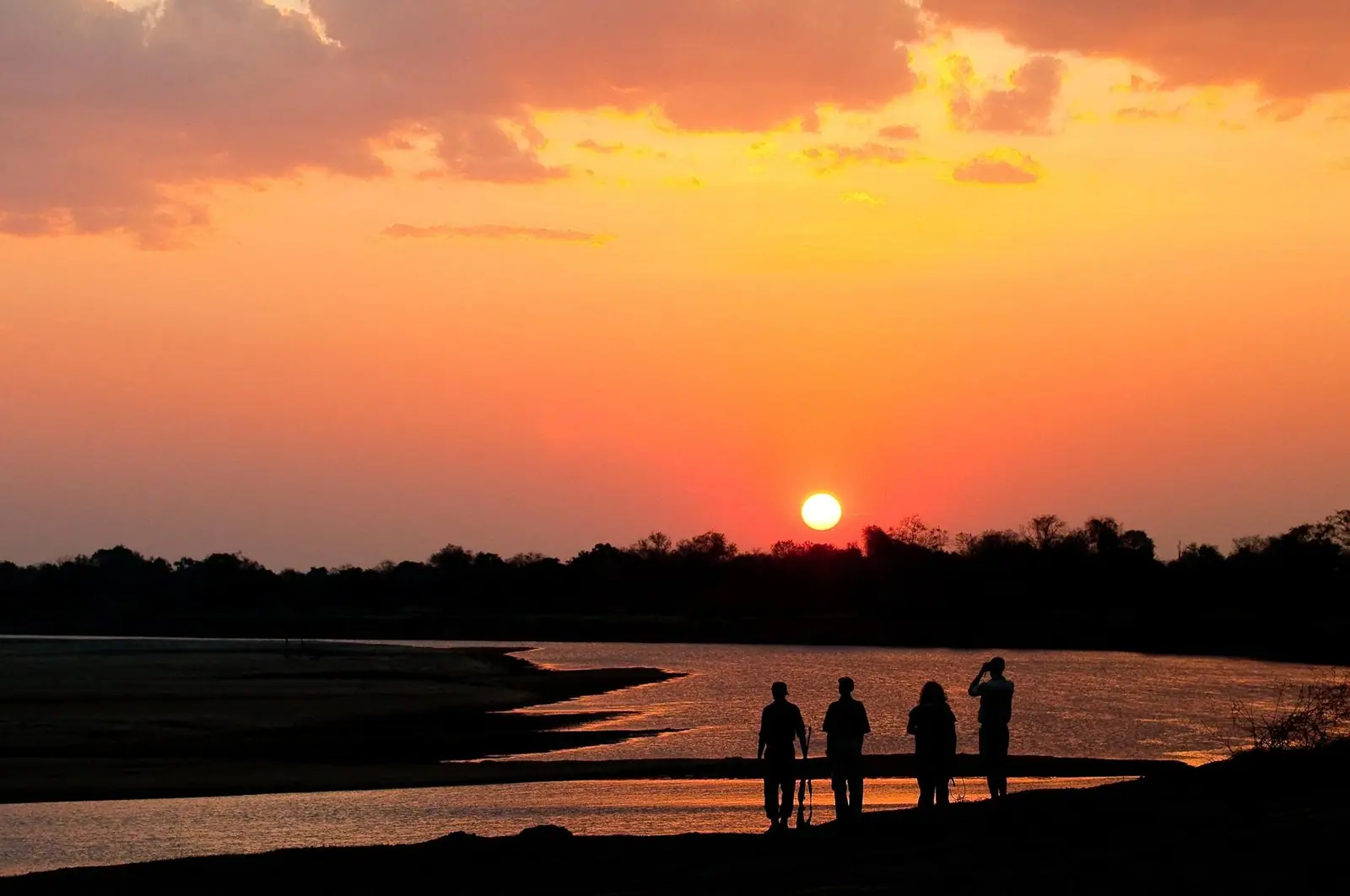 Photo: The Bushcamp Company
How a walk works
Every walk inside the national park goes out with a licensed guide and an armed DNPW scout, who is a government wildlife officer. Operators describe this as standard practice and a park requirement. Many camps add a tea porter. The guide interprets what you find; the scout is there for safety.
Walks are slow and close-up, and the small things on the ground get as much attention as the large animals. DNPW sets the minimum walking age at 12, and some camps set 16.
Distances are modest by design. Expect 3–5 km over three to four hours, starting soon after dawn and often finishing at a waiting vehicle that brings you back to camp for lunch.
A short history
Norman Carr opened Nsefu, generally described as the first game-viewing camp open to the public in Northern Rhodesia, in about 1950. The 1950 Game Department report records a tourist camp in Chief Nsefu's area. Revenue from the camp went back to the chief. Carr's conviction, which shaped the valley, was that wildlife survives only when the people who live alongside it have reason to protect it.
Government records date the launch of Carr's walking safari circuit to 1961. Guests crossed the Luangwa at the Chibembe pontoon and walked the Wilderness Trails to Lion Camp. It is the first commercial walking safari circuit on record. Walking in wild country was not new in Africa: in South Africa, Ian Player and Magqubu Ntombela led the first official wilderness trail at iMfolozi on March 19, 1959. The two men worked in parallel.
The Nsefu sector, where it began, is still a named part of the park and still hosts camps today.
Areas of the park
Mfuwe and the central park. The gateway to the park and home to many of its lodges. Drives here share the roads with other camps' vehicles, and walks are available from several lodges.
The Nsefu sector. North of Mfuwe, the original Nsefu reserve. Robin Pope Safaris runs Nsefu and Tena Tena here, and Remote Africa opened the new Olimba Camp in 2026.
The southern bushcamp area. A remote stretch of the southern park where The Bushcamp Company (BCC) holds an exclusive 140,000-acre area. Kafunta's camps sit in the far south.
The north, including the Mupamadzi. Quieter country around the Luwi, the Lion Plain and the Mupamadzi River, where vehicles are few and some areas have none at all.
Who walks, by format
Walking Expeditions
- Robin Pope Safaris, mobile walking safari. Set departures from June to mid-September on the Mupamadzi in the far north. Staff strike and re-pitch camp while guests walk, twice a day. Six guests at most, ages 16 and up. The trip begins and ends at Robin Pope's fixed camps.
- Remote Africa, Tafika Walking Trails. Chikoko Tree Camp and Big Lagoon are small seasonal camps in a vehicle-free walking area across the river from Tafika. Guests walk in, and can walk on from one camp to the other while porters move the bags.
Walking Camps
- Remote Africa, Tafika. Walks combined with drives, night drives and mountain biking; the gateway to the trails.
- Robin Pope Safaris, Nsefu and Tena Tena. Two activities a day in the Nsefu sector; guests choose to walk or drive.
- Time + Tide, Luwi, Nsolo, Kakuli and Mchenja. Daily walks are one of two included activities at each camp, alongside drives.
- Shenton Safaris, Mwamba. A small camp with walks, drives and hides. Its sister camp Kaingo closes from November 2026 to May 2027 for renovation.
- Kafunta Safaris, Three Rivers. On the east bank of the Luangwa in the far south, where walking is the signature activity.
- Sungani Lodge. A small seven-tent camp in the remote far south of the park, on the east bank, reached by charter.
- Mumbulu. An extremely rustic four-tent camp on a tourism concession inside the park, across the river from Chibembe, booked by one private group at a time. It also runs a few set-departure walking trails each season to a small fly camp at the Mupamadzi confluence.
- Chibembe Wildlife Reserve. An exclusive-use camp of four tents, rebuilt and reopened in June 2026, on 3,500 unfenced private acres beside the national park, north of the Nsefu sector. Its season runs June through October. Walking is the main point of the stay. Most of its land lies outside the national park.
- The Bushcamp Company. The largest operator in South Luangwa. It runs six seasonal bushcamps, the iconic Mfuwe Lodge and The Villas at KuKaya. Walks can be arranged at all eight properties, but most walking is done from the six bushcamps in the exclusive southern area. Groups are capped at eight walkers and are typically smaller. On request, BCC runs a fully walked circuit between its southern bushcamps; it covers the southern part of the park, not the whole of it.
Walks Offered
- Lion Camp. On the Lion Plain in the north, with walks and drives offered as two daily choices.
- Most lodges around Mfuwe, where walks are available but the drive leads.
When to go
The walking season runs from about June to October, with some camps opening in late May and closing in November. This is the dry season, and most seasonal bushcamps are built for it. When the rains arrive, the bushcamps close and walking stops.
Planning notes
- Book bushcamps early for the dry season; most hold six to eight guests.
- Three nights or more per camp is the common recommendation and gives you a mix of walks and drives.
- If walking is the main reason you are going, ask each camp how many walks it runs a day and how large its groups are.
Further reading: Wildlife of South Luangwa, from The Safari Heritage Collection, publisher of this site.
From The Bushcamp Company's Guide to the Luangwa: The Ultimate Guide to South Luangwa National Park · Inside the South Luangwa Ecosystem · Overview and History of South Luangwa National Park
Featured camps in South Luangwa
 Kapamba BushcampFour-chalet bushcamp where a morning walk with a guide, armed DNPW scout and tea porter usually precedes an afternoon…The Bushcamp CompanyView camp →FeaturedChamilandu BushcampThree-chalet bushcamp with a morning walk and an evening drive into the night; a second walk can be arranged on request.The Bushcamp CompanyView camp →FeaturedChindeni BushcampFour-tent bushcamp with a morning walk and an afternoon drive that often runs into a night drive, all walks with an…The Bushcamp CompanyView camp →FeaturedBilimungwe BushcampFour-chalet bushcamp where walking is the traditional main activity: a morning walk, then an afternoon and night drive.The Bushcamp CompanyView camp →FeaturedZungulila BushcampFour-tent bushcamp with few neighboring camps, where walks with an armed DNPW scout are offered alongside day and night…The Bushcamp CompanyView camp →FeaturedKuyenda BushcampSmall rondavel bushcamp where guests choose a morning walk or drive each day, followed by an afternoon drive.The Bushcamp CompanyView camp →Featured
 Chibembe Wildlife ReserveExclusive-use four-tent camp on 3,500 unfenced private acres, reopened June 2026; walking is the main activity, with…Chibembe Wildlife ReserveView camp →Featured
 Lion CampCamp on the Lion Plain offering two daily activities, walk or drive, with a guide and armed scout on walks; walkers 16…Lion CampView camp →
Featured listings are paid and labeled; they never affect how a camp is classified. All featured camps →
Publisher's note. WalkingSafaris.com is published by The Safari Heritage Collection, custodians of Chibembe and owners of Lion Camp and The Bushcamp Company. Some of our camps appear in this article, and they are assessed on exactly the same published criteria as every other camp in Africa. Who we are
Sources
- Expert Africa, Robin Pope Safaris Walking Safari — https://www.expertafrica.com/zambia/south-luangwa-national-park/robin-pope-safaris-walking-safari/in-detail
- Expert Africa, Chikoko Tree Camp — https://www.expertafrica.com/zambia/south-luangwa-national-park/chikoko-tree-camp/in-detail
- Expert Africa, Nsefu — https://www.expertafrica.com/zambia/south-luangwa-national-park/nsefu
- Expert Africa, Tena Tena — https://www.expertafrica.com/zambia/south-luangwa-national-park/tena-tena
- Expert Africa, Kaingo — https://www.expertafrica.com/zambia/south-luangwa-national-park/kaingo-camp
- Expert Africa, Three Rivers — https://www.expertafrica.com/zambia/south-luangwa-national-park/three-rivers-camp/in-detail
- Expert Africa, Lion Camp — https://www.expertafrica.com/zambia/south-luangwa-national-park/lion-camp/in-detail
- Time + Tide, Rates — https://www.timeandtideafrica.com/?p=7485
- Kafunta Safaris, Walking safari Zambia — https://kafuntasafaris.com/walking-safari-zambia-what-to-know/
- The Africa Specialists, Tafika Camp — https://www.theafricaspecialists.com/zambia/south-luangwa-national-park/tafika-camp/
- Wildlife Worldwide, Mwamba Bush Camp — https://www.wildlifeworldwide.com/accommodation/mwamba-bush-camp
- Zambia Tourism, New compact camp for Nsefu sector (Feb 17, 2026) — https://www.zambiatourism.com/new-compact-camp-for-nsefu-sector/
- Mumbulu Trails / Mambwe Safaris — https://mumbulu.com/
- The Bushcamp Company, About — https://bushcampcompany.com/about-us/
- The Bushcamp Company, Walking Safaris — https://bushcampcompany.com/products/walking-safaris
- The Bushcamp Company, Night Drives — https://bushcampcompany.com/products/night-drives
- Chibembe Wildlife Reserve, The Camp and History — https://www.chibembewildlifereserve.com/the-camp ; https://www.chibembewildlifereserve.com/history
- Legends & Legacies of Africa, Norman Carr — https://legendsandlegaciesofafrica.org/normancarr.php
- Travel Butlers, Norman Carr — https://www.travelbutlers.com/zambia/norman-carr/
- Wilderness Leadership School, About — https://www.wildernesstrails.org.za/about
- Country Life SA, iMfolozi under threat (Tony Carnie) — https://www.countrylife.co.za/conservation/imfolozi-under-threat
- Wikipedia, South Luangwa National Park — https://en.wikipedia.org/wiki/South_Luangwa_National_Park
Spotted an error? Tell us. How we classify camps: our methodology.