
Stories
Chibembe and the Birth of the Commercial Walking Safari
The first commercial walking safari circuit began at a seasonal river crossing in Zambia's Luangwa Valley, and the historic ground around it is open to walkers again.
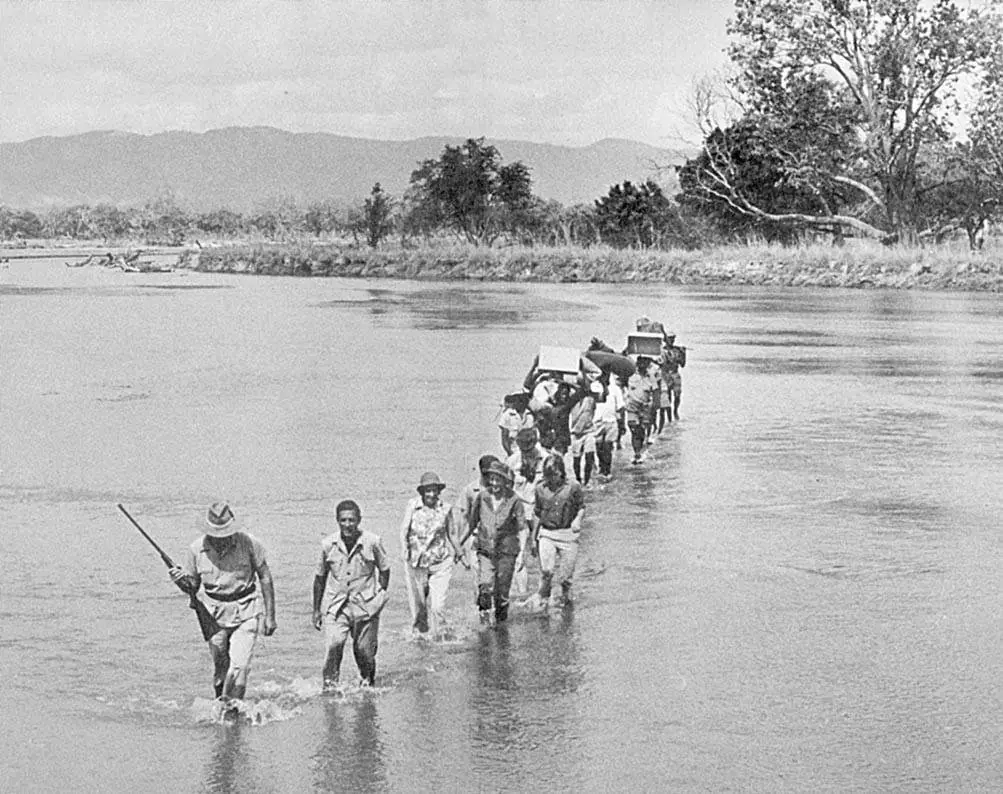 Photo: Norman Carr archive, courtesy The Safari Heritage Collection
Ground zero
Our article Who Invented the Walking Safari? tells the wider story of Norman Carr in Zambia and Ian Player in South Africa, and of the different firsts each can claim. This piece goes to one place in that story: the stretch of the Luangwa where the commercial walking safari began.
In the 1950s the colonial government was opening the Luangwa Valley to visitors. Its records chart the work year by year: a small tourist camp in Chief Nsefu's area in 1950, roads, rest camps and a pontoon ferry through the decade [3]. In 1955, a record of the Luangwa Valley Development Unit noted two things that would matter later [2]:
"A seasonal pontoon crossing built across the Luangwa at Chibembe to permit access from the east."
"Lion Camp and viewing tracks built."
The pontoon gave visitors from the east a way across the river at Chibembe. By 1959 Lion Camp housed the area's Game Officer's Station [3]. The pieces of the first walking circuit were now in place: a crossing, a camp to walk to, and the country between them.
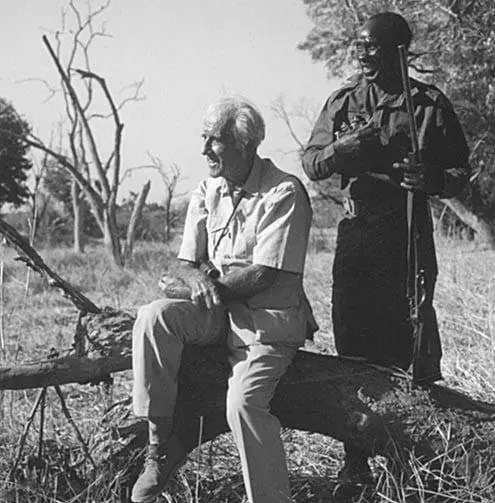 Photo: Norman Carr archive, courtesy The Safari Heritage Collection
1961: the circuit begins
Around 1960–61, Carr left government service and went into private safaris with Peter Hankin, through a company called Luangwa Safaris [4]. A government archive record from 1961, transcribed by the reserve, reads [2][3]:
"Lion camp leased to 'Luangwa Safaris', a director of this company was N.J. Carr; from this camp Wilderness Trails were pioneered by Carr as a type of tourism."
That is the documentary basis for dating the commercial walking safari circuit to 1961. The reserve attributes the record to W. L. Astle's 1999 history of wildlife conservation in the mid-Luangwa Valley [2].
The route was simple. Guests arrived at the Chibembe crossing, crossed the Luangwa on the pontoon, and set out on foot along Carr's Wilderness Trails to Lion Camp. The reserve's own account describes smaller bushcamps along the way [2]. People had walked in Africa's wild places long before, and in South Africa the first official wilderness trail ran at iMfolozi in 1959. What was new at Chibembe was the walking safari as a product: paying guests, in small groups, led on foot through big-game country on a set circuit, with a camp to walk to.
That is why the Chibembe area is ground zero. Lion Camp was the destination of the original trail; Chibembe was where it started.
1968: Chibembe Safari Camp
In 1968 Carr built Chibembe Safari Camp on the east bank of the Luangwa [1][4]. It became the hub of the Wilderness Trails walking circuit. Through the 1970s, Carr was running walking safaris in the Chibembe area [5], and between 1975 and 1977 the original Chinzombo camp was set up as a green-season extension, while Chibembe stayed the main dry-season base [1][5].
Carr described the walking life in his books. Valley of the Elephants (1979) closes with an account of a walking safari, for which, as one description puts it, the earlier part of the book is a preparation [6].
The model Carr built from Chibembe is still the one most walking safaris in Zambia follow: a small group, a licensed guide, an armed scout and a camp to return to.
After Carr
Carr died in 1997 [4]. In the 1990s an investor group acquired Wilderness Trails, and the walking circuit was gradually unwound [1]. For years afterwards Chibembe ran as a self-drive operation [1]. The crossing that had started it all was no longer the start of anything.
Chibembe Wildlife Reserve today
In 2023 the current owners bought the titled area known as Chibembe Wildlife Reserve directly from Wilderness Trails Limited. In 2025 Chieftainess Mwanya and the Mwanya Community Resource Board granted a lease on Kalovia Island, bringing the reserve to about 3,500 unfenced acres [1]. It lies in the Mwanya Chiefdom, with about 4.6 miles of river frontage [7]. Chibembe Island, across the main river channel, lies inside South Luangwa National Park [8].
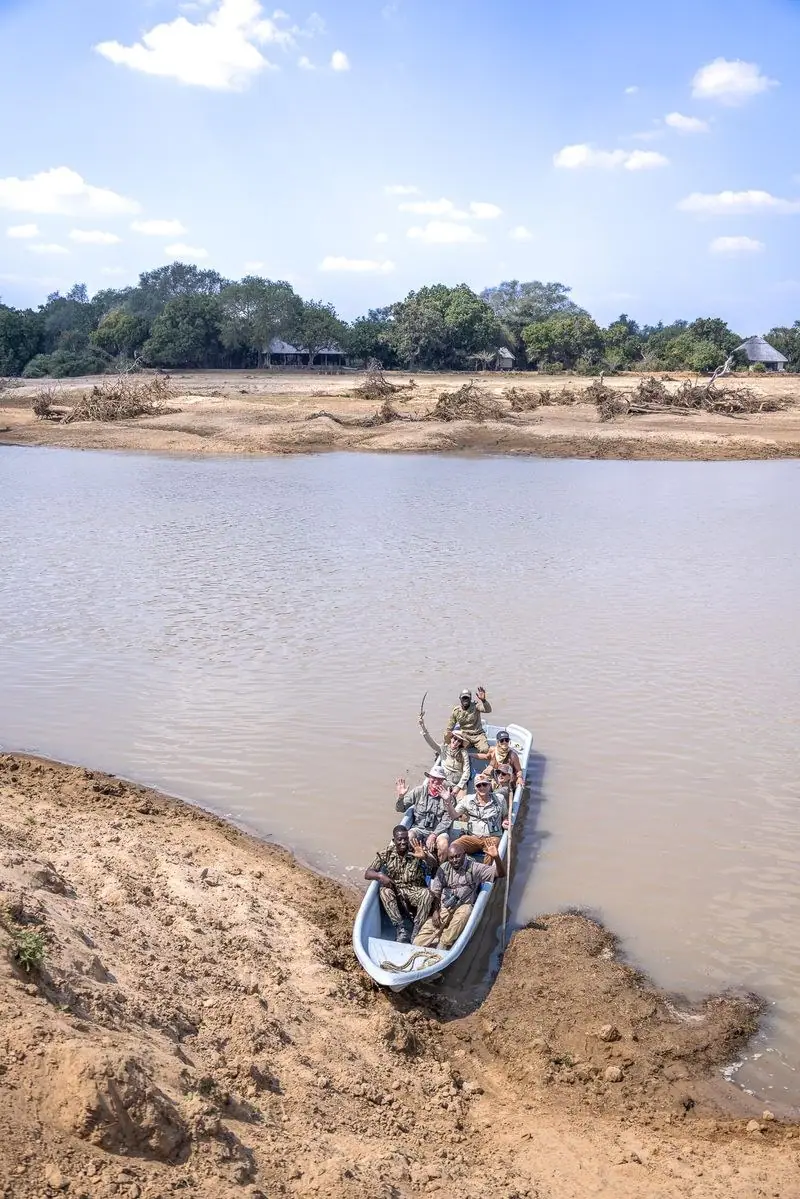 Photo: Chibembe Wildlife Reserve
The reserve reopened to guests in June 2026, after the camp was rebuilt [1]. It has one season, June through October. Its camp is small and private [9]:
- Four tents for eight guests, with room for larger multigenerational families.
- Exclusive use only: one group has the whole camp.
- Fully inclusive, with a minimum stay of five nights.
- Booked through The Bushcamp Company.
Walking is the main point of a stay. Guests walk on the reserve, on Chibembe Island and in the country beyond the Chibembe Channel [8]. Game drives run on the reserve's private roads, with no other vehicles, and night drives are offered along the main channel [8]. There are also fly-camp sleep-outs, and full-day trips south to the Nsefu sector, about 25 minutes away by vehicle [8][10].
Details of the walking program, including how many walks run each day, how far they go and how they are escorted, will be confirmed by the reserve and added to its profile on this site. As everywhere in the valley, walks end before dark.
Walking where it began
Few places in safari travel can point to the ground where something began. Chibembe can. The river, the channel and the country Carr's guests first walked through are still there, still unfenced. A morning on foot from Chibembe today follows, in spirit if not step for step, the first commercial walking safari circuit.
Lion Camp, the destination of the original trail, still stands on the Lion Plain in the north of South Luangwa, where walks and drives are offered as daily choices.
Further reading: The Safari Heritage Collection, which publishes this site, keeps the primary records and archive online: Norman Carr · The 1955 and 1961 records · The Road to Chibembe
From The Bushcamp Company's Guide to the Luangwa: Why South Luangwa Is the Birthplace of the Walking Safari · Overview and History of South Luangwa National Park
Publisher's note. WalkingSafaris.com is published by The Safari Heritage Collection, custodians of Chibembe and owners of Lion Camp and The Bushcamp Company. Some of our camps appear in this article, and they are assessed on exactly the same published criteria as every other camp in Africa. Who we are
Sources
- Chibembe Wildlife Reserve, History — https://www.chibembewildlifereserve.com/history
- Chibembe Wildlife Reserve, The Birth Certificate of the Walking Safari (1955 Luangwa Valley Development Unit record; 1961 Lion Camp lease record) — https://www.chibembewildlifereserve.com/post/the-birth-certificate-of-the-walking-safari
- Chibembe Wildlife Reserve, Where Africa's Perfect Safari Was Born (transcriptions of Northern Rhodesia Department of Game and Tsetse Control annual reports, 1949–1960, and the 1961 record) — https://www.chibembewildlifereserve.com/post/where-africa-s-perfect-safari-was-born-how-the-luangwa-valley-was-opened-to-the-world
- Legends & Legacies of Africa, Norman Carr (timeline and publications) — https://legendsandlegaciesofafrica.org/normancarr.php
- Zambia Tourism, New life for an old camp (Sept 2013) — https://www.zambiatourism.com/new-life-for-an-old-camp/
- Antiquarian Auctions, Valley of the Elephants — https://antiquarianauctions.com/lots/valley-of-the-elephants
- Chibembe Wildlife Reserve, Home — https://www.chibembewildlifereserve.com
- Chibembe Wildlife Reserve, On the Reserve — https://www.chibembewildlifereserve.com/on-the-reserve
- Chibembe Wildlife Reserve, The Camp — https://www.chibembewildlifereserve.com/the-camp
- Chibembe Wildlife Reserve, Nsefu Sector — https://www.chibembewildlifereserve.com/nsefu-sector
Spotted an error? Tell us. How we classify camps: our methodology.