
Stories
Who Invented the Walking Safari?
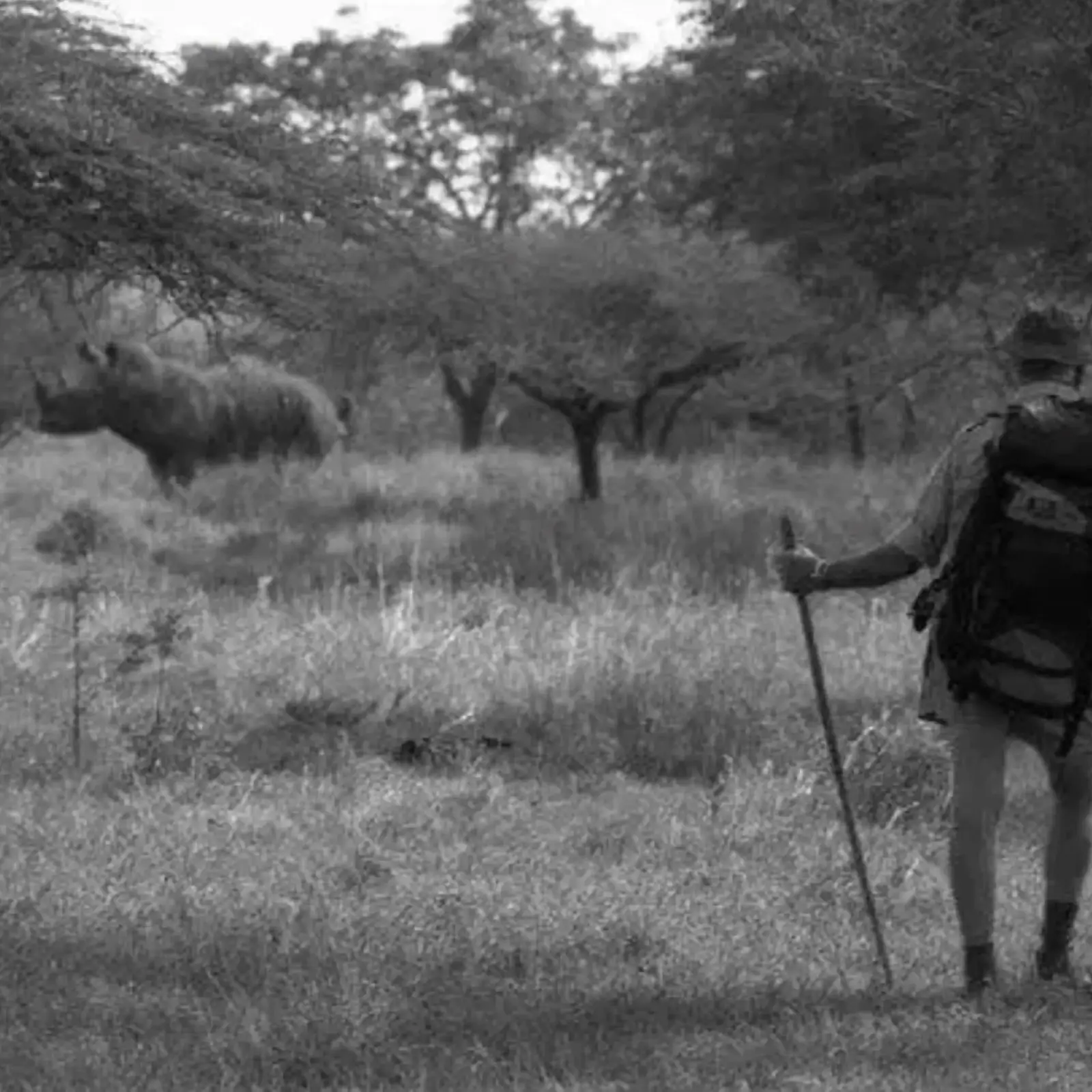 Photo: Hluhluwe-iMfolozi Park
Ask a guide in Zambia where the walking safari was born and you will hear one answer: the Luangwa Valley, and Norman Carr. Ask a trails ranger in South Africa and you may hear another: iMfolozi, and Ian Player. Both answers have a real basis in the record. They just describe different firsts.
This is the documented story of the two pioneers, what each actually did, and where you can still walk in their footsteps today.
Norman Carr and the Luangwa Valley
Norman Carr (1912–1997) spent most of his working life in what was then Northern Rhodesia. He began in the 1930s as an elephant control officer in the Luangwa Valley, served with the King's African Rifles in the Second World War, and returned as one of the colony's first game rangers. He later served as warden for the development of Kafue National Park in the early 1950s.
Around 1950, Carr persuaded Senior Chief Nsefu of the Kunda people to set aside part of his land as a game reserve. There he built Nsefu Camp, generally described as the first game-viewing camp open to the public in Northern Rhodesia. The colonial Game Department's annual report for 1950 records it plainly: a small tourist camp was established on the banks of the Luangwa in Chief Nsefu's area. By 1951 it was attracting twice as many visitors. The idea was radical for its time. Visitors came to look at animals rather than shoot them, and the camp's revenue went back to the chief and his community. Long before "community conservation" became a phrase, Carr was making the case that a living animal could be worth more to the people who lived alongside it than a dead one.
Some accounts say guests at Nsefu sometimes explored on foot in those early years. But the formal, guided walking safari as a commercial product is generally dated to the early 1960s.
Around 1960–61, Carr left government service and went into private safaris with Peter Hankin. Their company, Luangwa Safaris, began as a hunting operation. The government had built the infrastructure that made the next step possible: a 1955 development record notes a seasonal pontoon crossing at Chibembe and the building of Lion Camp, which by 1959 was the area's Game Officer's Station. In 1961, the government leased Lion Camp to Luangwa Safaris, with Carr as a director, and its record states that from this camp Carr pioneered "Wilderness Trails" as a type of tourism. Guests arrived at the Chibembe crossing on the Luangwa and set out on foot along Carr's Wilderness Trails to Lion Camp. The Chibembe area, where Chibembe Wildlife Reserve stands today, is where the walking safari as a paying guest experience began.
In 1968 Carr built Chibembe Safari Camp on the east bank of the river, which became the hub of his walking circuit through the 1970s. He set out the walking life in his own books. Valley of the Elephants (1979) closes with an account of a walking safari. Carr kept guiding and writing almost to the end. He died on April 1, 1997.
What Carr built in the Luangwa is the model most walking safaris still follow: a small group, a licensed guide, an armed scout, and a camp to return to.
Ian Player, Magqubu Ntombela and iMfolozi
Ian Player (1927–2014) joined South Africa's Natal Parks Board in 1952 and became the defining figure of iMfolozi Game Reserve. In 1958 the Parks Board proclaimed wilderness areas in iMfolozi, initially about 12,000 hectares and later expanded to roughly 32,000, along with an area at Lake St Lucia. The Wilderness Leadership School, which Player founded, describes these as the first official wilderness areas in Africa. Inside them there were to be no roads and no buildings. People could enter only on foot.
Player had already taken a group of schoolboys from St John's College on a wilderness trail at Lake St Lucia in 1957. Then, on March 19, 1959, he and his mentor and friend Magqubu Ntombela, a Zulu game guard with deep knowledge of the land, led six visitors into the newly proclaimed iMfolozi wilderness on the first official Natal Parks Board wilderness trail. Late on the first afternoon, a black rhino bull charged the group. No one was hurt.
Player and Ntombela's partnership lasted some 40 years. A white ranger and a black game guard leading trails together was itself a statement in apartheid South Africa, and over time the trails deliberately brought together people of different races, at a time when the law kept them apart. Player later wrote of taking multiracial groups whose members started out hostile toward one another. The Wilderness Leadership School was formalized in 1963.
Player is also remembered for Operation Rhino, which he initiated and led from the early 1960s. It moved white rhino from iMfolozi to reserves across Africa and beyond, and is widely credited with helping save the southern white rhino from extinction.
His trails were not designed as a business. They were designed to change the people who walked them.
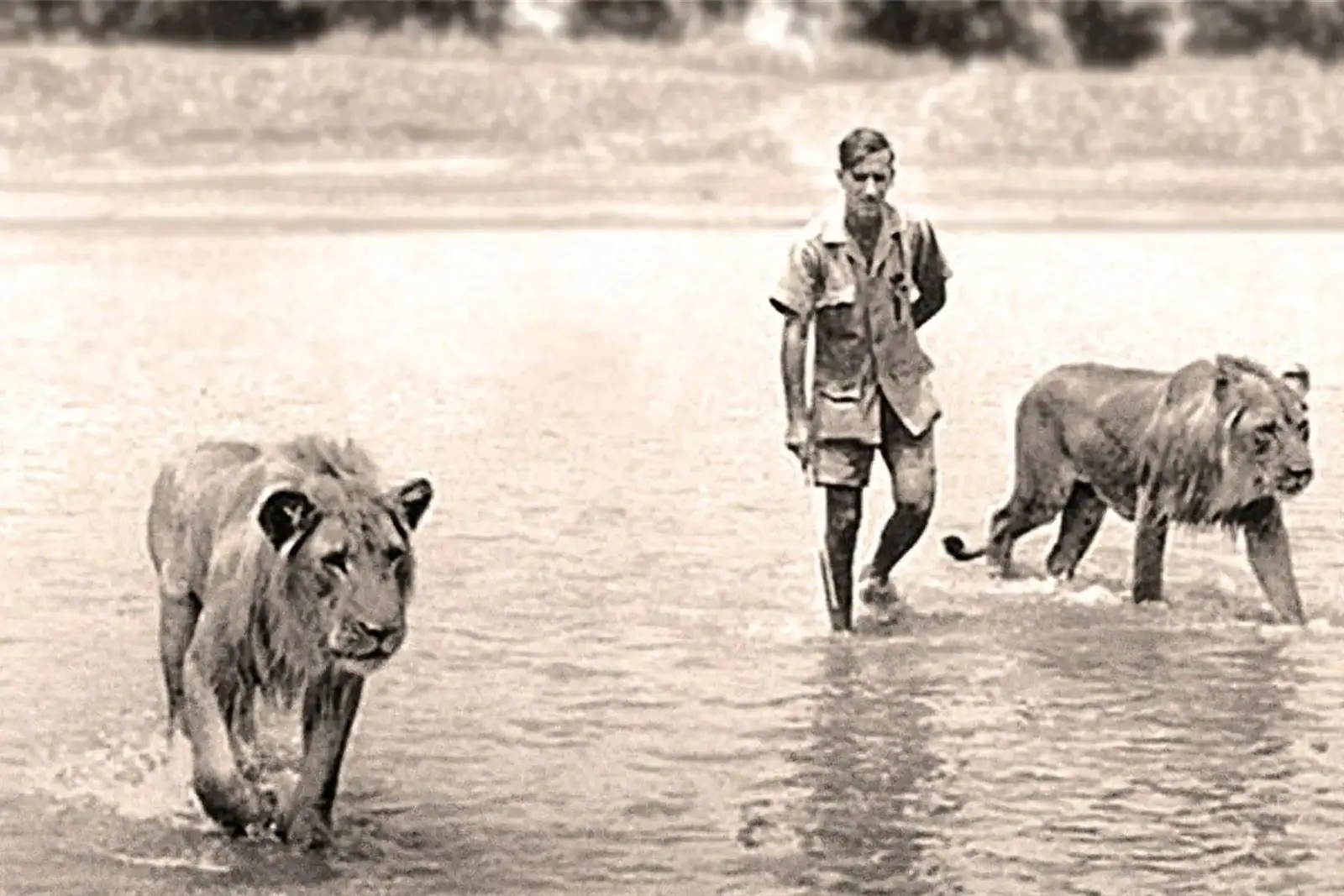 Photo: Norman Carr archive, courtesy The Safari Heritage Collection
Did Carr and Player know each other?
It is often said that the two men knew each other and traded ideas. We could find no evidence of it. Neither man's biographies, obituaries or published accounts that we were able to review mention the other. The term "wilderness trail" was used by both, and on the evidence available the Natal Parks Board used it first, in 1959. It was a natural phrase in an era when the idea of protected wilderness was spreading internationally, and the most accurate description of the two men is as pioneers working in parallel, more than a thousand miles apart.
If you know of a letter, a meeting or a reference in either man's writing that connects them, we would like to hear about it.
So where was the walking safari born?
It depends on which first you mean.
- The first public game-viewing camp built on community benefit: Norman Carr, Nsefu, Luangwa Valley, around 1950.
- The first officially designated wilderness trail: Ian Player and Magqubu Ntombela, iMfolozi, March 1959.
- The first commercial walking safari, sold to paying guests from a safari camp: Norman Carr, Luangwa Valley, early 1960s.
The two traditions still shape how people walk in Africa today. The Luangwa model, in which a guided walk with a licensed guide and an armed scout stands as an equal choice to the game drive every day, is the pattern in Zambia's South Luangwa and in many camps across southern and East Africa. The iMfolozi model of a multi-day trail into country with no roads lives on in South Africa's wilderness trails, including Kruger's, the first of which, the Wolhuter Trail, opened in 1978.
Both men proved the same thing. To understand wild country, and to want to protect it, you have to leave the vehicle and walk.
Walking in their footsteps today
- The Nsefu sector, South Luangwa, Zambia. Carr's first camp site is still a safari camp today, run by Robin Pope Safaris, alongside its sister camp Tena Tena.
- Chibembe Wildlife Reserve, Luangwa Valley, Zambia. A private reserve at the confluence of the Luangwa River and the Chibembe Channel, on the site of Carr's walking circuit. It reopened to guests in June 2026.
- Lion Camp, northern South Luangwa, Zambia. Part of Carr's early walking circuit.
- iMfolozi wilderness trails, KwaZulu-Natal, South Africa. Multi-day trails are still run in the wilderness area Player fought to protect, by Ezemvelo KZN Wildlife and by the Wilderness Leadership School.
Further reading: The Safari Heritage Collection, which publishes this site, keeps the primary records and archive online: Norman Carr · The 1955 and 1961 records · The Road to Chibembe
From The Bushcamp Company's Guide to the Luangwa: Why South Luangwa Is the Birthplace of the Walking Safari
Sources
- Legends & Legacies of Africa, "Norman Carr" (timeline and publications): https://legendsandlegaciesofafrica.org/normancarr.php
- Rhodesian Study Circle, "Norman Carr": https://www.rhodesianstudycircle.org.uk/?p=63831
- Alistair Tough, Norman Carr: Pioneer of Community-based Wildlife Conservation (2024): https://muse.jhu.edu/book/129049
- Expert Africa, "Nsefu" (camp history): https://www.expertafrica.com/zambia/south-luangwa-national-park/nsefu/in-detail
- Chibembe Wildlife Reserve, "History": https://www.chibembewildlifereserve.com/history
- Chibembe Wildlife Reserve, "Where Africa's Perfect Safari Was Born" (transcriptions and images of Northern Rhodesia Department of Game and Tsetse Control annual reports, 1949–1960, and the 1961 Lion Camp lease record): https://www.chibembewildlifereserve.com/post/where-africa-s-perfect-safari-was-born-how-the-luangwa-valley-was-opened-to-the-world
- Chibembe Wildlife Reserve, "The Birth Certificate of the Walking Safari" (1955 Luangwa Valley Development Unit record): https://www.chibembewildlifereserve.com/post/the-birth-certificate-of-the-walking-safari
- Wilderness Leadership School, "About": https://www.wildernesstrails.org.za/about
- Tony Carnie, "iMfolozi under threat," Country Life (South Africa): https://www.countrylife.co.za/conservation/imfolozi-under-threat
- Wilderness Foundation Africa, 50-year anniversary (2022): https://wildernessfoundation.co.za/wilderness-foundation-africa-kicks-off-its-50-year-anniversary-celebrations-with-leave-some-for-the-honey-badger/
- Ian Player, Using Wilderness Experiences to Enhance Human Potential and Understanding (1988 lecture): https://objects.lib.uidaho.edu/forestryresearch/forestryresearch962.pdf
- Wilderness Foundation UK, "History": https://wildernessfoundation.org.uk/history/
- Hitchins and Walker, "Ian Player" obituary, Pachyderm No. 56: https://pachydermjournal.org/index.php/pachyderm/article/download/382/368/920
- Save the Rhino, "RIP Dr Ian Player": https://www.savetherhino.org/poaching-crisis/rip-dr-ian-player/
- SANParks, Kruger wilderness trails: https://www.sanparks.org/parks/kruger/what-to-do/activities/wilderness-trails
Spotted an error? Tell us. How we classify camps: our methodology.