
Where to Walk
Kafue Walking Safari Guide
Kafue is Zambia's largest park and one of its quietest. Walking is offered at most of its camps, but only a few make it a daily core activity.
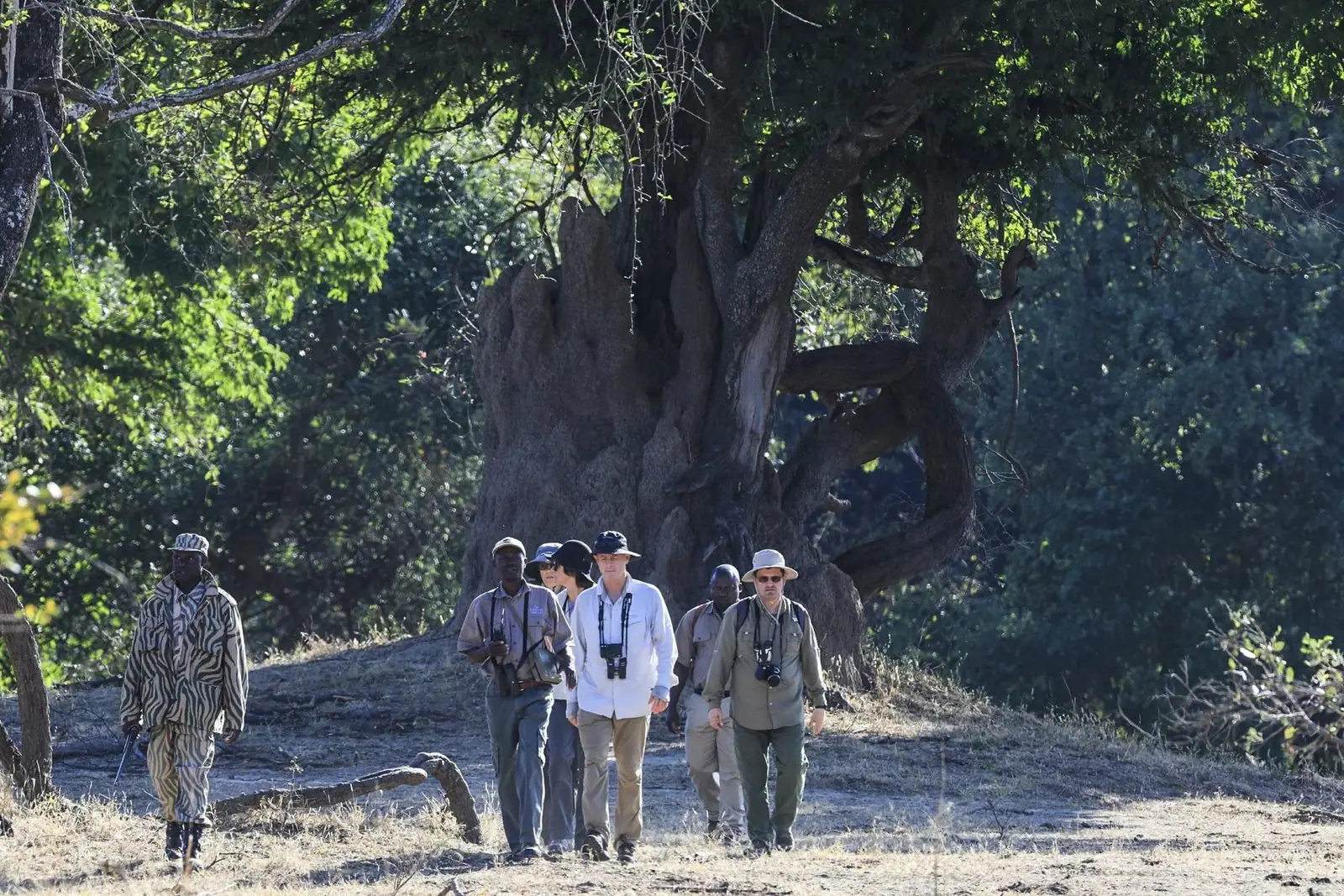 Photo: The Bushcamp Company
What kind of park Kafue is
Kafue is big. At about 22,400 km², it is roughly two and a half times the size of South Luangwa [1]. The Lusaka–Mongu road crosses the park north of its center and splits it in two [1][7].
Most of the park is miombo woodland on flat or gently rolling ground, with granite hills in places [1]. The park is named for the Kafue River, which flows into the Itezhi-Tezhi reservoir, a man-made lake that lies partly inside the park [1]. Rainfall rises from about 510 mm a year in the south to over 1,020 mm in the north [1].
Management changed recently. African Parks and DNPW ran a joint support plan from 2021, and in 2022 the government invited African Parks to manage Kafue under a 20-year agreement [1][2]. The park holds elephant and large predators [2].
The main walking areas
The Busanga Plains. In the far northwest, the Lufupa River spreads over open grassland during the rains and floods the Busanga Plains [1][7]. The swamps here are one of the few known breeding sites for wattled cranes [1]. The plains are open and slow to dry, so walking here is mostly a dry-season activity. Camps on the plains are drive-led, with walks as an option.
The Kafue River in the north. The Lufupa and Lunga rivers join the Kafue here [1]. Walks run through woodland and floodplain and along old river courses and drying lagoons [4][5]. At Musekese, guides often cross the river to walk on the far bank, in an area vehicles cannot reach [5].
The central park. Around the main road and the river south of it are several riverside lodges. Walks are offered at most of them, alongside drives and boating.
Nanzhila and the south. South of Itezhi-Tezhi lie the Nanzhila Plains: open grassland and shallow floodplains called dambos, ringed by miombo woodland and mopane [8]. Few visitors reach the area. One writer recorded roan, sable, oribi and lion tracks there [8].
Rules and guiding
Zambian practice applies in Kafue. Walks inside the national park go out with a guide and an armed DNPW scout. At Musekese, walks are "always accompanied by a trained, armed national park scout" [5]. One specialist describes Kafue walks as led by "a highly-experienced guide and an armed ranger" [4]. Our Walking Safari Rules by Park page covers the Zambian rules in more detail.
Zambia's national minimum walking age is 12 (see Walking Safaris in Zambia), and each camp may set a higher limit. In Kafue, most walking camps set 14: Musekese, Mawimbi and the Busanga Plains mobile walking safari all do [3][5][6]. One specialist agent gives 14 as its general rule for walking safaris in Zambia, and notes that some longer trips set 16 or more [12]. Ask any camp for its own policy before you book.
Group sizes are small at the walking-led camps. Musekese caps activities at six guests [9]. Few other Kafue camps publish a group cap, so ask.
The camps that walk daily
These camps treat walking as a daily core activity. We class them as Walking Camps: walks are offered every day as an equal choice with drives.
- Musekese Camp. A small, owner-run camp of five chalets on the Kafue River in the north, open June to November [5][9]. Many guests choose to focus on walking here [5]. Walks run through woodland, floodplain and along the river, and often cross to a vehicle-free bank. Group size six; walkers 14 and up [5][9].
- Mawimbi Bush Camp. Four tented suites on the Kafue River, reopened under new owners in 2025. Activities are game drives, walking safaris and river trips, with two included each day; walkers 14 and up [6][10].
- Lwenge River Camp and Nanzhila Plains Safari Camp. Both are listed in our directory as Walking Camps, pending fuller evidence. Nanzhila Plains is a small owner-managed camp of three chalets and three tents on the edge of a dambo in the south [8].
Where Walks are Offered
Most Kafue camps fall here. Walks are available, but the drive or the boat leads. The Busanga Plains camps are drive-led in this way. So are many of the riverside lodges in the central park.
Some offer walks with a distinct character. At KaingU Safari Lodge, walks climb rocky inselbergs and visit rapids on the river [4]. Around Itezhi-Tezhi, walks follow the lakeshore [4]. These are good choices if you want one or two walks in a stay built around drives and boating.
One product needs a note. A six-night trail in the Malala area of southern Kafue, run with African Parks, has guests carry 60–70 liter packs of about 15 kg and walk about 10 km a day [11]. Because guests carry their own gear, it falls outside the scope of this site.
When to go
Kafue is a dry-season park. The rains run roughly November to April. Seasonal rivers flood, dirt roads become impassable, and most camps close [7]. Access improves in May. By June almost all tracks are passable, even on the Busanga Plains [7]. The remote camps, including those on the plains, close at the end of October [7].
Specialists differ on the best months to walk. One rates June, July and August as ideal, with "perfect weather for walking safaris" in August [7]. Another says walking is possible from May to November and finds September to November more comfortable [4]. The late dry season is hot, so walks start early. In the wet season, dense vegetation limits walking [7].
Getting there
The drive from Lusaka takes roughly three to four hours to the central camps on a tarmac road [7]. There are no scheduled flights into the park, but charter companies fly in on request [7]. Beyond the main road, a 4WD is essential, and a guided safari is the easier option [7].
How Kafue compares with South Luangwa
Both parks follow the same Zambian rules: a guide and an armed DNPW scout on every walk, a national minimum walking age of 12 (often 14 in Kafue), and a dry-season walking calendar [5]. The difference is depth. South Luangwa has 24 walking-led camps, about half of its commercial camps, and walking runs across the whole park. Kafue has four Walking Camps in our directory, out of about 24 camps that offer walks of any kind. We have not yet counted every commercial camp in Kafue, so we do not publish a walking share for it.
Kafue's case rests on space and quiet. It is far larger than South Luangwa, with fewer camps spread across it, and the northern Walking Camps work in country that sees few other people. Its other strengths are variety: open plains, a large river for boating, and the remote south.
The practical reading: if daily walking is the main reason for your trip, South Luangwa gives you the widest choice of camps. If you want a quieter park with good walking at one or two camps, plus boating and plains, Kafue is a strong choice. The two parks can be combined on one Zambian trip. Our South Luangwa Walking Safari Guide covers the valley in detail.
Sources
- Wikipedia, Kafue National Park — https://en.wikipedia.org/wiki/Kafue_National_Park
- African Parks, Kafue National Park — https://www.africanparks.org/the-parks/kafue
- Safari Frank, Mobile walking safari, Busanga Plains — https://safarifrank.com/adventures/mobile-safari-busanga-plains-kafue/
- Natural High Safaris, Walking safari in Kafue National Park — https://www.naturalhighsafaris.com/walking-safaris/zambia/walking-safari-in-kafue-national-park/
- Expert Africa, Musekese Camp — https://expertafrica.com/zambia/kafue-national-park/musekese-camp/in-detail
- Zambia Tourism, Mawimbi Bush Camp — https://www.zambiatourism.com/listing/mawimbi-bush-camp/
- Expert Africa, Kafue National Park — https://www.expertafrica.com/zambia/kafue-national-park
- Africa Geographic, Nanzhila Plains: hidden Kafue gem — https://africageographic.com/stories/nanzhila-plains-hidden-kafue-gem/
- Tribes Travel, Musekese Camp — https://www.tribes.co.uk/accommodation/musekese-camp/details-and-map
- Mawimbi Bush Camp, 2026 fact sheet — https://b-cdn.springnest.com/media/doc/1gr/2026_mawimbi_bush_camp_fact_sheet.pdf
- Zambia Tourism, New walking safari experience for Kafue — https://www.zambiatourism.com/new-walking-safari-experience-for-kafue/
- Audley Travel, Walking safaris in Zambia — https://www.audleytravel.com/us/zambia/country-guides/walking-safaris-in-zambia
Spotted an error? Tell us. How we classify camps: our methodology.