
Where to Walk
Walking Safaris in Zambia: The Parks, the Rules and the Season
Zambia is where the guided walking safari began, and walking is still built into the country's safari life, though far more in some parks than in others.
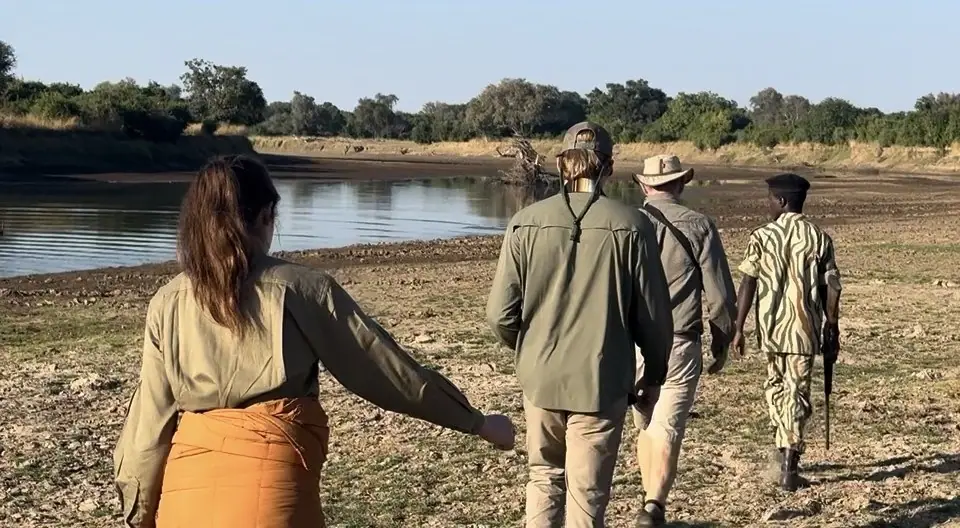 Photo: Chibembe Wildlife Reserve
Walking parks in Zambia
Select a park on the map.
Walking-led camps (larger dot, more camps)Walks offered onlyDrag to move · + and − to zoomRelief: NASA Earth Observatory · Rivers: Natural Earth
Why Zambia is the home of the walking safari
In 1950 Norman Carr persuaded Senior Chief Nsefu to set aside tribal land as a game reserve, and built the first game-viewing camp open to the public in what was then Northern Rhodesia [7]. In the early 1960s, working from Lion Camp in the north of what is now South Luangwa, he began the guided walks that became known as wilderness trails [7]. Government records date that walking circuit to 1961: guests crossed the Luangwa at the Chibembe pontoon, built in 1955, and walked to Lion Camp. The full story, and how it relates to Ian Player's trails in South Africa, is in Who Invented the Walking Safari?
Specialist agents still describe South Luangwa as the birthplace of the walking safari [1][5]. The habit Carr started, a small group on foot with a guide and an armed escort, is now standard practice across the country's walking parks [2][3].
The national rules
A guide and an armed scout. Walks in Zambia's national parks are led by a walking guide and accompanied by an armed scout from DNPW, the government wildlife authority. One Kafue camp describes this as being "in accordance with Zambian park rules" [2]. The division of labor is the point: the scout carries the rifle and watches for animals, which leaves the guide free to stop and explain [4]. More on guide training is in Who Leads Your Walk?
Guide standards. Walking guides sit demanding exams before they may lead on foot. Specialist agents credit Zambia's strict guiding exams for the consistent standard of its walks [4][23].
Age. Under national park safety regulations, children under 12 may not join walking safaris [3][25]. Camps may set their own, higher limit. Musekese and Mawimbi in Kafue, for example, take walkers from 14 [2][16]. See Walking Safari Age Limits, Country by Country.
Pace and distance. Zambian walks are slow and interpretive. Much of the attention goes to tracks, dung, birds and plants rather than closing in on large animals [4]. A typical walk covers about 3–5 km (2–3 miles) over three to four hours, leaving at first light and returning by mid-morning [4][5]. Walks end before dark; evenings belong to drives. See How Far Do You Actually Walk on a Walking Safari?
Park-by-park differences are set out in Walking Safari Rules by Park.
The walking parks
South Luangwa
South Luangwa covers about 9,050 km² (some 2.2 million acres) of unfenced river valley in eastern Zambia [8]. It has more walking-led camps than any other park we track: 24, about half of its commercial camps [22]. Walking here is always optional. At a walking camp, guests choose a walk or a drive for each activity, and the two are treated as equal choices.
The walking-led camps span several operators, among them Robin Pope Safaris, Remote Africa (Chikoko and Big Lagoon), Time + Tide (Luwi, Nsolo, Kakuli and Mchenja) and The Bushcamp Company, as well as smaller owner-run camps [1][24]. The park's formats run from mobile walking safaris and vehicle-free trail camps to camps with daily walks alongside drives. Full detail is in our South Luangwa Walking Safari Guide.
North Luangwa
North Luangwa is a separate park of about 4,636 km² (some 1.1 million acres) further up the same valley [9]. The land south of the Mwaleshi River is managed as a strict wilderness zone, and tourism has always been light [9]. The three camps we could confirm for 2026 are all small, seasonal and built around walking: one Walking Expedition, where viewing is on foot only, and two Walking Camps [22]. One of them, Takwela, adds day and night drives to its walks [10]. See North Luangwa: Zambia's Walking Wilderness.
Luambe
Luambe is a small park of about 254 km² (some 63,000 acres) on the east bank of the Luangwa, between North and South Luangwa [11]. It has one small dry-season camp, open June to October, offering guided walks, game drives and night drives [11][12]. We class it as a Walking Camp [22]. Sources differ on the details, including the park's area and whether it has one camp or two, so confirm the current picture when you book.
Kafue
Kafue is Zambia's largest national park, at about 22,400 km² [13]. Since July 2022 it has been managed under a 20-year agreement between the Zambian government and African Parks [14]. Kafue is mainly a drive-and-boat park. Walking is popular in the dry months, and dense wet-season growth restricts it [15].
Of the Kafue camps in our directory that offer walks, four are Walking Camps and about 20 sit under Walks Offered, meaning walking is not a core activity there [22]. Two of the four Walking Camps are still being verified. The two we have confirmed:
- Musekese. A small owner-run camp where "walking is a strong focus," with an armed national park scout on every walk. Open June 1 to November 30; walkers from 14 [2].
- Mawimbi Bush Camp. A four-tent camp in a private concession between the Kafue River and a wetland, where guests choose two activities a day from walks, drives and river cruises. Walkers from 14 [16].
Lower Zambezi
The Lower Zambezi National Park covers about 4,092 km² on the north bank of the Zambezi, facing Zimbabwe's Mana Pools [17][18]. Most camps there offer walks with a qualified guide and an armed ranger, but the river is the main draw, and canoeing and boating lead the program [17]. Only one Lower Zambezi camp in our directory, Chula Island, is classed as a Walking Camp [22]. See our Lower Zambezi Walking Safari Guide.
When to go
Walking in Zambia follows the dry season, roughly June to October [6]. In South Luangwa, all lodges and bushcamps are open by early June, and walking is largely impractical from about December to March [1]. North Luangwa's camps open in mid-June and close at the end of October [10]. In Kafue, most camps close from roughly January to April, and the Busanga Plains camps close at the end of October [15].
Within the season, specialists rate June for its walking conditions and August for its weather [1][15]. By October, heat becomes the main limit on walking [17]. See The Best Time of Year for a Walking Safari.
How to get there
Most visitors arrive at Kenneth Kaunda International Airport in Lusaka, the hub for Proflight Zambia [21].
- South Luangwa: Proflight flies from Lusaka to Mfuwe in about 70 to 80 minutes, and camp staff meet guests at the airport [1][19]. Mfuwe is also the nearest airport for Luambe [12].
- Luambe: remote, with poor roads that become impassable in the rains [11]. North Luangwa is similarly remote; ask your camp how it arranges transfers.
- Lower Zambezi: Proflight serves Jeki and Royal airstrips, about 35 and 65 minutes from Lusaka. A direct flight links Mfuwe and the Lower Zambezi, which makes the two easy to combine [20].
- Kafue: there are no scheduled flights into the park; charters fly in on request. By road, central Kafue is about three to four hours from Lusaka on tarmac [15].
How Zambia compares
Zambia's walking is concentrated in the Luangwa Valley. Counted on the criteria in How We Classify Walking Safaris, the picture by park is [22]:
| Park | Walking-led camps | What it means |
|---|---|---|
| South Luangwa | 24 (about half of commercial camps, 49–62%) | The widest choice anywhere |
| North Luangwa | 3 (every camp we confirmed) | Walking-first, very few visitors |
| Luambe | 1 | One small camp |
| Kafue | 4 (two still being verified) | A few walking camps in a drive-and-boat park |
| Lower Zambezi | 1 | Mostly walks offered; the river leads |
Across the border, Mana Pools in Zimbabwe has a higher walking share, about two-thirds to three-quarters of its camps, on a smaller base. Hwange's share is about 10–13%, and Greater Kruger's is under one in ten. South Luangwa has more walking-led camps in total than any of them. See Where Walking Really Matters: Walking Share by Park.
The practical reading: if walking is the reason for your trip, start in the Luangwa Valley. Add North Luangwa for solitude, or the Lower Zambezi or Kafue for a different landscape, with walking as one activity among several.
From The Bushcamp Company's Guide to the Luangwa: Zambia, the Luangwa Valley, and the Deeper Story Behind a Safari · Conservation in the Luangwa Valley
Featured camps in Zambia
 Kapamba BushcampFour-chalet bushcamp where a morning walk with a guide, armed DNPW scout and tea porter usually precedes an afternoon…The Bushcamp CompanyView camp →FeaturedChamilandu BushcampThree-chalet bushcamp with a morning walk and an evening drive into the night; a second walk can be arranged on request.The Bushcamp CompanyView camp →FeaturedChindeni BushcampFour-tent bushcamp with a morning walk and an afternoon drive that often runs into a night drive, all walks with an…The Bushcamp CompanyView camp →FeaturedBilimungwe BushcampFour-chalet bushcamp where walking is the traditional main activity: a morning walk, then an afternoon and night drive.The Bushcamp CompanyView camp →FeaturedZungulila BushcampFour-tent bushcamp with few neighboring camps, where walks with an armed DNPW scout are offered alongside day and night…The Bushcamp CompanyView camp →FeaturedKuyenda BushcampSmall rondavel bushcamp where guests choose a morning walk or drive each day, followed by an afternoon drive.The Bushcamp CompanyView camp →Featured
 Chibembe Wildlife ReserveExclusive-use four-tent camp on 3,500 unfenced private acres, reopened June 2026; walking is the main activity, with…Chibembe Wildlife ReserveView camp →Featured
 Lion CampCamp on the Lion Plain offering two daily activities, walk or drive, with a guide and armed scout on walks; walkers 16…Lion CampView camp →
Featured listings are paid and labeled; they never affect how a camp is classified. All featured camps →
Publisher's note. WalkingSafaris.com is published by The Safari Heritage Collection, custodians of Chibembe and owners of Lion Camp and The Bushcamp Company. Some of our camps appear in this article, and they are assessed on exactly the same published criteria as every other camp in Africa. Who we are
Sources
- Expert Africa, South Luangwa National Park — https://www.expertafrica.com/zambia/south-luangwa-national-park
- Expert Africa, Musekese Camp — https://www.expertafrica.com/zambia/kafue-national-park/musekese-camp
- Kafunta Safaris, Walking safari Zambia: what to know (Feb 2025) — https://kafuntasafaris.com/walking-safari-zambia-what-to-know/
- Yellow Zebra Safaris, The best walking safaris: Zimbabwe vs. Zambia — https://yellowzebrasafaris.com/us/inspiration/safari-insights/the-best-walking-safaris-zimbabwe-vs-zambia/
- Timbuktu, Walking safaris in the South Luangwa — https://timbuktutravel.com/experience/walking-safaris-in-the-south-luangwa
- Wilderness, Walking safaris in Zambia — https://www.wildernessdestinations.com/africa/zambia/walking-safaris
- Legends & Legacies of Africa, Norman Carr — https://legendsandlegaciesofafrica.org/normancarr.php
- Wikipedia, South Luangwa National Park — https://en.wikipedia.org/wiki/South_Luangwa_National_Park
- Wikipedia, North Luangwa National Park — https://en.wikipedia.org/wiki/North_Luangwa_National_Park
- Expert Africa, Takwela Camp — https://www.expertafrica.com/zambia/north-luangwa-national-park/takwela-camp
- SafariBookings, Luambe National Park — https://www.safaribookings.com/luambe
- Go2Africa, Luambe Camp — https://www.go2africa.com/accommodation/luambe-camp
- Wikipedia, Kafue National Park — https://en.wikipedia.org/wiki/Kafue_National_Park
- African Parks, The Zambian Government makes historic commitment to protect Kafue National Park — https://www.africanparks.org/zambian-government-makes-historic-commitment-protect-kafue-national-park
- Expert Africa, Kafue National Park — https://www.expertafrica.com/zambia/kafue-national-park
- Zambia Tourism, Mawimbi Bush Camp — https://www.zambiatourism.com/listing/mawimbi-bush-camp/
- Expert Africa, Lower Zambezi National Park — https://expertafrica.com/zambia/lower-zambezi-national-park
- Wikipedia, Lower Zambezi National Park — https://en.wikipedia.org/wiki/Lower_Zambezi_National_Park
- SouthLuangwa.com, Proflight Zambia flights to South Luangwa — https://www.southluangwa.com/proflight-zambia-south-luangwa-flights.html
- LowerZambezi.com, Proflight Zambia flights to Lower Zambezi — https://www.lowerzambezi.com/proflight-zambia-lower-zambezi-flights.html
- Wikipedia, Proflight Zambia — https://en.wikipedia.org/wiki/Proflight_Zambia
- walkingsafaris.com research: camp directory and walking share by park (internal research, 2026 season)
- Expert Africa, Walking safaris in Zambia — https://www.expertafrica.com/walking-safaris/zambia
- Time + Tide, South Luangwa — https://www.timeandtideafrica.com/destination/zambia/south-luangwa/
- Wildlife Camp, Walking safaris — https://wildlifezambia.com/activities/walking-safaris/
Spotted an error? Tell us. How we classify camps: our methodology.