
Where to Walk
North Luangwa: Zambia's Walking Wilderness
North Luangwa has only a handful of camps, and walking is the reason most of them exist.
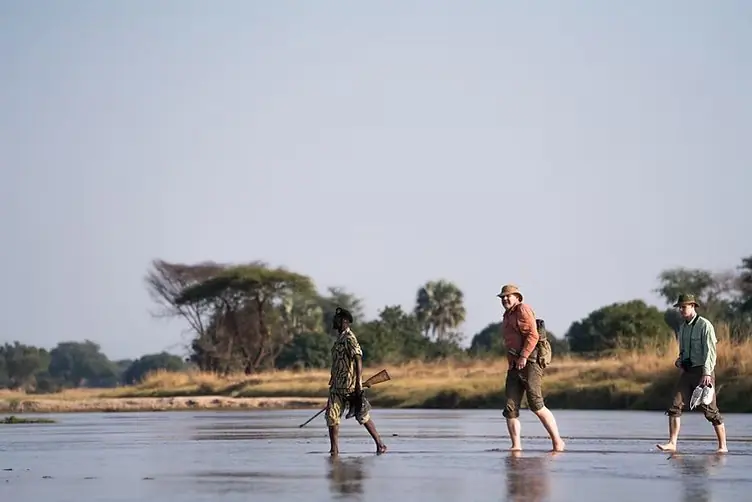 Photo: Classic Zambia
A different park from South Luangwa
The names cause confusion, so it is worth being clear. North Luangwa and South Luangwa are two separate national parks in Zambia's Luangwa Valley, with their own boundaries and their own camps. North Luangwa is the northernmost of the valley's three national parks. Its eastern boundary is the Luangwa River, and it runs west up onto the Muchinga Escarpment [1].
The two parks feel very different on the ground. South Luangwa has dozens of commercial camps, where walks and game drives are offered as equals. North Luangwa has a few camps, areas where game-drive vehicles are not allowed at all, and far fewer visitors [2][5]. Some operators run camps in both, and a trip can combine them, but they are different experiences.
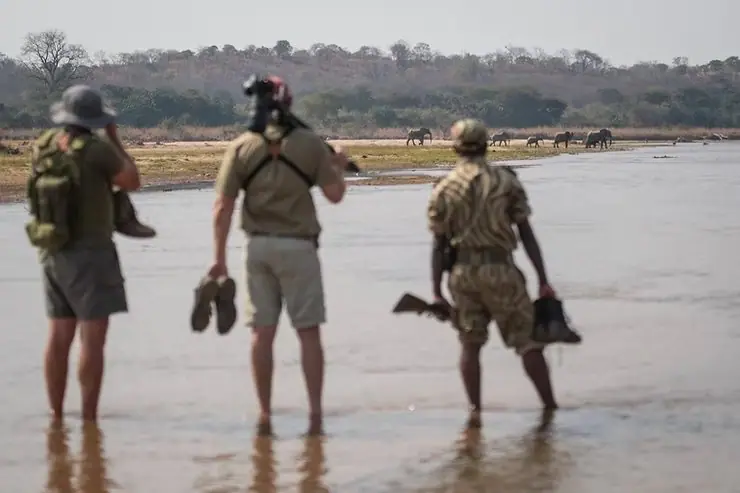 Photo: Classic Zambia
A park managed for wilderness
North Luangwa was set aside as a game reserve in 1938 and became a national park in 1972 [1]. It received far less tourism investment than its southern neighbor, and that is part of its appeal today. The area south of the Mwaleshi River is managed as a strict wilderness zone [1], and much of the walking takes place there.
Conservation has been long-term and international. The Frankfurt Zoological Society has worked in the park with Zambia's wildlife authority since 1986, and in June 2003 the first five black rhinos were released as part of a program to bring the species back to the park [8].
Walking in North Luangwa
Walking here is less a choice between activities than the main way to see the park. At the walking-only camp, there are no game drives at all. A vehicle is kept only to reach distant walking areas [4][7].
The camps sit along the Mwaleshi River, and walks there include river crossings made on foot in the dry season [7]. Camps are small, so a walking group is small too: the camps that publish a figure take six to eight guests in total [4][6][9].
As elsewhere in Zambia, a licensed guide leads and an armed scout from the national parks department walks with the group [4][6]. Walks start early, move slowly and stop often, and they end before dark.
The camps
These are the camps we could confirm for the 2026 season. All are small, seasonal and unfenced.
Mwaleshi (Remote Africa Safaris). A Walking Expedition in our terms: game viewing is on foot only, and a vehicle is used just for access to more distant areas [4][7]. Four chalets, for six guests by one agent's count and eight by another's [4][9]. Open mid-June to the end of October. Guests who stay four nights or more can add a riverside camp-out [4]. Three to five nights is the usual recommendation [4].
Takwela (Remote Africa Safaris). Opened in July 2019 "as a departure from the walking-only camps" that had defined the park [5]. It is a Walking Camp: morning walks, with day and night drives as well. Four chalets, eight beds, open from June 15 to October 31 [5]. Takwela sits downstream of Mwaleshi, and the two are linked by a walk of a few hours [5][10].
Kutandala (Classic Zambia). A relaunched camp on the Mwaleshi River (the original closed in 2010) with five safari tents, open June to October. Walking is the focus, with day and night drives and hides also offered [11]. We class it as a Walking Camp with a strong walking lean.
Other camps have operated in North Luangwa in past seasons. We could not confirm a 2026 operating season for them, so they are not listed here.
When to go
North Luangwa's walking season is the dry season, June to October [3]. Camps close for the rains, from November to May, and are rebuilt each year before reopening [3][10]. June and July are cooler for walking. September and October are hotter, and wildlife concentrates along the rivers as water elsewhere dries up.
Who North Luangwa suits
North Luangwa is for travelers who want walking to be the heart of their safari, and who value solitude more than variety. It suits:
- Experienced safari-goers who have done a game-drive safari and want something quieter and more immersive.
- Committed walkers, especially at Mwaleshi, where every outing is on foot.
- Small groups and couples, given the tiny camp sizes.
It is a less natural fit for a first safari, for travelers who want night drives every evening (available at Takwela, not at Mwaleshi), or for anyone on a short trip. Getting there takes time, and some camps include flights only on longer stays [11]. Plan on at least three nights, and ideally pair it with a second park.
Sources
- Wikipedia, North Luangwa National Park — https://en.wikipedia.org/wiki/North_Luangwa_National_Park
- Africa Geographic, North Luangwa National Park — https://travel.africageographic.com/destinations/zambia/north-luangwa-national-park
- Yellow Zebra Safaris, North Luangwa National Park — https://yellowzebrasafaris.com/au/zambia/where-to-go/north-luangwa-national-park/
- Tribes Travel, Mwaleshi Camp — https://www.tribes.co.uk/accommodation/mwaleshi-camp/details-and-map
- Expert Africa, Takwela Camp — https://www.expertafrica.com/zambia/north-luangwa-national-park/takwela-camp
- Sun Safaris, Kutandala Camp — https://www.sunsafaris.com/safari/zambia/north-luangwa-national-park/kutandala-camp.html
- Expert Africa, Mwaleshi Camp — https://www.expertafrica.com/zambia/north-luangwa-national-park/mwaleshi-camp
- Rhino Resource Center, Reintroduction of black rhino to North Luangwa National Park, Zambia — https://rhinoresourcecenter.com/library/references/reintroduction-of-black-rhino-to-north-luangwa-national-park-zambia/
- Sun Safaris, Mwaleshi Camp — https://sunsafaris.com/safari/zambia/north-luangwa-national-park/mwaleshi-camp.html
- Safari.com, Walk on the wild side — https://www.safari.com/blog/walk-on-the-wild-side
- Expert Africa, Kutandala Camp — https://www.expertafrica.com/zambia/north-luangwa-national-park/kutandala-camp
Spotted an error? Tell us. How we classify camps: our methodology.