
Plan
How a Multi-Camp Walking Safari Works in South Luangwa
In South Luangwa, a multi-camp safari usually means several small bushcamps, a walk most mornings, and a choice at each move: drive to the next camp, or walk there.
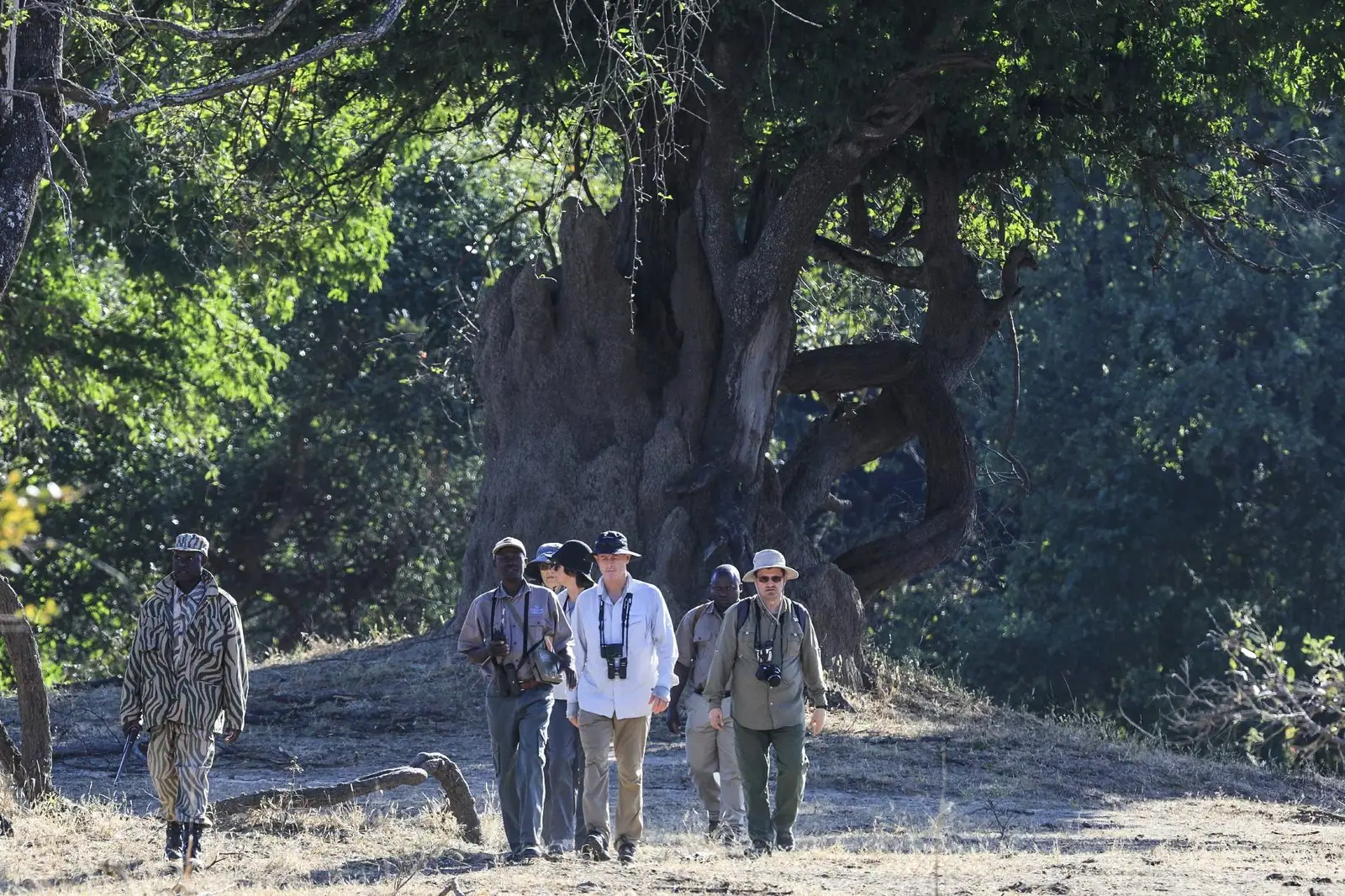 Photo: The Bushcamp Company
Why move between camps
South Luangwa's walking country is dotted with small seasonal bushcamps, many with only four or five tents. Each sits on its own stretch of river, lagoon or plain. Moving between two or more of them over a week or more gives you different landscapes, different guides' perspectives and a sense of traveling through the valley rather than visiting it.
The idea has deep roots in the valley. Carr's original walking safari circuit, which government records date to 1961, took guests across the Luangwa at the Chibembe pontoon and on foot along the Wilderness Trails to Lion Camp. Today's circuits are gentler and more flexible, but the idea is the same: a journey through the valley, camp by camp.
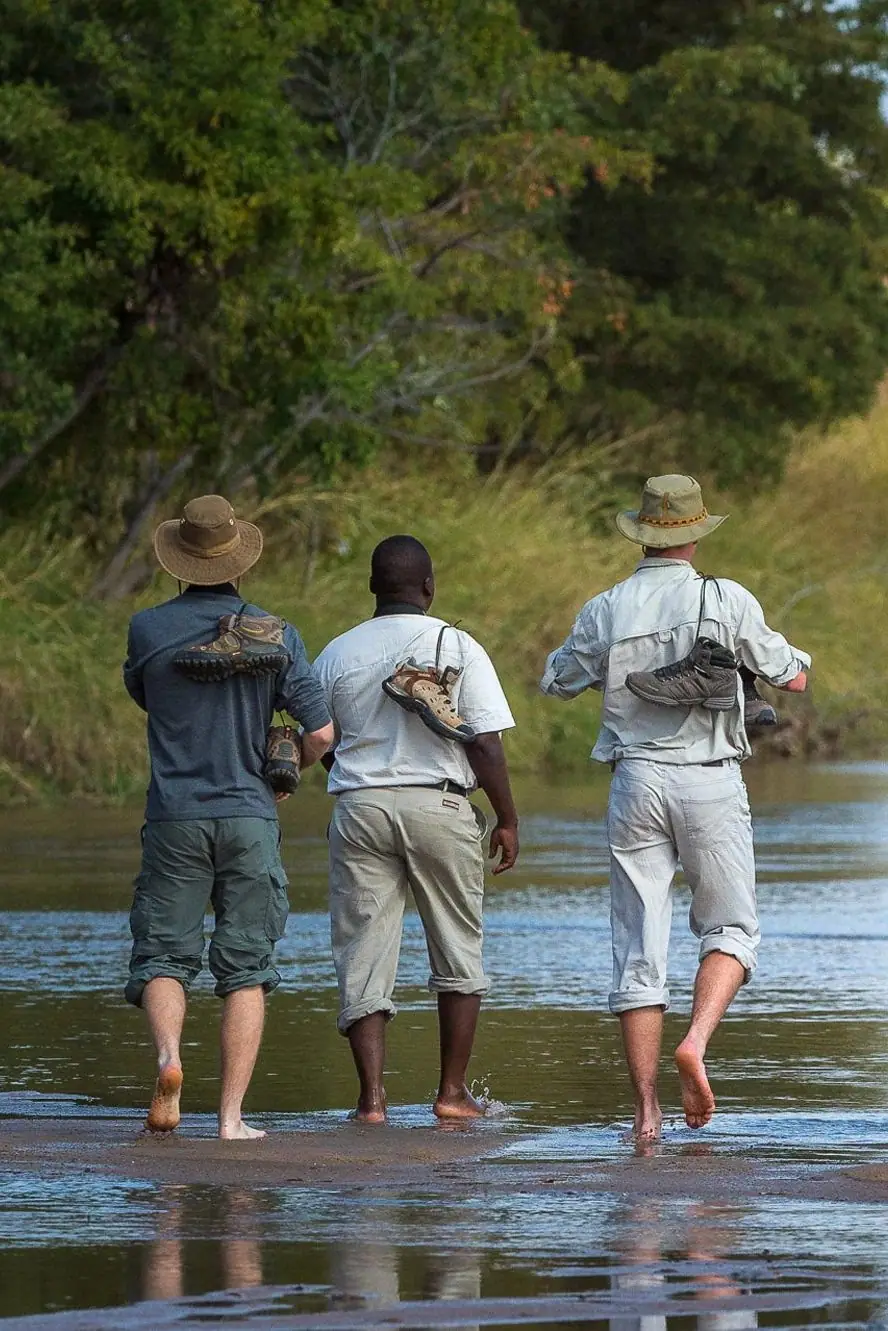 Photo: The Bushcamp Company
How a typical trip runs
Most multi-camp trips in South Luangwa follow a simple pattern.
Arrival. Guests fly into Mfuwe and are driven into the park. For camps in the remote south, the first leg is a game-drive transfer of about three to four hours, so the safari starts the moment you leave the airstrip [2][3].
Days at each camp. Each day offers two activities. The usual pattern is a morning walk, a rest through the midday heat, then an afternoon drive that carries on into a night drive with a spotlight [4]. Walking is optional, and guests can choose a drive instead.
Moving on. Every few days, you move to the next camp. For most guests, this is a game drive: you game-view on the way, and the transfer counts as part of the safari.
The walked leg, if you want it. On BCC's southern circuit (below), guests can walk from one camp to the next instead of driving. The walk is much like any morning walk: slow, with a guide and scout, a tea stop along the way, and a lot of time spent on tracks and birds. The difference is that it ends at a new camp instead of a waiting vehicle. Legs are kept short, usually 3–5 km, and finish by late morning, before the heat. Walks always end well before dark.
The Bushcamp Company's southern circuit
The Bushcamp Company (BCC) is the largest operator in South Luangwa. It runs six small seasonal bushcamps, Kuyenda, Chamilandu, Chindeni, Bilimungwe, Kapamba and Zungulila, in an exclusive 140,000-acre area in the south of the park, plus the iconic Mfuwe Lodge and The Villas at KuKaya [5]. The area covers the southern part of the park, not the whole of it.
Most BCC guests combine two or more bushcamps and move between them by vehicle, on a game-drive transfer. Walking is an optional activity at every camp [1], and a typical bushcamp day is one morning walk followed by an afternoon and night drive [4][6]. A second walk in place of the drive can sometimes be arranged [2].
For guests who want more time on foot, BCC runs a fully walked circuit between its southern bushcamps on request. BCC describes inter-camp walks of about two to four hours as part of its Bushcamp Circuit walking journey [1]. Its 12-night "Bushcamp Circuit: Complete Immersion" itinerary links four camps, Chamilandu, Kapamba, Bilimungwe and Chindeni, with the inter-camp walks offered as an option [7]. Expert Africa describes a similar sample route of about three to four hours per leg [4].
A few practical points:
- Group size: walks are capped at eight walkers and are usually smaller.
- Mixing and matching: you can walk one leg and drive the next. Nothing about the circuit is mandatory.
- Exclusive area: the 140,000-acre southern area is exclusive to BCC's camps.
- Mfuwe Lodge: walks can be arranged at all eight BCC properties, but most walking is done from the bushcamps. At Mfuwe Lodge, a walk needs a private guide.
Other ways to move between camps on foot
BCC is not the only operator in the park with more than one walking camp.
Remote Africa's Tafika Walking Trails. Chikoko Tree Camp and Big Lagoon Camp sit in a vehicle-free walking area across the river from Tafika. They can only be reached on foot, with porters carrying luggage, and each takes up to six guests [8][9]. Guests can also walk from one trail camp to the other to stay, with porters moving the bags.
Robin Pope Safaris' mobile walking safari. If you want walking to be the whole trip, this is the Walking Expedition alternative. It runs on set departures in the far north of the park, on the Mupamadzi River. Staff move the camp while guests walk, twice a day, about 3–10 km each time. Groups are capped at six, guests must be 16 or older, and the trip begins and ends at Robin Pope's fixed camps [10].
Other operators, including Time + Tide, Robin Pope (Nsefu and Tena Tena) and Kafunta, run more than one camp in the park, and a stay can be split between them.
Is a multi-camp trip right for you?
Choose a multi-camp Walking Camp trip if you want variety, a walk most mornings and a drive most evenings, and the option to walk a leg or two between camps without committing to walking every day.
Choose a Walking Expedition if you want to walk twice a day, every day, and are happy to give up game drives for the duration.
Stay at one camp if you have only three or four nights. Moving camps takes time, and a short trip is better spent in one place.
Planning notes
- How long: three nights per camp is a common recommendation. Two camps make a good week; three or four suit ten nights or more.
- When: June to October. Bushcamps close when the rains arrive.
- Ask ahead: if you want to walk between camps, say so when you book, so the operator can plan guides and scouts.
- Fitness: a walked leg is no harder than a normal morning walk. If you can manage three or four hours on uneven ground at a slow pace, you can manage the circuit.
From The Bushcamp Company's Guide to the Luangwa: Why Moving Camps Creates the Classic African Safari · What Makes a Bushcamp Safari Different?
Publisher's note. WalkingSafaris.com is published by The Safari Heritage Collection, custodians of Chibembe and owners of Lion Camp and The Bushcamp Company. Some of our camps appear in this article, and they are assessed on exactly the same published criteria as every other camp in Africa. Who we are
Sources
- The Bushcamp Company, Walking Safaris — https://bushcampcompany.com/products/walking-safaris
- Expert Africa, Chamilandu Bushcamp in detail — https://expertafrica.com/zambia/south-luangwa-national-park/chamilandu-bushcamp/in-detail
- Tribes, Zungulila — https://www.tribes.co.uk/accommodation/zungulila/details-and-map
- Expert Africa, Kapamba Bushcamp — https://www.expertafrica.com/zambia/south-luangwa-national-park/kapamba-bushcamp
- The Bushcamp Company, About — https://bushcampcompany.com/about-us/
- The Bushcamp Company, Night Drives — https://bushcampcompany.com/products/night-drives
- The Bushcamp Company, Bushcamp Circuit: Complete Immersion — https://bushcampcompany.com/collections/complete-immersion
- Expert Africa, Chikoko Tree Camp — https://www.expertafrica.com/zambia/south-luangwa-national-park/chikoko-tree-camp/in-detail
- Zambia Tourism, Tafika Walking Trails — https://www.zambiatourism.com/listing/tafika-walking-trails
- Expert Africa, Robin Pope Safaris Walking Safari — https://www.expertafrica.com/zambia/south-luangwa-national-park/robin-pope-safaris-walking-safari/in-detail
Spotted an error? Tell us. How we classify camps: our methodology.