
Plan
Your First Walking Safari: Where to Go
For a first walking safari, the safest bet is a format that lets you walk every morning and still drive every evening, in a park built around exactly that.
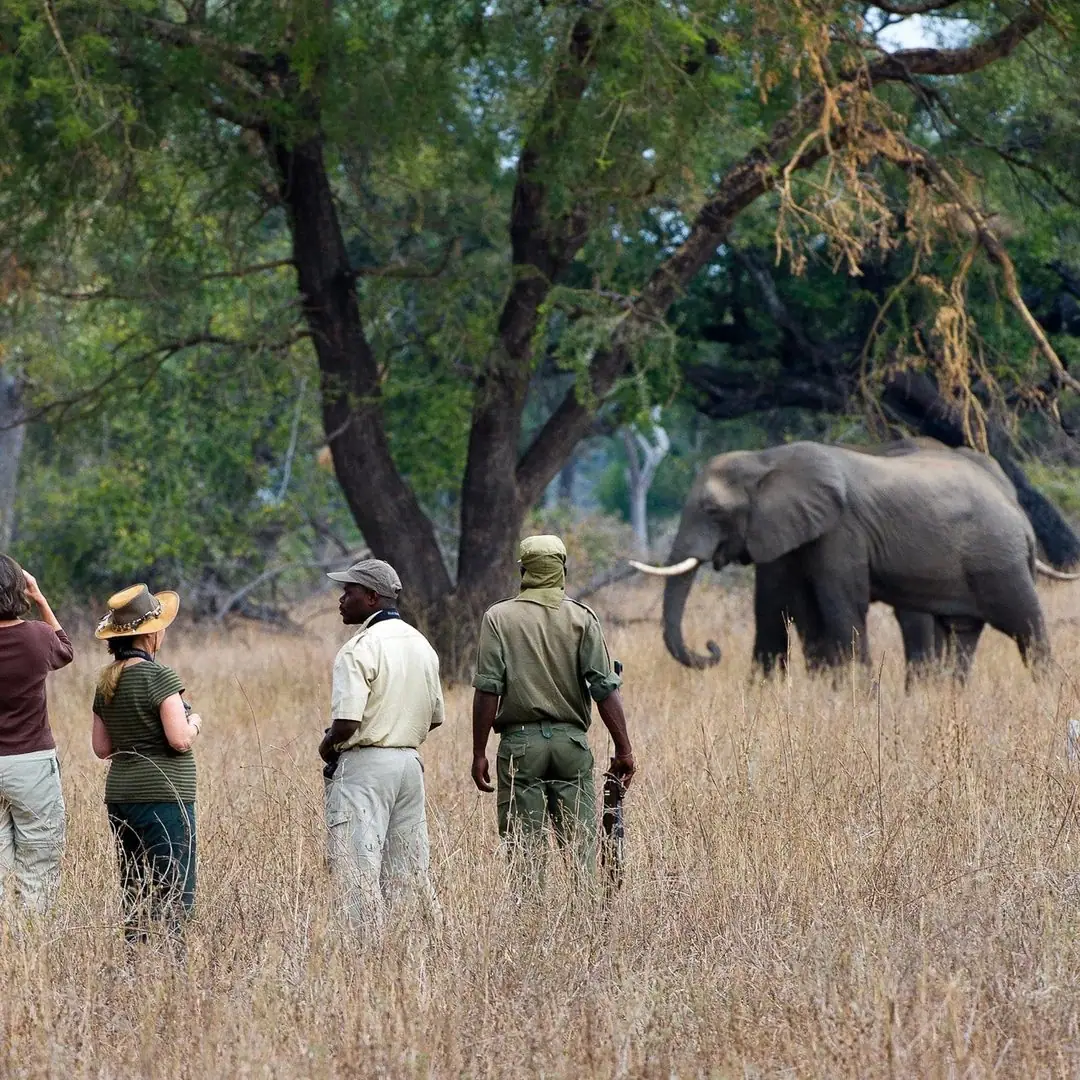 Photo: The Bushcamp Company
Start with a Walking Camp
There are three ways to walk on safari. A Walking Expedition makes walking the whole trip, with vehicles used only for transfers. A Walking Camp offers a walk every day as an equal choice with a game drive. Where Walks Offered, a walk is on request or secondary to the drive. These are formats, not rankings, and each suits a different traveler.
For a first trip, the Walking Camp is the best fit, for three reasons.
You keep both experiences. A morning walk shows you the bush up close: tracks, birds, trees and the way animals react to a person on foot. An afternoon drive covers ground, gets you closer to predators and, in South Luangwa, carries on after dark with a spotlight. First-time visitors usually want both.
You choose day by day. If the heat or your legs say rest, you take the drive. If the first walk wins you over, you walk every morning. Nothing is locked in at booking.
The distances are modest. A Walking Camp walk usually covers 3–5 km over three to four hours, at a slow pace with frequent stops [1]. Most reasonably fit adults manage it comfortably. A Walking Expedition, with two walks a day and 10 km or more on foot, is a better second trip, once you know you love it.
There is one trade-off worth knowing. Walks end before dark, and a long walk cannot carry a proper sundowner. In a Walking Camp, the evening belongs to the drive, so you lose nothing.
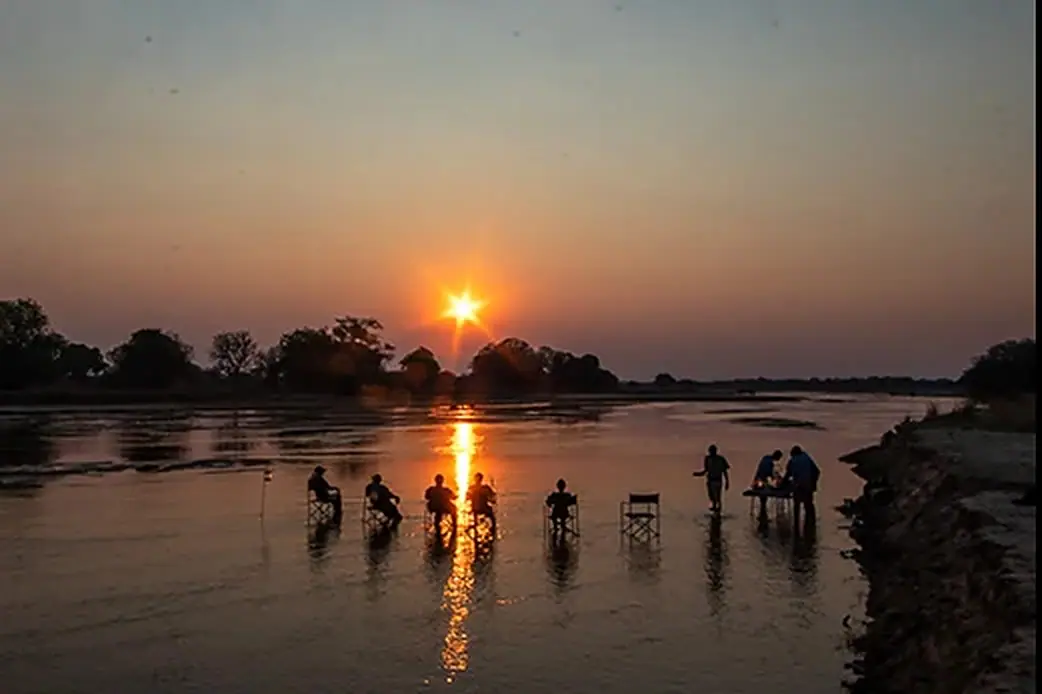 Photo: The Bushcamp Company
Why South Luangwa
You can walk in many parks, but South Luangwa in eastern Zambia is a natural first choice.
Walking is normal here. Counted on our published criteria, about half of the park's commercial camps make walking a daily core activity, 24 camps in all, the most of any park we track. In Greater Kruger, the share is under one in ten.
The safety model is consistent. Every walk inside the national park goes out with a licensed guide and an armed scout from the Department of National Parks and Wildlife (DNPW), which operators describe as standard practice [1][2]. Groups are small, usually six to eight walkers at most.
Night drives are permitted. Many African parks do not allow driving after dark. South Luangwa does, and nearly every Walking Camp includes a night drive [2]. That makes the walk-then-drive day especially rewarding.
It has a long walking history. Government records date Norman Carr's walking safari circuit in the Luangwa Valley to 1961. Guests crossed the Luangwa at the Chibembe pontoon and walked the Wilderness Trails to Lion Camp.
The wildlife is close to the river. In the dry season, animals concentrate along the Luangwa and its lagoons. Walkers regularly see elephants, buffalo, giraffes, antelope, large numbers of hippos and crocodiles, and a great many birds.
Other parks have their own strengths. Mana Pools in Zimbabwe has a higher share of walking camps and open floodplain woodland that is superb on foot, and it suits walkers who have been on safari before. Kruger's wilderness trails, run by the South African state parks agency, offer long days on foot in simpler accommodation [3]. Both are excellent. For a first walk, South Luangwa's mix of walking, driving and night drives is a strong fit.
"Isn't Zambia for a second safari?"
You will often read that Zambia rewards travelers on their second or third safari, and that Zimbabwe or South Africa is the easier introduction. That advice is fair for the remote end of Zambian safari: walking-only camps reached on foot, multi-day mobile walks, and parks with long road transfers.
It fits South Luangwa's Walking Camps less well. You can fly to Mfuwe on a scheduled flight, the camps offer game drives as well as walks, and night drives are part of the day. For a first-timer who wants to try walking without giving up anything else, that combination is a gentle and complete introduction. Keep the remote walking-only trips for later, when you know you want them.
Where to stay in South Luangwa
These are Walking Camps or close to it, described on the same criteria. All are seasonal or small, and all offer walks with a guide and scout.
The Bushcamp Company (BCC). The largest operator in the park, with six small seasonal bushcamps in an exclusive 140,000-acre area in the south of the park, plus Mfuwe Lodge and The Villas at KuKaya [4]. Walking is optional at every camp [2]. Most walking is done from the six bushcamps, where a typical day is a morning walk followed by an afternoon drive that runs into a night drive [5]. Groups are capped at eight walkers and are usually smaller. For guests who want more walking, a fully walked circuit between the southern bushcamps runs on request.
Robin Pope Safaris, Nsefu and Tena Tena. Two camps in the Nsefu sector, where Norman Carr opened Nsefu, generally described as the first game-viewing camp open to the public in Northern Rhodesia, in about 1950. Guests choose a walk or a drive for each of two daily activities [6][7]. Robin Pope also runs a mobile walking safari in the far north of the park, a good Walking Expedition for a later trip [8].
Time + Tide, Luwi, Nsolo, Kakuli and Mchenja. Four seasonal bushcamps where a daily walk is one of two included activities, alongside drives [9].
Chibembe Wildlife Reserve. An exclusive-use camp of four tents on 3,500 unfenced private acres beside the national park, north of the Nsefu sector, at the place where Carr's walking guests once set out. Rebuilt, it reopened to guests in June 2026. Its season runs June through October, and walking is the main point of the stay. The whole camp is booked by one party, with a minimum stay of five nights, which suits families and small groups [10].
Mumbulu. An extremely rustic four-tent camp on a tourism concession inside the park, across the river from Chibembe, booked by one private group at a time [11]. Expect basic, back-to-nature camping: best for walkers who want the bush, not comfort.
Other good Walking Camps include Remote Africa's Tafika, the gateway to its vehicle-free walking trails; Shenton Safaris' Mwamba; and Kafunta's Three Rivers, on the east bank of the Luangwa in the far south, where walking is the signature activity. Our South Luangwa guide lists them all.
Questions to ask before you book
- How many walks does the camp run each day, and can I walk every morning if I want to?
- What is the largest group on a walk?
- What is the minimum walking age? It is 12 under park rules, but some camps set 16 [2].
- Does the walk end at a vehicle, or loop back to camp?
- Are night drives included?
Planning notes
- When: June to October is the walking season. Many bushcamps open in late May and close by early November.
- How long: three nights or more per camp gives you a balance of walks and drives. Two camps make a good first trip.
- Book early: most bushcamps hold six to eight guests, and dry-season dates fill.
From The Bushcamp Company's Guide to the Luangwa: Why South Luangwa Works for Families, Couples and First-Time Travelers · Where Is the Best Walking Country in South Luangwa?
Publisher's note. WalkingSafaris.com is published by The Safari Heritage Collection, custodians of Chibembe and owners of Lion Camp and The Bushcamp Company. Some of our camps appear in this article, and they are assessed on exactly the same published criteria as every other camp in Africa. Who we are
Sources
- Kafunta Safaris, Walking safari Zambia: what to know — https://kafuntasafaris.com/walking-safari-zambia-what-to-know/
- The Bushcamp Company, Walking Safaris — https://bushcampcompany.com/products/walking-safaris ; Night Drives — https://bushcampcompany.com/products/night-drives
- SANParks, Kruger Wilderness Trails — https://www.sanparks.org/parks/kruger/what-to-do/activities/wilderness-trails
- The Bushcamp Company, About — https://bushcampcompany.com/about-us/
- Expert Africa, Kapamba Bushcamp — https://www.expertafrica.com/zambia/south-luangwa-national-park/kapamba-bushcamp
- Expert Africa, Nsefu — https://www.expertafrica.com/zambia/south-luangwa-national-park/nsefu
- Expert Africa, Tena Tena — https://www.expertafrica.com/zambia/south-luangwa-national-park/tena-tena
- Expert Africa, Robin Pope Safaris Walking Safari — https://www.expertafrica.com/zambia/south-luangwa-national-park/robin-pope-safaris-walking-safari/in-detail
- Time + Tide, Rates — https://www.timeandtideafrica.com/?p=7485
- Chibembe Wildlife Reserve, The Camp and History — https://www.chibembewildlifereserve.com/the-camp ; https://www.chibembewildlifereserve.com/history
- Mumbulu Trails — https://mumbulu.com/
Spotted an error? Tell us. How we classify camps: our methodology.