
Why Walk
Mobile, Camp-Based or Trail: The Three Kinds of Walking Safari
Every safari brochure mentions walking, but the trips behind those words are built in three very different ways.
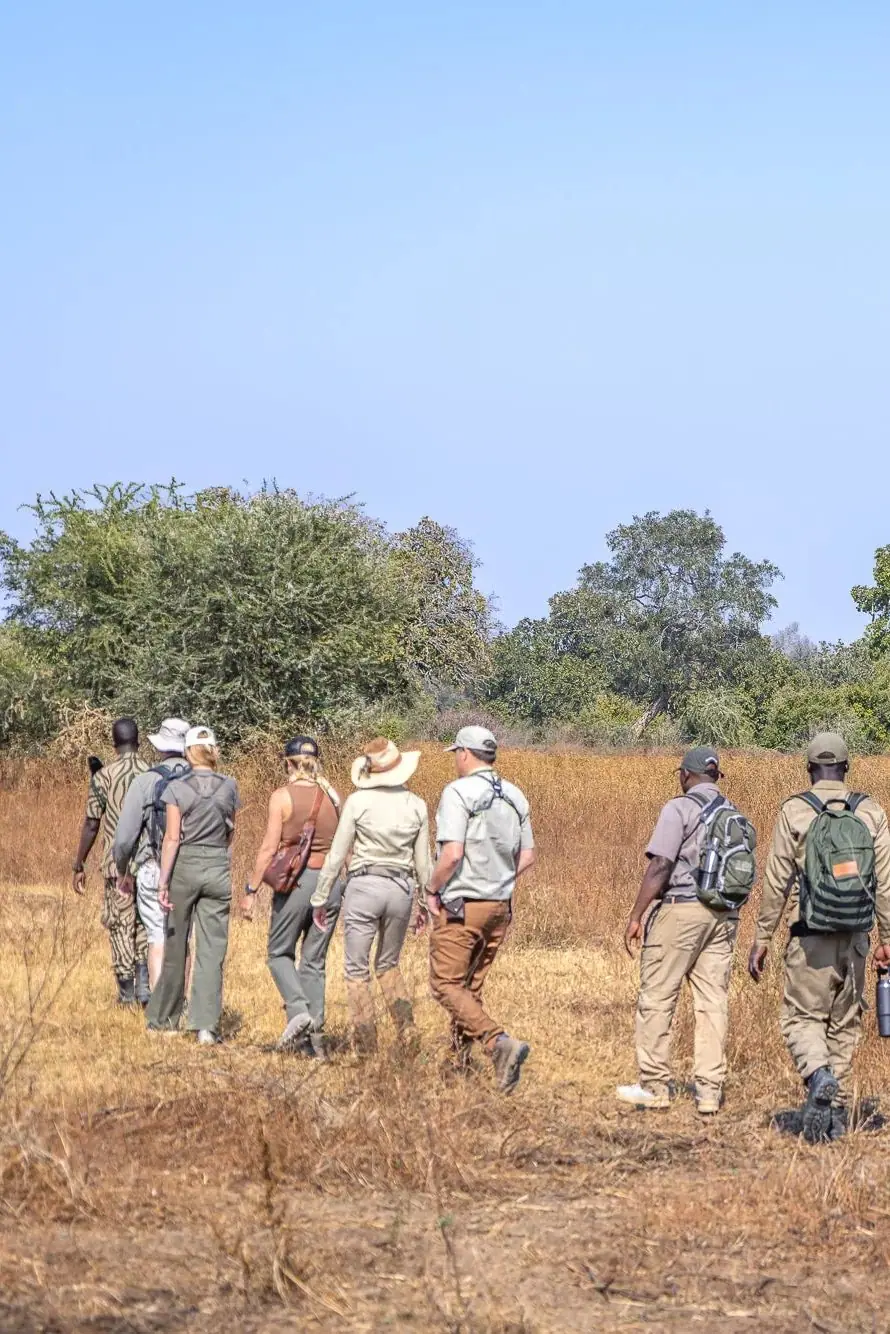 Photo: The Bushcamp Company
Two safaris can both promise "guided walks" and deliver completely different holidays. On one, you walk every morning and afternoon for days, and the only vehicle you see brings you in and takes you out. On another, you walk each morning if you choose and spend the evening on a game drive. On a third, a walk is something the guide may arrange if conditions allow.
We sort walking safaris into three formats: the Walking Expedition, the Walking Camp and Walks Offered. These describe how a trip is built. They are not a quality ranking. A Walking Camp with excellent guides can give you better walking than an expedition with weaker ones.
The Walking Expedition: walking is the trip
On a Walking Expedition you give up the vehicle almost entirely. The formats vary: mobile camps that move while you walk, fixed trail camps reached only on foot, and multi-day wilderness trails.
Robin Pope Safaris' mobile walking safari in South Luangwa is a well-known example. It runs on the Mupamadzi River in the remote north of the park, with set departures in the dry season. Guests walk twice a day, from 3 to 10 km on each walk, in groups of no more than six, with a guide, an armed scout and a tea bearer. While guests walk, the staff strike camp and pitch it again further on. The minimum age is 16.
In the same park, Remote Africa's Tafika Walking Trails link small camps, Chikoko Tree Camp and Big Lagoon Camp, that have no vehicles and are reached on foot. In North Luangwa, Mwaleshi is a walking-only camp, with a vehicle used just for access.
South Africa offers the largest set of multi-day trails. Kruger National Park has seven SANParks wilderness trails: Wolhuter, Olifants, Nyalaland, Bushman, Sweni, Napi and Mathikithi. Each runs for three nights, takes a maximum of eight walkers aged 12 to 65, and covers up to 20 km a day. The first, Wolhuter, opened in July 1978.* Kruger's private reserves add commercial trail camps such as Pafuri Walking Trails and Simbavati Trails Camp.
Who it suits: people who want to walk all day and are content to give up evening drives. Walks have to end before dark, so an expedition day finishes in camp, not on the road at dusk.
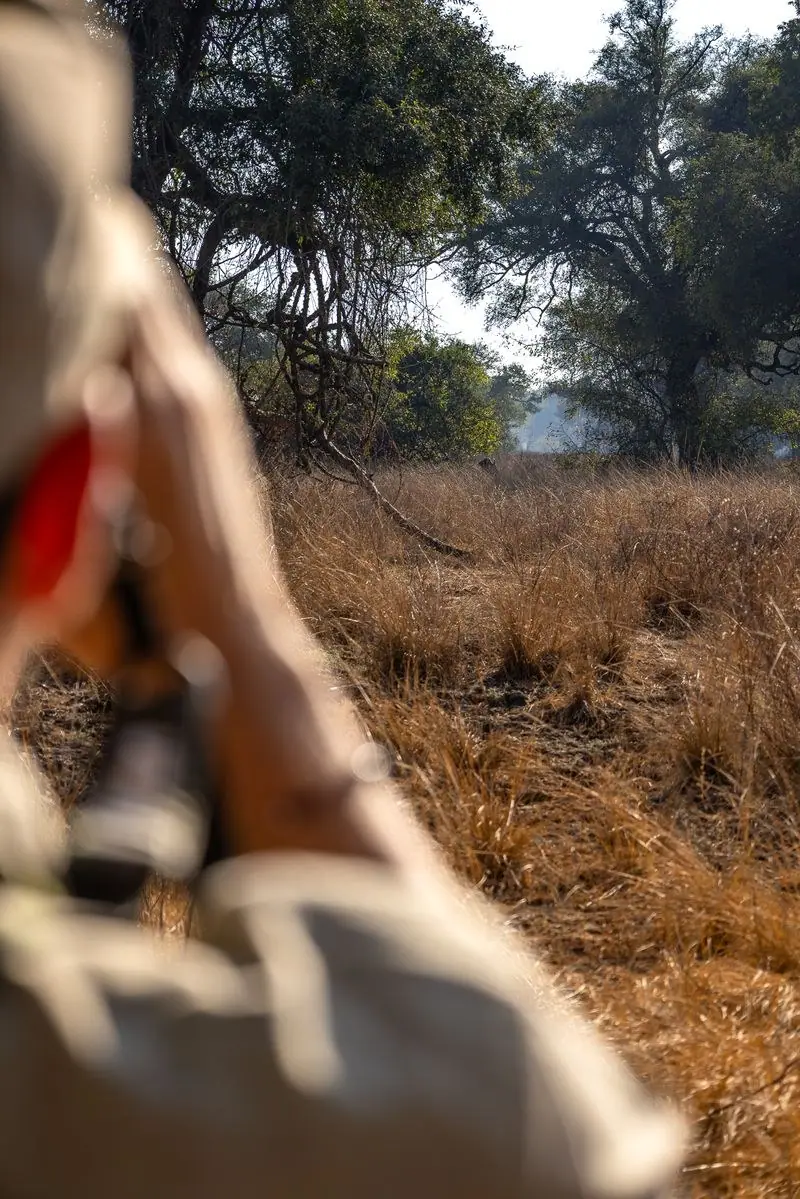 Photo: Chibembe Wildlife Reserve
The Walking Camp: walk or drive, every day
A Walking Camp schedules a guided walk every day as a primary activity, on equal footing with the game drive. You choose each day. A common pattern is a morning walk and an afternoon drive.
In a Walking Camp, a typical walk covers 3 to 5 km over three to four hours. It often ends at a vehicle, and you are back in camp by lunch. The afternoon drive can then run past sunset, with a proper sundowner, which a long walk cannot carry.
South Luangwa in Zambia has more Walking Camps than any other park we have assessed. Camps run by Time + Tide, Robin Pope Safaris, Remote Africa and others offer a daily walk alongside drives. In Zambia, a licensed guide and an armed government scout from the Department of National Parks and Wildlife go on every walk in the national parks, and night drives are permitted in South Luangwa.
Mana Pools in Zimbabwe is the other great Walking Camp destination. Camps such as Wilderness's Chikwenya and African Bush Camps' Nyamatusi treat walking as a core daily activity across the open floodplain woodland of Ana trees. Walks there are led by an armed, licensed Zimbabwe Professional Guide, a qualification widely regarded as one of the most demanding in Africa.
Who it suits: most travelers, including first-timers and anyone who wants both the intimacy of walking and the reach of a vehicle.
Walks Offered: a walk when it suits
At many excellent lodges, walking is available but secondary. A walk may be offered on request, at the guide's discretion, or only when conditions allow, and it is usually shorter.
Most lodges in Sabi Sand, in South Africa's Greater Kruger, work this way. Walks there are an optional alternative to the morning drive. In our research, we found no Sabi Sand lodge that schedules daily walks as its primary activity.
Who it suits: travelers whose main interest is game drives and who would like to try a walk once or twice.
How to tell them apart in a brochure
Brochure language rarely tells you which format you are buying. These questions will:
- How many walks run each day, and are they scheduled or on request? A Walking Camp walks every day as standard.
- Can I walk every day of my stay? If the answer depends on the guide, the season or other guests, it is probably Walks Offered.
- How long and how far is a typical walk? Three to four hours is the norm in a Walking Camp. Expeditions often walk twice a day.
- Who leads the walk, and who carries the rifle? Ask for the guide's walking license and whether an armed scout or ranger comes along.
- What is the maximum number of walkers? Six to eight is the usual ceiling.
- What happens in the evening? A drive or night drive suggests a Walking Camp. A quiet evening in camp suggests an expedition.
- What is the minimum age for walking? It is set by operator policy and is usually 16.
- Is the walking area shared? Ask whether you are likely to meet other groups or vehicles.
Which one is for you
If you are unsure, start with a Walking Camp. It gives you a daily walk without giving up the drive, and it shows you whether you want more.
* The SANParks wilderness trails are run by South African National Parks, a state agency, rather than a commercial operator. We list them for completeness and footnote them wherever we count them.
Sources
- Expert Africa, Robin Pope Safaris Walking Safari: https://www.expertafrica.com/zambia/south-luangwa-national-park/robin-pope-safaris-walking-safari/in-detail
- Expert Africa, Robin Pope walking safari prices and departures: https://expertafrica.com/zambia/safari/robin-pope-walking-safari/prices
- Expert Africa, Chikoko Tree Camp: https://www.expertafrica.com/zambia/south-luangwa-national-park/chikoko-tree-camp/in-detail
- Expert Africa, Mwaleshi: https://www.expertafrica.com/zambia/north-luangwa-national-park/mwaleshi-camp
- SANParks, Kruger Wilderness Trails: https://www.sanparks.org/parks/kruger/what-to-do/activities/wilderness-trails
- ATTA, RETURN Africa's Pafuri Walking Safaris: https://atta.travel/resource/return-africa-s-pafuri-walking-safaris-open-for-2024-season.html
- Safari.com, Simbavati Trails Camp: https://www.safari.com/simbavati-trails-camp
- Kafunta Safaris, Walking safari Zambia: https://kafuntasafaris.com/walking-safari-zambia-what-to-know/
- Go2Africa, Chikwenya: https://www.go2africa.com/accommodation/chikwenya
- Safari.com, Nyamatusi Camp: https://www.safari.com/nyamatusi-camp
- Zimbabwe Professional Guides Association, Education: https://zpga.org/areas-of-focus/education/
- Singita, Guided safari walks: https://singita.com/lodge/singita-boulders-lodge/experience-guided-safari-walks
- Yellow Zebra Safaris, Zimbabwe family safari (minimum walking age): https://yellowzebrasafaris.com/zimbabwe/safari-styles/family-safari/
Spotted an error? Tell us. How we classify camps: our methodology.