
Plan
South Luangwa vs Kruger for a Walking Safari
In South Luangwa, walking is half of the safari; in Kruger, it is usually a separate trip you choose on purpose.
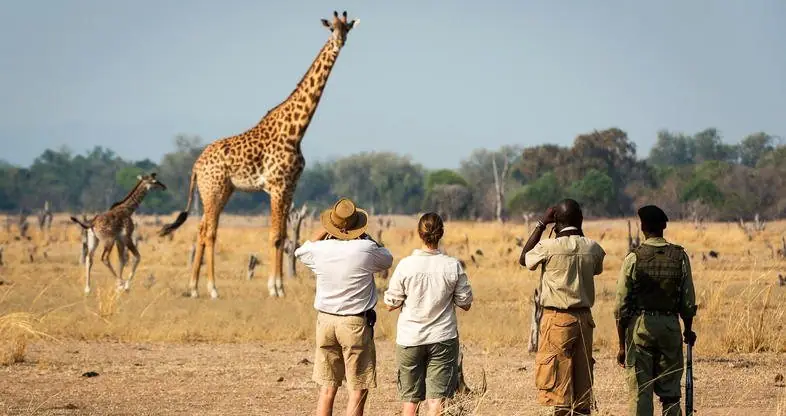 Photo: The Bushcamp Company
Walking as an equal, or walking as an add-on
The biggest difference between the two is not the animals or the scenery. It is where walking sits in the day.
In South Luangwa, about half of all commercial camps make walking a daily core activity. That is 24 walking-led camps, the most of any park we assess [1]. At most of them you choose a walk or a drive for each outing, and a common day is a morning walk followed by an afternoon drive that carries on into a night drive. Walking is not something you have to ask for. It is the other half of the safari.
In Greater Kruger, which includes the national park and the open private reserves along its western side, the picture is reversed. Only about 5–7% of commercial camps are walking-led: 8 camps out of roughly 120 to 170 [2][3]. At most private lodges the game drive leads, and a walk is an alternative you request, often at the guide's discretion [4]. In the Sabi Sand we found no lodge that schedules daily walks as its primary activity.
That does not make Kruger a poor place to walk. It means that in Kruger you have to choose a walking product deliberately, rather than finding walking built into almost any camp.
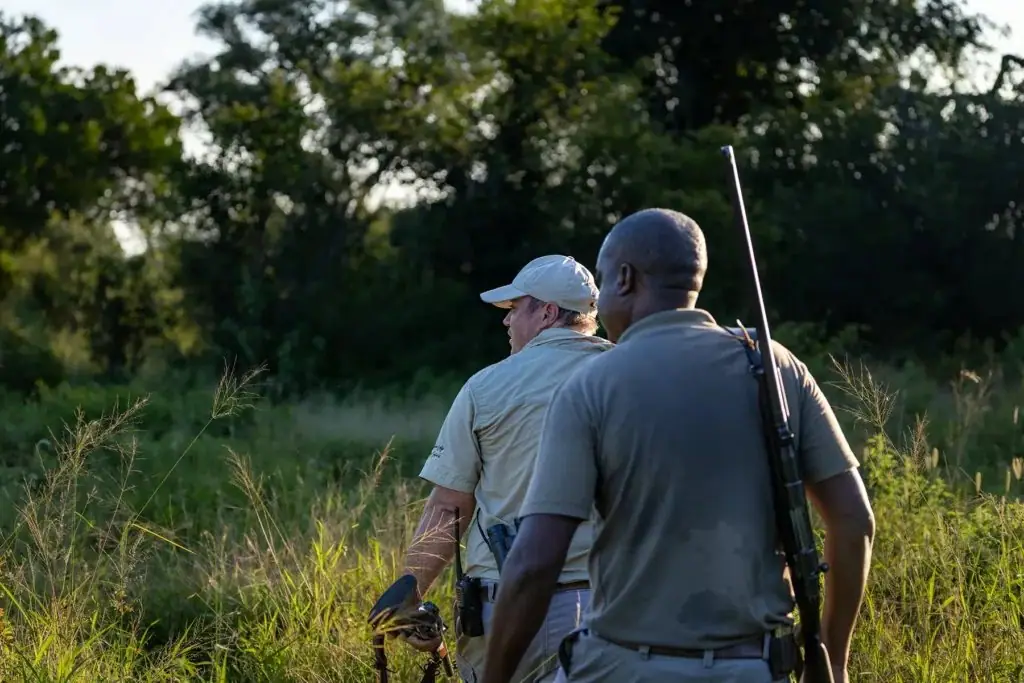 Photo: Seolo Africa
Kruger's strength: the wilderness trails
Kruger's best walking is run by the state. South African National Parks (SANParks) operates seven wilderness trails: Wolhuter, Olifants, Nyalaland, Bushman, Sweni, Napi and Mathikithi [5]. The first, Wolhuter, opened in July 1978 [5]. These are state-run trails, not commercial camps, booked directly through SANParks.
How they work [5]:
- Three nights at a small, rustic trail camp, with two full walking days.
- Up to 20 km a day, in a long morning walk that starts before dawn and a shorter afternoon walk.
- Eight walkers at most, aged 12 to 65.
- No game drives. Walking is the whole trip.
In our terms that is a Walking Expedition. Few products anywhere give you more hours on foot. If your aim is to walk as far and as much as possible, a Kruger trail is hard to beat.
A small number of commercial trails camps in Kruger's private concessions and reserves also put walking first [2]. SANParks rest camps sell short guided walks of a few hours, led by two armed field guides [6].
South Luangwa's strength: walking and driving together
South Luangwa's model is the Walking Camp. Walks go out with a licensed walking guide and an armed scout from the Department of National Parks and Wildlife (DNPW), a government wildlife officer [7]. A typical walk covers 3–5 km over three to four hours, often ending at a vehicle, and you are back in camp for lunch [7].
Walks end before dark, and the evening belongs to the drive. Night drives are permitted in South Luangwa and offered at nearly every walking camp there, The Bushcamp Company's among them [8]. This mix suits most travelers: a slow, close-up morning on foot, then the reach of a vehicle and a spotlight after dark.
For those who want more walking, South Luangwa also has a handful of Walking Expeditions, including mobile walking safaris and vehicle-free trails camps [1].
Fenced or unfenced
South Luangwa is an unfenced park in a long river valley. Animals move freely in and out of it.
Greater Kruger is open inside and fenced outside. In 1993, fences between Kruger and many of the private reserves on its western side came down, creating one open system [9]. The outer boundary is different: about 650 km of fence runs along the western and southern boundary of greater Kruger [10]. For a walker, the practical difference is small. Both are wild, dangerous-game country where you walk with armed escorts. The difference lies more in the overall feel. Kruger is a large, well-developed park with public rest camps and large numbers of day visitors; South Luangwa feels more remote.
Crowds and character
Kruger is one of Africa's busiest parks. South Africans alone made more than 1.3 million entries in 2024 [11]. Most are day visitors: in one recent festive season, 86% of entries were day visits [12]. Once you are on a wilderness trail, though, you share the wilderness area with your own small group.
South Luangwa publishes no official visitor figure, but it receives few visitors for its size [13]. Its walking areas, especially away from Mfuwe, are quiet.
Who should choose which
Choose South Luangwa if…
- You want to walk most mornings and still drive, including at night.
- You are new to walking safaris and want walking built into the stay.
- You want to combine several small camps, all of which walk.
- You can travel in the dry season, roughly June to October.
Choose Kruger if…
- You want to walk as much as possible, up to 20 km a day, on a state-run wilderness trail.
- You are between 12 and 65 and fit for two full walking days.
- You want to walk outside the main dry-season window, since SANParks trails run all year.
- You are already in South Africa and want to add a dedicated walking trip.
- You want a classic lodge safari with the option of an occasional walk.
The two also combine well. A Kruger trail and a few nights in a Luangwa Walking Camp show you two different traditions of walking in Africa, one built on long trails and one on walking and driving as equals.
From The Bushcamp Company's Guide to the Luangwa: Private Game Reserve or Unfenced National Park?
Publisher's note. WalkingSafaris.com is published by The Safari Heritage Collection, custodians of Chibembe and owners of Lion Camp and The Bushcamp Company. Some of our camps appear in this article, and they are assessed on exactly the same published criteria as every other camp in Africa. Who we are
Sources
- Expert Africa, South Luangwa National Park (lodges and camps) — https://www.expertafrica.com/zambia/south-luangwa-national-park
- krugerpark.co.za, Kruger private concession lodging — https://www.krugerpark.co.za/Kruger-Park-Private-Concession-Lodging/
- Safari.com, Timbavati, Klaserie, Manyeleti and Thornybush lodge listings — https://www.safari.com/timbavati ; https://www.safari.com/klaserie ; https://www.safari.com/manyeleti ; https://www.safari.com/thornybush
- Singita, Guided safari walks (Boulders) — https://singita.com/lodge/singita-boulders-lodge/experience-guided-safari-walks
- SANParks, Kruger Wilderness Trails — https://www.sanparks.org/parks/kruger/what-to-do/activities/wilderness-trails
- SANParks, Kruger guided walks — https://www.sanparks.org/parks/kruger/tourism/activities/walks.php
- Kafunta Safaris, Walking safari Zambia: what to know — https://kafuntasafaris.com/walking-safari-zambia-what-to-know/
- The Bushcamp Company, Night Drives — https://bushcampcompany.com/products/night-drives
- Africa Geographic, Greater Kruger — https://africageographic.com/stories/greater-kruger-south-africa/
- Parliamentary Monitoring Group, Question NW147 to the Minister of Forestry, Fisheries and the Environment (Kruger boundary fence) — https://pmg.org.za/committee-question/28031/
- Modern Campground, Kruger National Park expands accommodation (Dec 2025) — https://moderncampground.com/africa/kruger-national-park-expands-accommodation-and-tightens-safety-measures-ahead-of-major-festive-season-surge
- Tourism Update, Kruger festive numbers — https://www.tourismupdate.com/article/kruger-festive-numbers-at-93-recovery
- Zambia Tourism, South Luangwa National Park — https://www.zambiatourism.com/destinations/national-parks/south-luangwa-national-park/
Spotted an error? Tell us. How we classify camps: our methodology.