
Plan
South Luangwa vs Lower Zambezi: Which Is Better for a Walking Safari?
One is a river safari. The other is a whole valley you explore on foot and by vehicle, day and night. If walking is the reason for your trip, the choice is not close.
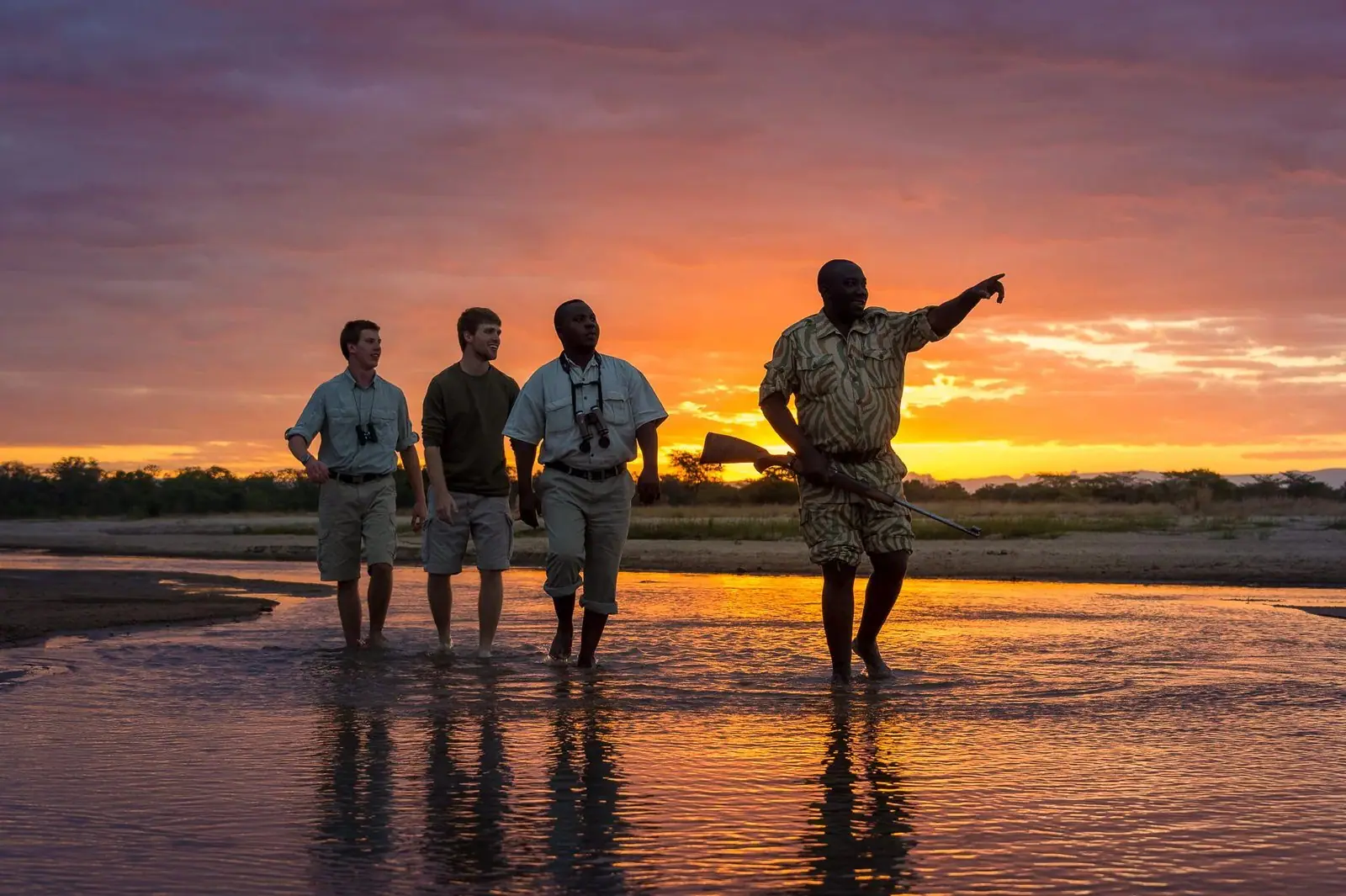 Photo: The Safari Heritage Collection
Two very different parks
Lower Zambezi runs along the north bank of the Zambezi, facing Zimbabwe's Mana Pools [2]. Most of the park is hilly escarpment under miombo woodland. The game concentrates on a narrow strip of floodplain and winterthorn woodland between the river and the escarpment, especially in the dry season [3]. That is where the drives and walks happen, and where the big herds of elephant and buffalo gather [2][3].
South Luangwa is more than twice the size: a broad valley floor of floodplains, oxbow lagoons, mopane and riverine woodland and ebony groves, with the Luangwa River winding through it [1]. There is no single corridor where the animals collect. They are spread across a landscape large enough that where you stay, and how you move through it, changes what you see.
In Lower Zambezi, the geography tells you where to go. In South Luangwa, you learn the valley.
Walking: where the difference is greatest
This is the deciding factor for most readers of this site.
South Luangwa is where the commercial walking safari began, in the early 1960s (see Who Invented the Walking Safari?). About half of the park's commercial camps are walking-led, 24 camps in all, the most of any park we track [4]. At most of them a walk is an equal choice with the drive every day, led by a licensed guide with an armed DNPW scout [5]. In the remote parts of the valley you can walk from one small camp to the next, going deeper into the wilderness each day.
Lower Zambezi offers walks at most camps, with a qualified guide and an armed ranger, and some guides do it very well [3]. But walking usually runs at the guide's or manager's discretion, alongside canoeing, boating, fishing and drives, rather than as a daily core activity [3][10]. Only one Lower Zambezi camp in our directory, Chula Island, is a Walking Camp [4]. Walks also tend to be shorter: one to three hours at some camps, against three to four in the Luangwa [10][11].
See our South Luangwa Walking Safari Guide and Lower Zambezi Walking Safari Guide.
Game viewing and wildlife
The headline list overlaps. Both parks have lion, leopard, elephant, buffalo, hippo, crocodile, wild dog and spotted hyena [1][2].
South Luangwa: depth and variety. The Luangwa River and its lagoons support over 400 bird species, and surveys have found some of the highest leopard densities in southern Africa in the park's Nsefu sector [1]. Night drives, permitted inside the park, are the best time to see leopards hunting. The valley also has its own animals:
- Thornicroft's giraffe, found only in the Luangwa Valley [8].
- Cookson's wildebeest and Crawshay's zebra, endemic or near-endemic to the valley [1].
- Puku, the golden antelope that fills the Luangwa's floodplains, and is absent from Lower Zambezi [9].
Specialists describe Lower Zambezi's game as "not quite as diverse or prolific as South Luangwa" [9].
Lower Zambezi: elephants and the river. Herds of elephant, some up to a hundred strong, gather at the river's edge [2]. Watching them feed on the islands or swim a channel from a canoe at water level is something South Luangwa cannot offer. Buffalo, waterbuck, kudu, zebra, lion and wild dog share the valley floor [2]. There are no giraffes, because the hilly terrain does not suit them, and no puku [2][9].
What you actually do
In South Luangwa, a typical day is a morning walk, an afternoon drive and a night drive back to camp. Over several days you see the valley on foot, by vehicle, by day and after dark. There is no canoeing on the Luangwa.
In Lower Zambezi, the river sets the rhythm. A morning canoe trip, drifting downstream past hippos, crocodiles and elephants, is the signature experience [3]. Add a boat cruise at sunset, fishing for tigerfish (best in September and October), a game drive and perhaps a walk [2].
Crowds
South Luangwa is busier around Mfuwe, near the main gate, where many of the lodges are. Popular sightings there can draw several vehicles in peak season. Away from Mfuwe, in the remote north and the bushcamps of the south, camps are small and far apart, and you can go days without seeing another vehicle.
Lower Zambezi has fewer camps overall. But because the game concentrates on a narrow strip of floodplain, the vehicles that are there tend to work the same ground. The river is where Lower Zambezi feels most private.
In both parks, the camp you choose matters more than the park's reputation.
Choose South Luangwa if…
- Walking is the main reason for your trip.
- You want walks and drives as equals, with a night drive most evenings.
- You want the widest variety of wildlife, including leopards and the Luangwa's own giraffe, wildebeest and zebra.
- You have five nights or more.
Choose Lower Zambezi if…
- You want a river safari: canoeing, boating and fishing.
- Elephants at water level are high on your list.
- You have only two or three nights, or want a short trip from Lusaka.
- Walking is a pleasant extra, not the point.
Doing both
The two parks combine well, and a direct flight links Mfuwe and the Lower Zambezi [12].
Give South Luangwa five to seven nights. The valley takes time to understand. The first day or two you are getting your bearings; by the third or fourth you start to read it. Then fly to Lower Zambezi for two or three nights. The contrast is immediate: the horizon opens, you get in a canoe, and elephants cross between islands.
Spend enough time in South Luangwa to understand it. Then let the Lower Zambezi surprise you.
Frequently asked questions
Is South Luangwa better than Lower Zambezi? For walking, and for variety of wildlife, yes. For a river safari with canoeing and fishing, Lower Zambezi is the one to choose. Many travelers do both.
Is Lower Zambezi good for walking safaris? Walks are offered at most camps and can be very good, but at most camps walking is not a daily core activity. Chula Island is the exception in our directory [4].
Can you canoe in South Luangwa? No. Canoeing is a Lower Zambezi experience, and one of the best reasons to add it to a Zambia trip.
How many nights do I need? Five to seven in South Luangwa, two to three in Lower Zambezi.
Which first? Either works, but most travelers find South Luangwa makes the better anchor, with Lower Zambezi as a contrast at the end.
Sources
- Wikipedia, South Luangwa National Park — https://en.wikipedia.org/wiki/South_Luangwa_National_Park
- Zambia Tourism, Lower Zambezi National Park — https://www.zambiatourism.com/destinations/national-parks/lower-zambezi-national-park/
- Expert Africa, Lower Zambezi National Park — https://expertafrica.com/zambia/lower-zambezi-national-park
- walkingsafaris.com research: camp directory and walking share by park (November 2026)
- Kafunta Safaris, Walking safari Zambia: what to know (Feb 2025) — https://kafuntasafaris.com/walking-safari-zambia-what-to-know/
- Chalo Africa, Chiawa Camp — https://www.chaloafrica.com/accommodation/chiawa-camp-lower-zambezi-zambia/
- Expert Africa, Chula Island Camp — https://www.expertafrica.com/zambia/lower-zambezi-national-park/chula-island-camp
- Wikipedia, Thornicroft's giraffe — https://en.wikipedia.org/wiki/Thornicroft%27s_giraffe
- Tribes Travel, Lower Zambezi National Park — https://www.tribes.co.uk/places/lower-zambezi-national-park/
- Yellow Zebra Safaris, Old Mondoro — https://yellowzebrasafaris.com/zambia/accommodation/old-mondoro/
- Yellow Zebra Safaris, The best walking safaris: Zimbabwe vs. Zambia — https://yellowzebrasafaris.com/us/inspiration/safari-insights/the-best-walking-safaris-zimbabwe-vs-zambia/
- LowerZambezi.com, Proflight Zambia flights to Lower Zambezi — https://www.lowerzambezi.com/proflight-zambia-lower-zambezi-flights.html
Spotted an error? Tell us. How we classify camps: our methodology.