
Plan
What to Wear on a Walking Safari
On foot, what you wear stops being a fashion question: it affects how close the animals let you come, how comfortable you are by mid-morning, and whether your feet survive the thorns.
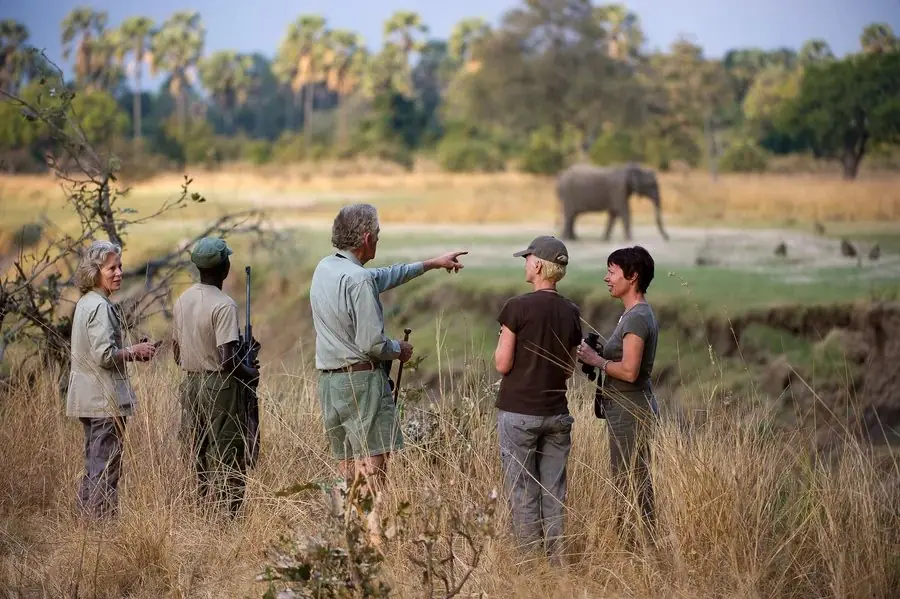 Photo: The Bushcamp Company
Why clothing matters more on foot
In a vehicle, animals tend to see the vehicle, not the people in it. On foot, you are much smaller and much more obvious [1]. Neutral clothing that blends into the bush makes a real difference to how animals react to a walking group, and earth tones like khaki, green and brown are the standard advice [2]. Comfort matters too. A walk lasts three to four hours over rough ground, and late in the dry season the morning heats up quickly.
 Photo: The Bushcamp Company
Colors
Wear: khaki, olive, green, brown, beige and other muted earth tones [2][3].
Avoid white and bright colors. Bright colors and white stand out in the bush [1]. White also shows every speck of dust, and it can attract insects at night [4].
Avoid dark blue and black in tsetse areas. Tsetse flies are drawn to dark colors, especially black and dark blue [5][6]. If you are not sure whether your destination has tsetse, leave the navy shirt at home. Dark colors also absorb the sun and leave you hotter [7].
Leave camouflage at home. In Zimbabwe it is illegal for civilians to wear any clothing made from camouflage material [8]. Elsewhere in the region, guides advise against camouflage and army-style clothing too, because it can draw unwanted attention at border and police checks [6]. Plain khaki does the same job without the risk.
Footwear
Your shoes are the most important thing you pack.
- Closed shoes with a thick sole. Thorns are everywhere on the ground in the dry season, and a thick sole protects against them [1][6]. Closed-toe walking shoes are essential [1].
- Broken in. Wear them for several weeks at home before you travel [6]. A blister on day one can cost you every walk after it.
- Boots or shoes? Heavy hiking boots are not needed. Light hiking boots, desert boots or sturdy walking shoes all work. In hot conditions, traditional walking boots can be too warm, so lighter footwear is often more comfortable, especially late in the dry season [3].
- No sandals on a walk. They are fine around camp, but not in the bush [4].
- Socks: bring enough for a clean pair each day. Some walks include a shallow river crossing where you take your shoes off to wade [1], so a small towel in your daypack is useful.
Covering up
Long sleeves and long trousers protect against sun and insects [2], as well as grass seeds and thorny scrub. Lightweight cotton or quick-drying fabrics in safari colors work best [3]. Shorts are acceptable on many walks [3], but trousers protect your legs better in long grass and thorn thickets.
Add:
- A wide-brimmed hat that shades your face, neck and ears [1].
- Sunglasses [2].
- Sunscreen and lip balm, applied before you leave camp.
- Insect repellent for early mornings and evenings [6].
Layers for cold mornings
Visitors are often surprised by how cold an African dawn can be. Walking safaris run in the dry season, which in southern Africa is also winter. In the southern winter, roughly June to September, early mornings can be genuinely cold, and you will want several warm layers [4]. Pack a fleece or warm jacket for the start of the walk [1], plus a light scarf or gloves if you feel the cold.
By mid-morning you will be shedding layers, so choose clothes that pack down small. Late in the dry season, mornings are milder and the heat arrives quickly.
What your guide will ask you to leave behind
Every briefing is different, but expect these points:
- Anything bright or reflective. A bright backpack, a white cap or a shiny water bottle undoes the work your neutral clothing is doing.
- Anything that rattles or flaps. Loose straps, jangling keys and swishing waterproofs carry a long way in a quiet bush. The group walks in silence for a reason.
- Your phone's sound. Switch it to silent before the walk.
- Excess kit. Carry only what you need. A small daypack with water, sunscreen, a camera or binoculars and a layer is enough. The guide may suggest how much water to bring.
If you are unsure about anything, ask before the walk rather than on the trail.
Packing for small planes
Many walking camps are reached by light aircraft. Luggage is usually limited to 15 kg, sometimes 20 kg, and soft bags are generally required [4]. A small wardrobe of neutral clothing is easier to fly with than a large one. Ask your camp whether it offers laundry; if it does, you can pack less than you think.
A simple packing list
- Two or three long-sleeved shirts in khaki, green or brown
- Two pairs of light trousers, one pair of shorts
- A fleece or warm jacket, plus a light scarf
- Broken-in closed walking shoes or light boots, and sandals for camp
- A wide-brimmed hat and sunglasses
- Sunscreen, lip balm and insect repellent
- A small daypack in a neutral color
- Binoculars
The bottom line
Dress to disappear. Choose earth tones, avoid white, bright colors, dark blue and camouflage, wear shoes you already trust, and bring a warm layer for the dawn start. Everything else is comfort.
From The Bushcamp Company's Guide to the Luangwa: What to Pack for a South Luangwa Safari
Sources
- Timbuktu Travel, What to wear on safari — https://www.timbuktutravel.com/blog/?p=15302
- Kafunta Safaris, Walking safari Zambia: what to know — https://kafuntasafaris.com/walking-safari-zambia-what-to-know/
- Audley Travel, Walking safaris in Zambia — https://www.audleytravel.com/us/zambia/country-guides/walking-safaris-in-zambia
- Travel Butlers, What to take on safari — https://travelbutlers.com/safari/what-to-take-on-safari.asp
- andBeyond, Tsetse flies on safari — https://www.andbeyond.com/magazine/tsetse-flies-on-safari
- South Luangwa Safaris, What to pack for safari — https://www.southluangwasafaris.com/what-to-pack-for-safari/
- Rhino Africa, Top 5 questions about walking safaris answered — https://blog.rhinoafrica.com/2024/05/28/5-things-about-walking-safaris-you-should-know/
- UK Foreign, Commonwealth & Development Office, Zimbabwe travel advice: safety and security — https://www.gov.uk/foreign-travel-advice/zimbabwe/safety-and-security
Spotted an error? Tell us. How we classify camps: our methodology.