
Why Walk
A Morning on Foot: What Happens on a Walking Safari
A walking safari morning has a shape, and once you know it, the day makes sense: up before the sun, out on foot in the cool, back in camp before the heat.
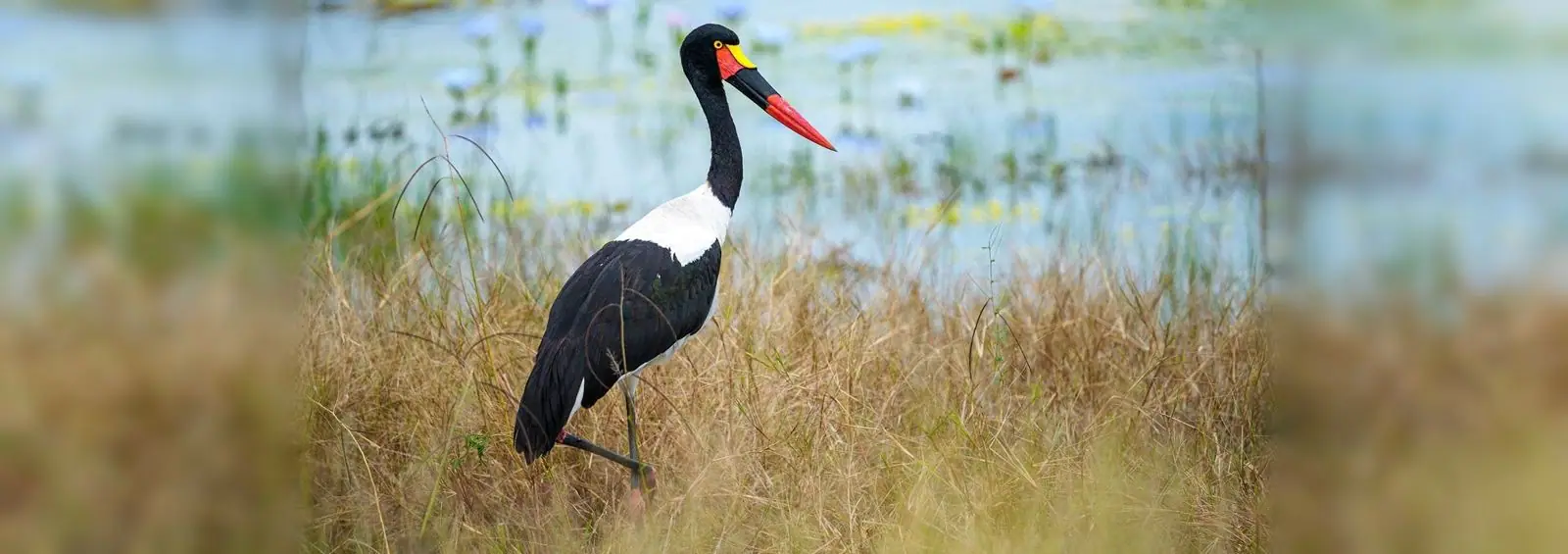 Photo: Wild Expeditions
Before dawn: the wake-up call
The day starts in the dark. A member of the camp team comes to your tent or chalet with a quiet greeting, and sometimes a lantern. There is no alarm and no rush, but there is no lingering either. The point of starting early is to be on foot in the coolest, most active hours of the day.
You dress for walking: broken-in closed shoes, long trousers, long sleeves in khaki, green or brown, and a wide-brimmed hat [2]. Sandals and bright colors stay in the tent.
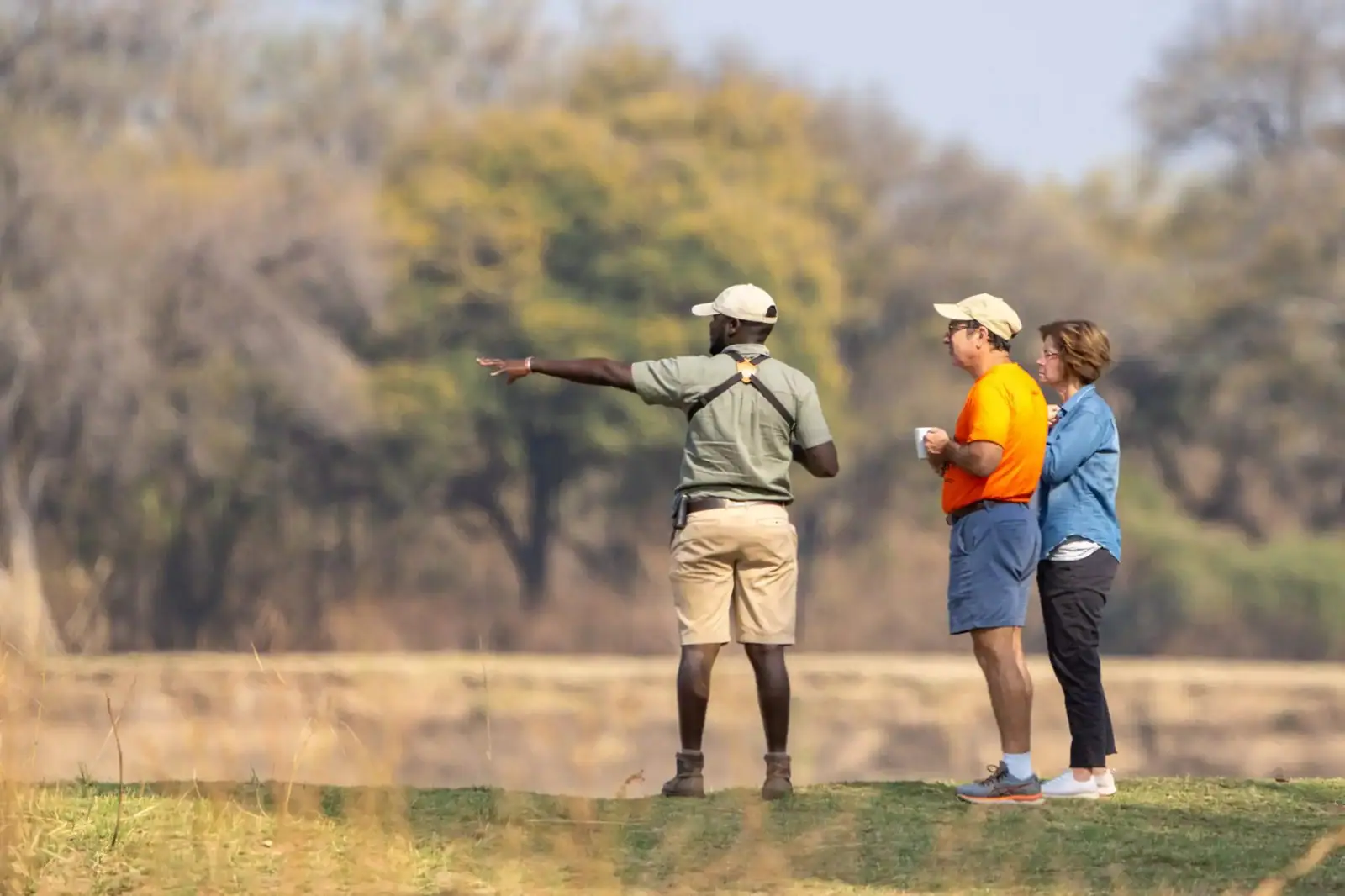 Photo: Lion Camp
First light: tea by the fire
Breakfast is a simple buffet around the fire, with tea and coffee. At many bushcamps it is served in time to watch the sun come up before the morning activity [3]. It is a light meal, deliberately so. Brunch comes later.
This is also the time to ask questions. The guide is usually there, and it is a good moment to mention an old knee injury, a fear of snakes or a particular bird you hope to see.
The briefing
Before anyone leaves camp, the guide gives a safety briefing. You will hear it on every first walk, and often a shorter version before each walk after that. It covers the basics [2]:
- Walk in single file, behind the guide and scout.
- Keep noise low and talk quietly, if at all.
- Follow the guide's instructions at once, without debate.
You will also meet the team. The guide leads, reads the ground and interprets what you find. The armed DNPW scout is a government wildlife officer whose job is safety: using knowledge of animal behavior to defuse a tense moment long before it becomes dangerous [2]. Operators describe a scout on every walk as standard practice in Zambia's national parks [1][2]. A tea porter, sometimes a trainee guide, carries water and refreshments [1][4].
Setting out
Walks start in different ways. Some leave on foot straight from camp. Others begin with a short drive to an area the guide knows and loves. Sometimes the guide drives until something interesting turns up, such as fresh buffalo tracks or the alarm calls of birds and monkeys, and the walk starts there. And at some camps, including The Bushcamp Company's southern bushcamps, you can walk from one camp to the next in the morning, arriving on foot in time for brunch. For many walkers, that is the ultimate walking safari memory.
The first few minutes on foot can feel strange. There is no engine, no roof and no door. The bush is louder than you expected: francolins calling, a baboon barking somewhere along the river, the crunch of your own steps on dry leaves.
The pace is slow, much slower than a hike. The group stops often. A walk of three to four hours covers about 3–5 km [2], but distance is not the point. Much of the morning goes into learning: reading tracks, understanding the habitat, getting to know the trees and bushes, and watching wildlife big and small. A walking safari is as much an education as a search for the next sighting.
Tracks, signs and the morning's news
Most walks begin with the ground. Overnight, the sand along paths and riverbanks fills with tracks, and the guide reads them like a newspaper: a hyena that passed in the night, the drag marks of a feeding hippo, the round print of an elephant crossed by smaller tracks laid down after it.
From there, the walk follows whatever the morning offers. You are likely to see antelope such as impala and puku, troops of baboons and monkeys, and a great many birds. Elephants, buffalo, giraffes, zebras and kudu are seen regularly. On the Luangwa itself, hippos and crocodiles gather in large numbers, and walking along a high bank above a pod of hippos is a classic Luangwa scene. Lions and leopards are seen less often on foot, and when they are, the guide keeps a careful distance.
What surprises most first-time walkers is how much of the morning goes on small things: a termite mound and the trees growing from it, a dung beetle at work, the alarm snort of an impala, a tree whose bark elephants have stripped. A walk is less about ticking off animals than about learning how the pieces fit together.
When the guide spots large animals ahead, the group stops. The guide and scout assess the wind, the ground and the animals' mood. Sometimes you wait and watch from a safe distance. Sometimes you quietly change direction. Either way, the decision is theirs.
Mid-morning: the tea stop
Somewhere along the way, often in the shade of a large tree or on a rise with a view, the group stops for tea. The porter unpacks a flask, mugs and something to eat; homemade biscuits are a common feature at Luangwa bushcamps [3]. It is a pause, not a picnic: a short break to drink, rest your legs, look through binoculars and ask the guide the questions that have been building up all morning.
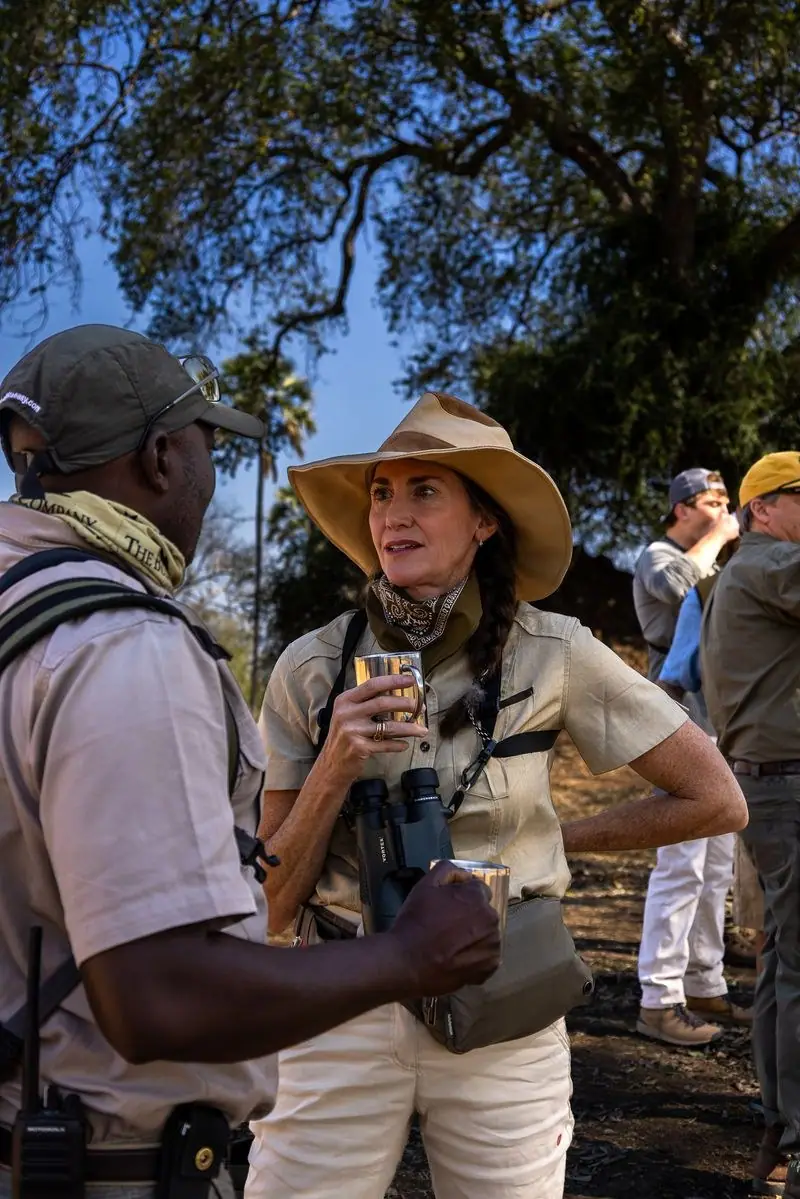 Photo: The Bushcamp Company
It is also a moment to notice how far you have come, which is usually less than it feels. Then the walk continues.
The vehicle pickup
Many South Luangwa walks do not loop back to camp. Instead, the walk ends where a vehicle is waiting [2]. This lets the walk follow the most interesting ground rather than turning back halfway, and it means no one walks home in the rising heat.
The drive back is often short, but it is still a game drive. Guides will stop for anything worth seeing on the way.
Late morning: brunch
By about 10:30 the walk is usually over [3], and brunch is served soon after, often around 11:00 [3]. It is the main meal of the morning, and the time to compare notes on what everyone saw.
The afternoon is quiet. The heat builds, and most guests read, sleep or watch the river from camp. Later in the afternoon, after tea, comes the game drive, which in South Luangwa usually carries on after sunset into a night drive with a spotlight. Walks always end well before dark, which is why the evening belongs to the vehicle and the sundowner.
At The Bushcamp Company's bushcamps in the south of the park, for example, a typical day follows this pattern: one morning walk with a guide, armed DNPW scout and tea porter, then an afternoon drive that runs into a night drive [1][5]. Walking is optional there, as it is at most Walking Camps, and guests choose a walk or a drive each morning.
Why the morning works
The shape of the day is not arbitrary. Mornings are cool, animals are active and tracks are fresh. By late morning the bush goes quiet in the heat, and so do the walkers. A walking safari works with that rhythm rather than against it, and after two or three mornings on foot, most guests find they are reading the ground for themselves.
From The Bushcamp Company's Guide to the Luangwa: Where Is the Best Walking Country in South Luangwa?
Publisher's note. WalkingSafaris.com is published by The Safari Heritage Collection, custodians of Chibembe and owners of Lion Camp and The Bushcamp Company. Some of our camps appear in this article, and they are assessed on exactly the same published criteria as every other camp in Africa. Who we are
Sources
- The Bushcamp Company, Walking Safaris — https://bushcampcompany.com/products/walking-safaris
- Kafunta Safaris, Walking safari Zambia: what to know — https://kafuntasafaris.com/walking-safari-zambia-what-to-know/
- Expert Africa, Bilimungwe Bushcamp in detail — https://www.expertafrica.com/zambia/south-luangwa-national-park/bilimungwe-bushcamp/in-detail
- Rainbow Tours, The Bushcamp Company — https://www.rainbowtours.co.uk/zambia/walking-safaris/hotels/bushcamp-company
- Expert Africa, Kapamba Bushcamp — https://www.expertafrica.com/zambia/south-luangwa-national-park/kapamba-bushcamp
Spotted an error? Tell us. How we classify camps: our methodology.