
Why Walk
How Far Do You Actually Walk on a Walking Safari?
Less than most people expect, and more slowly: a typical morning walk in a Walking Camp covers 3–5 km, and the time goes on looking, not on covering ground.
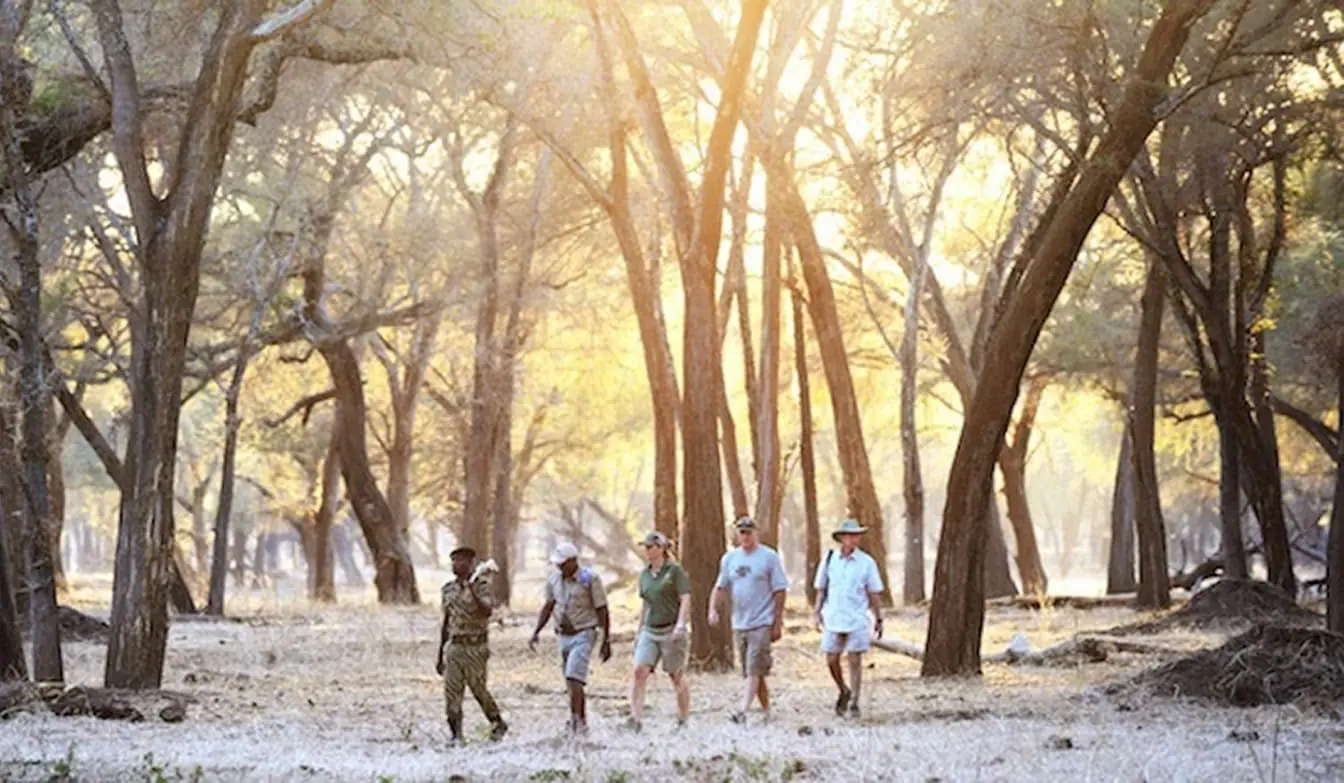 Photo: Chiawa Safaris
The short answer
On most walking safaris you walk less far than you would on a day hike at home, and much more slowly. The point of a walk is not distance. It is stopping to read a set of tracks, waiting while the guide assesses a herd of buffalo ahead, crouching over a dung beetle at work. A three-hour walk is as much about learning the bush as covering ground.
How far you go depends mainly on the format of trip you choose.
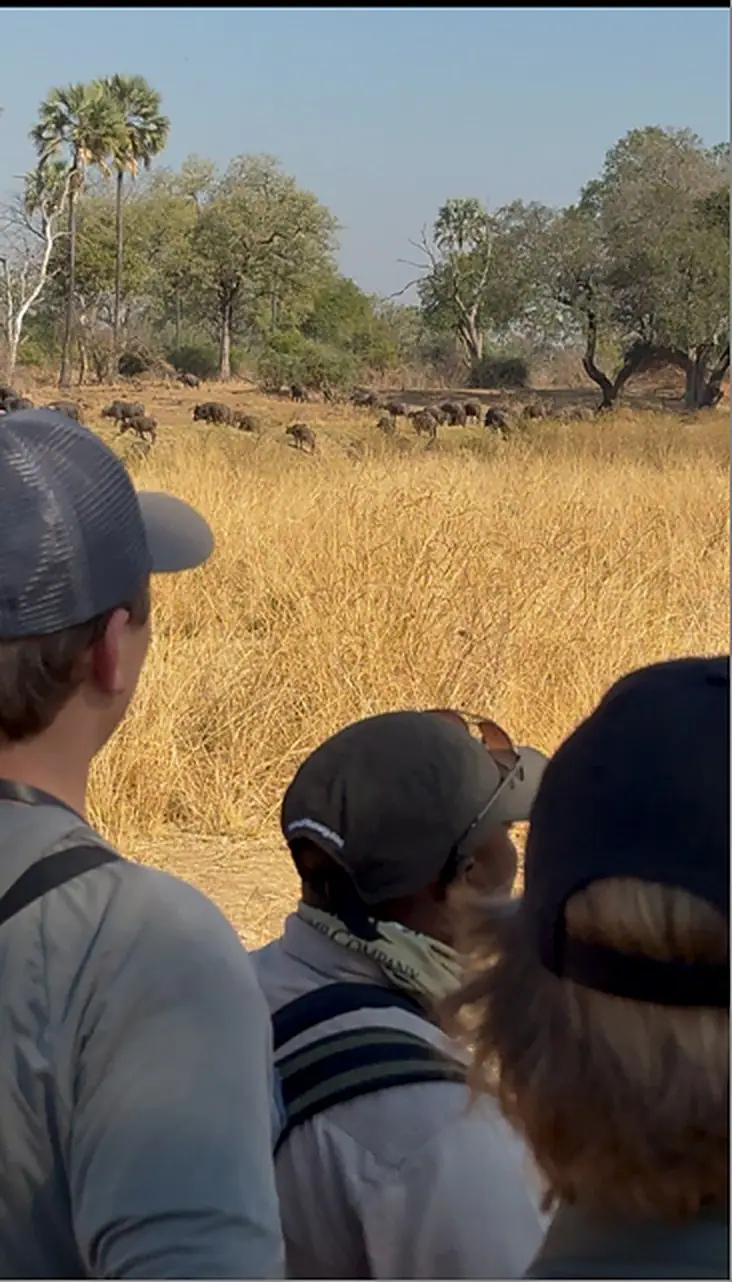 Photo: The Bushcamp Company
In a Walking Camp: 3–5 km over a morning
In a Walking Camp, guided walks are offered every day as an equal choice with game drives. South Luangwa in Zambia is a good example, because about half of its commercial camps make walking a daily core activity.
A typical day there starts with an early wake-up and a light breakfast, then a walk that sets off soon after first light. Most walks cover about 3–5 km (2–3 miles) over three to four hours, depending on terrain and what the group finds [1]. The pace is deliberately slow [1]. The walk often ends where a vehicle is waiting, and the group is driven back to camp in time for lunch. The afternoon is usually a game drive that runs on into a night drive.
That is a comfortable morning for most adults. You are on your feet for several hours, but rarely walking hard for long.
On a Walking Expedition: longer days on foot
A Walking Expedition makes walking the whole trip, and the distances go up. Published figures vary by operator and route.
- Mobile walking safaris in South Luangwa run two walks a day of about 3–10 km each, with around 10 km a day reported as typical [2][3].
- Tanzania's mobile walking camps: one Serengeti camp reports about 10 km a day across two walks [4]. A 2025 review of another reported camp moves of 18–22 km [5].
- Kenya: a camel-supported walking safari in Laikipia covers 8–16 km in a single walk that ends around lunch [6], and a multi-day walk in Tsavo covers 11–16 km a day [7].
If you want a long day on foot, this is the format to choose.
Kruger's wilderness trails: up to 20 km a day
South Africa's national parks agency runs seven wilderness trails in Kruger. Each is a three-night trip with two full walking days. Each walking day has a long walk that starts before dawn and a shorter walk in the afternoon, adding up to as much as 20 km (about 12 miles) a day [8]. Groups are capped at eight, and walkers must be aged 12 to 65 [8].
Commercial trail camps in the reserves around Kruger typically run two walks a day: three to four hours in the morning and two to three hours in the afternoon [9]. One Kruger camp lists its morning walk at 5–12 km over three to five hours [10].
Walks Offered: an hour or two
Where walking is an extra to the game drive, walks are usually short. Published examples include one-hour walks at a private Kruger lodge and two-hour walks on a Kenyan conservancy [11][12]. These are a good taste of walking, but they are a different experience from a full morning on foot.
Why "5–10 miles" is usually wrong
You may see walking safaris described as covering 5–10 miles (8–16 km) a day. For a Walking Camp, that is wrong. A normal morning walk there is 3–5 km, or 2–3 miles. Figures in the 8–16 km range belong to some Walking Expeditions and longer trails, where walking is the whole trip.
If a figure matters to you, ask the camp directly how long its walks usually last and how far they usually go. A good operator will answer in hours as well as distance, because hours are a better guide to what the morning will feel like.
Fitness
You do not need to be an athlete. Walks move slowly, with frequent stops, and are suitable for most fitness levels [13]. If you can walk comfortably for three or four hours on uneven ground, you are fit enough for a Walking Camp. Walking Expeditions and Kruger's trails ask more: several hours on foot twice a day, for several days in a row. Kruger's trails also set an upper age limit of 65 [8].
Practical points help more than training:
- Wear broken-in, closed walking shoes. The ground is uneven, and sandals are not suitable [1].
- Wear long sleeves and trousers in neutral colors for sun and insects [1].
- Tell your guide before the walk about any injury or condition.
Heat
Heat, not distance, is what tires most walkers. Walking seasons fall in the dry months, and late in the season it gets hot. In Mana Pools, October temperatures can top 40°C (104°F) [14]. This is why walks start at first light and finish by late morning. Drink water before you set off, carry what the guide suggests, and wear a wide-brimmed hat. Dark colors absorb the sun and leave you hotter [13].
The bottom line
A walking safari is measured in hours and observations, not kilometers. In a Walking Camp, plan on 3–5 km over a morning. If you want to walk 10 km or more a day, choose a Walking Expedition or a Kruger trail.
Sources
- Kafunta Safaris, Walking safari Zambia: what to know — https://kafuntasafaris.com/walking-safari-zambia-what-to-know/
- Expert Africa, Robin Pope Safaris Walking Safari — https://www.expertafrica.com/zambia/south-luangwa-national-park/robin-pope-safaris-walking-safari/in-detail
- Yellow Zebra Safaris, Walking safari in Zambia — https://yellowzebrasafaris.com/us/zambia/things-to-do/walking-safari/
- Yellow Zebra Safaris, Wayo Walking Camp — https://yellowzebrasafaris.com/us/tanzania/accommodation/wayo-walking-camp/
- Expert Africa, Expeditionary Walking Camp reviews — https://www.expertafrica.com/tanzania/serengeti-migration-area/expeditionary-walking-camp/reviews/1
- Expert Africa, Karisia Walking Safaris — https://www.expertafrica.com/kenya/laikipia/karisia-walking-safaris/in-detail
- Africa Geographic, Walking with Giants — https://travel.africageographic.com/safaris/walking-with-giants
- SANParks, Kruger Wilderness Trails — https://www.sanparks.org/parks/kruger/what-to-do/activities/wilderness-trails
- Safari.com, Simbavati Trails Camp — https://www.safari.com/simbavati-trails-camp
- Yellow Zebra Safaris, Plains Camp — https://yellowzebrasafaris.com/us/south-africa/accommodation/plains-camp/
- Chalo Africa, andBeyond Ngala Tented Camp — https://www.chaloafrica.com/accommodation/andbeyond-ngala-tented-camp-south-africa/
- Elewana, Lewa Safari Camp activities — https://elewanacollection.com/lewa-safari-camp/activities
- Rhino Africa, Top 5 questions about walking safaris answered — https://blog.rhinoafrica.com/2024/05/28/5-things-about-walking-safaris-you-should-know/
- Expert Africa, Mana Pools — https://expertafrica.com/zimbabwe/mana-pools-national-park
Spotted an error? Tell us. How we classify camps: our methodology.