
Where to Walk
Where Is the Best Game Viewing on a Walking Safari?
There is no single best park for wildlife on foot. There is a best park for what you most want to see, and for the kind of walking you want to do.
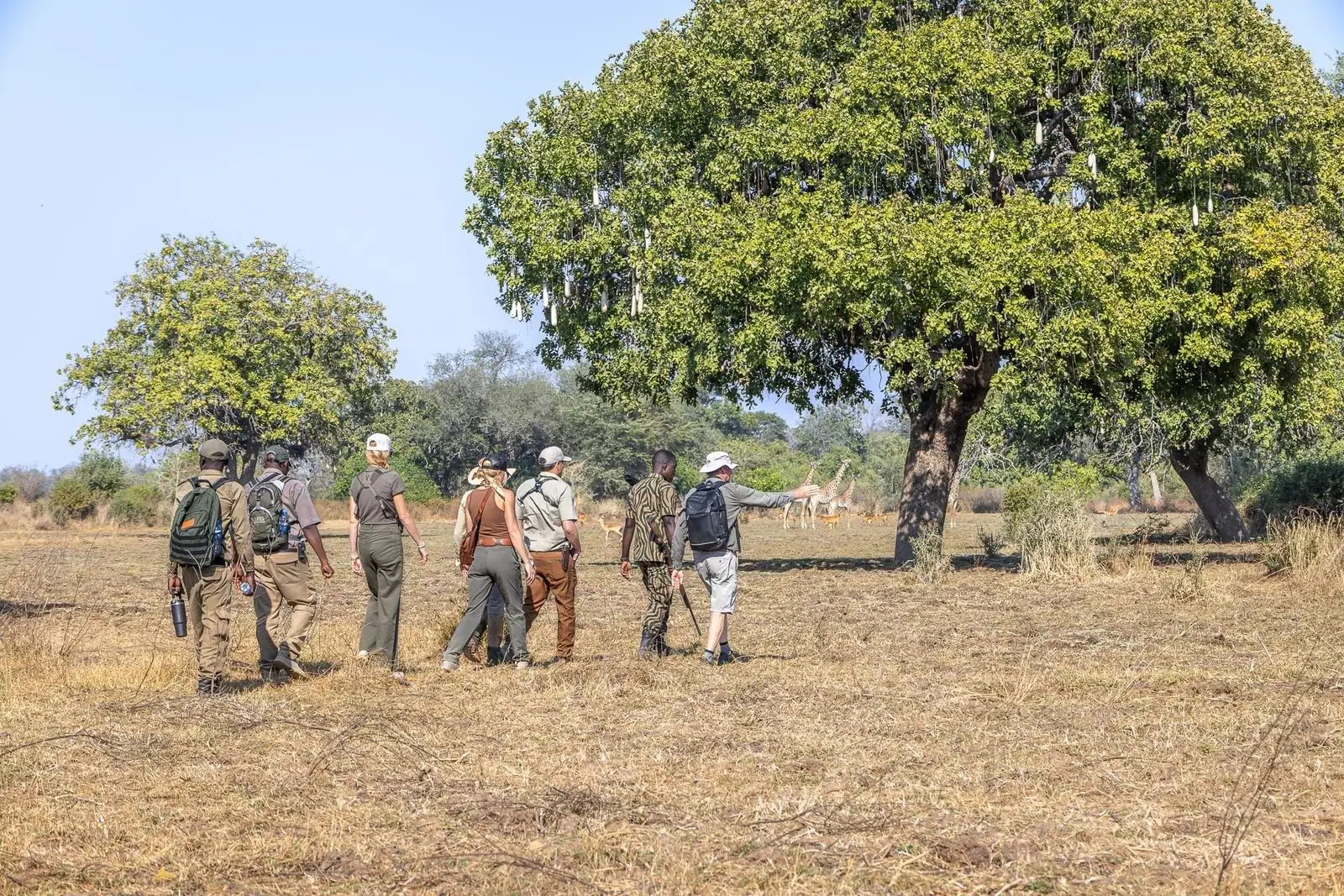 Photo: Chibembe Wildlife Reserve
First, what "good game viewing" means on foot
A walk is not a game drive without the vehicle. On foot you see fewer animals in a morning, and you see them differently. Most walking sightings are of elephant, buffalo, giraffe, zebra, hippo and antelope, along with tracks, birds and the small things a vehicle drives past. Big cats are seen on foot now and then, but a good guide does not go looking for a close encounter with lion, and you should not expect one.
So the best parks for walking are not simply the parks with the most animals. They are the parks where:
- Animals are plentiful, so a three- or four-hour walk reliably finds something.
- The mix is varied, so every morning is different.
- There is something special you will not see in many other places.
- The ground is good for walking: open enough to see ahead, with animals used to people on foot.
- Walking is a core activity, with plenty of camps where walks run every day.
No park wins on all five. That is why the honest answer depends on what you want.
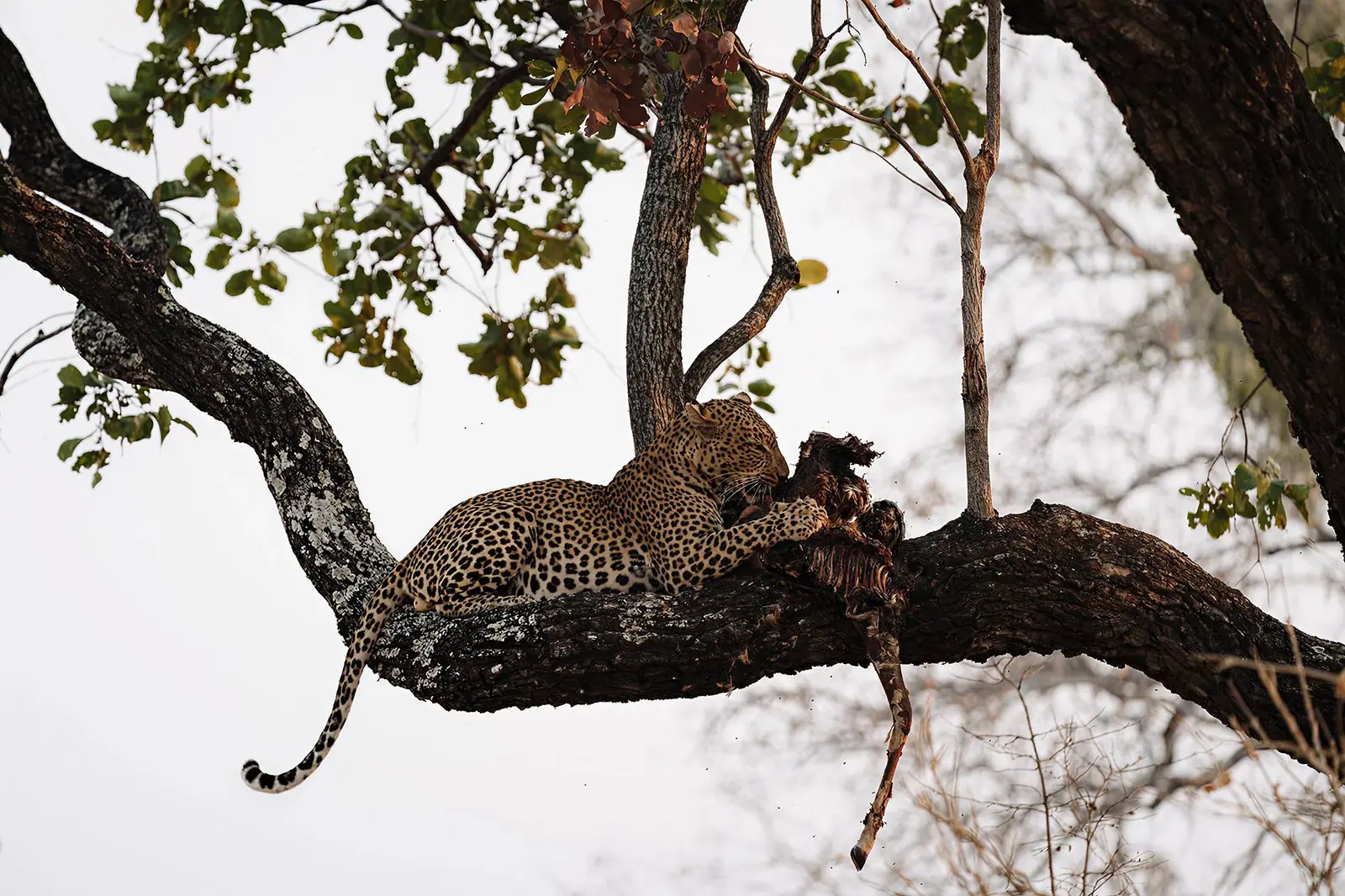 Photo: The Bushcamp Company
South Luangwa, Zambia: best all-round
If you want the most wildlife and the widest variety on a typical morning walk, South Luangwa is hard to beat. The park is known for having one of the largest concentrations of wildlife in southern Africa [11], and its Nsefu sector has some of the highest recorded leopard densities in the region [1]. The Luangwa River and its lagoons hold large pods of hippo and attract herds of elephant and buffalo through the dry season.
The valley also has animals found almost nowhere else. Thornicroft's giraffe live only in the Luangwa Valley, with a wild population of only about 550 [2]. Cookson's wildebeest and Crawshay's zebra are local forms of the valley too [1]. The Luangwa and the neighboring Mid-Zambezi Valley hold Zambia's largest lion and wild dog populations [3].
What makes South Luangwa stand out for walkers is the combination of that density with how many camps walk. It has 24 walking-led camps, the most of any park we track, where walks run every day as an equal to the game drive [12]. Walks are led by a licensed guide with an armed scout from the Department of National Parks and Wildlife.
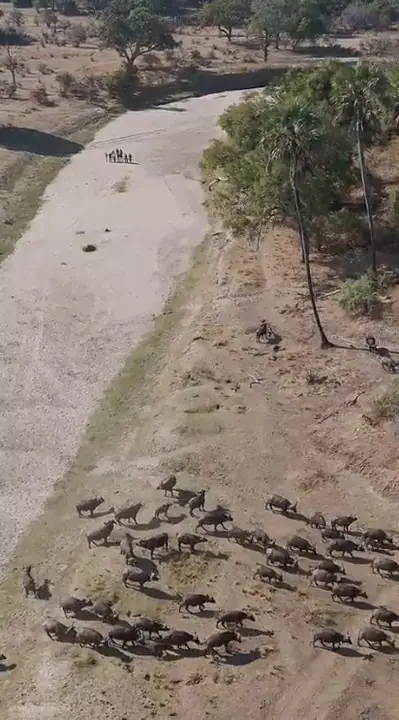 Photo: The Bushcamp Company
Best for: first-time walkers, anyone who wants a lot of variety, and leopard on the evening drive. Less suited to: anyone set on rhino, which are no longer found here [1].
Mana Pools, Zimbabwe: best walking ground
Mana Pools may be the most beautiful place in Africa to walk. Its woodland of mahogany, ebony, wild fig and acacia beside the Zambezi has little undergrowth, so walkers can see well ahead [4]. Walking has been encouraged here since the park opened in 1963, and the animals are relatively relaxed with people on foot [4].
Elephants are the stars. Bulls are often watched on foot at close range, and toward the end of the dry season some stand on their hind legs to reach the albida seedpods, a sight Mana Pools is famous for [4]. The park is also a stronghold for wild dogs, and its packs are known for being unusually comfortable with walkers [4][5]. Wild dog numbers have gone through hard times, though: the park's population fell sharply in the decade to 2020 [13].
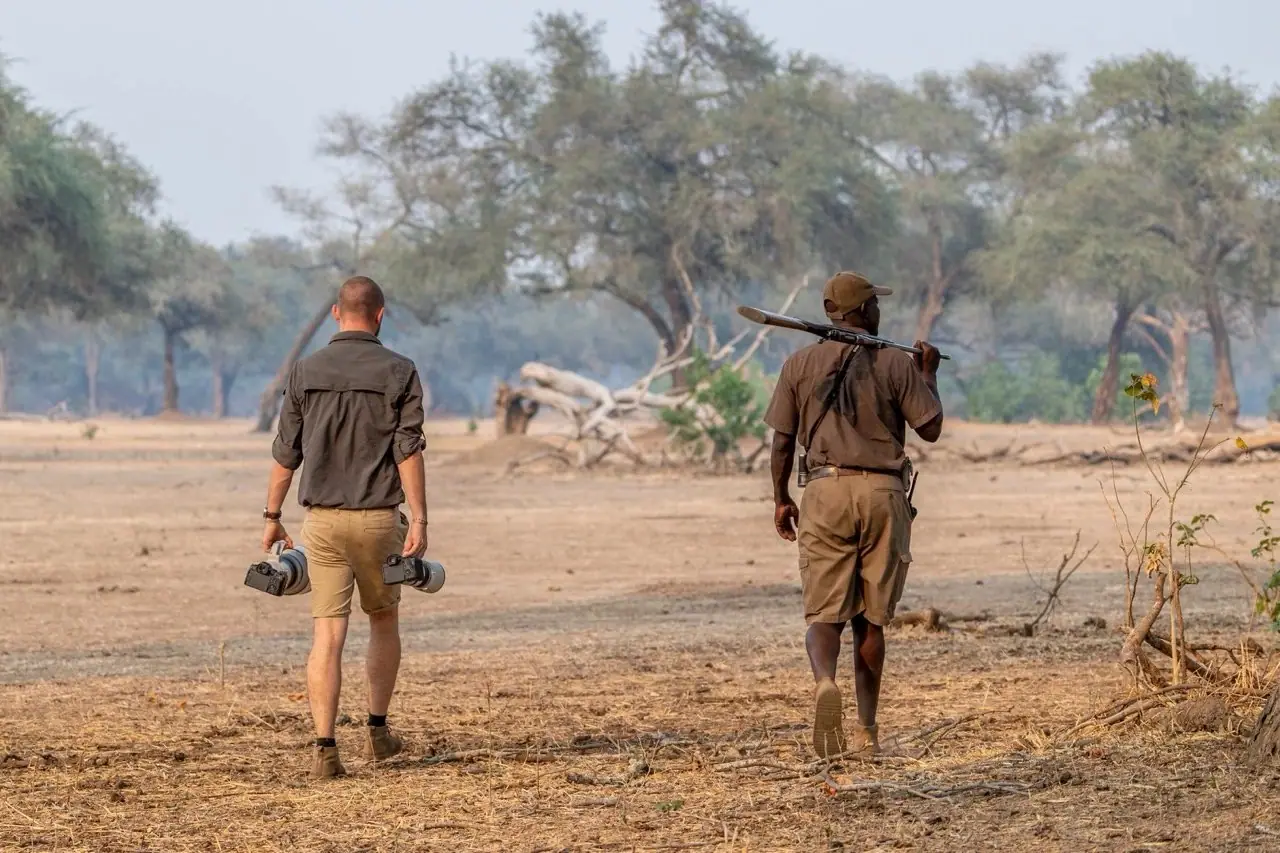 Photo: Mana Pools Expeditions Company
Mana Pools has fewer animals and less variety than South Luangwa. It has no giraffe and no rhino [4]. But for the experience of walking itself, many guides would put it first.
Best for: experienced walkers, photographers and anyone who loves elephants. Less suited to: anyone who wants the widest variety of animals.
Greater Kruger and Hluhluwe-iMfolozi, South Africa: best for rhino
If seeing a rhino on foot is high on your list, South Africa is the place. Hluhluwe-iMfolozi was the base of Operation Rhino in the 1950s and 1960s, which saved the southern white rhino from extinction, and it still protects one of the densest rhino populations in Africa [7]. Guided wilderness trails cross its roadless interior on foot [7].
Kruger also offers walking among rhino, though poaching has taken a heavy toll. By the end of 2022 the park held about 1,850 white rhino and about 210 black rhino [6]. Both parks hold the full range of large mammals, including lion and leopard.
Best for: rhino, and walkers who want a shorter flight from Johannesburg. Less suited to: anyone looking for a remote, uncrowded park. Kruger is busy, though its walking concessions are quiet.
Hwange, Zimbabwe: biggest elephant herds
Hwange is elephant country. Estimates put its population at around 40,000, and in the dry season, from about July to October, herds gather at its waterholes in large numbers [8]. It is also one of the best places in Africa for wild dogs, with an estimated 200 dogs in more than 30 packs [5].
Best for: big elephant herds and wild dogs. Less suited to: walkers who want river scenery. Hwange's game centers on waterholes in dry woodland and grassland.
Ruaha and Nyerere, Tanzania: lions and wilderness
Southern Tanzania's big parks are vast and lightly visited. Ruaha is Tanzania's largest safari park and is said to hold about 10% of the world's remaining lions, with prides sometimes larger than 20 [9]. Wild dogs are found there too. Walking is offered at several Ruaha and Nyerere camps, often with fly camps reached on foot.
Best for: big lion prides and a real sense of wilderness. Less suited to: walkers who want a dense, varied concentration of game on every walk.
North Luangwa, Zambia: the wildest walking
North Luangwa is one of Africa's most remote walking destinations, with very few camps. Game is thinner than in South Luangwa, but the park has Zambia's largest elephant population, and it is the only place in Zambia with black rhino, reintroduced from 2003 onward [10]. Walkers come here for the wilderness, not for the numbers, and should not expect to see rhino.
Best for: experienced walkers who want solitude. Less suited to: a first walking safari.
Honorable mentions
- Botswana: walking is not allowed in Moremi or most national parks, but private concessions in the Okavango and Linyanti offer walks in superb game country. See Walking in Botswana.
- Kenya: walking happens on conservancies and private ranches, notably in Laikipia, which is also good for wild dogs [5]. See Walking Safaris in Kenya.
The bottom line
For most travelers, especially on a first walking safari, South Luangwa offers the best game viewing on foot. It has the density and variety to make every walk worthwhile, a few animals found almost nowhere else, and more walking camps than any other park. Mana Pools is the walker's walk, with the most beautiful walking ground in Africa and memorable elephants. South Africa is the place for rhino. The best trip of all may combine two of them.
From The Bushcamp Company's Guide to the Luangwa: Guide to South Luangwa Wildlife · Why South Luangwa Is One of Africa's Best Places to See Leopards
Publisher's note. WalkingSafaris.com is published by The Safari Heritage Collection, which runs walking camps in South Luangwa, one of the parks discussed here. Every park and camp is assessed on the same published criteria. Who we are
Sources
- Wikipedia, South Luangwa National Park — https://en.wikipedia.org/wiki/South_Luangwa_National_Park
- Wikipedia, Thornicroft's giraffe — https://en.wikipedia.org/wiki/Thornicroft%27s_giraffe
- Zambian Carnivore Programme, Luangwa Valley Ecosystem — https://www.zambiacarnivores.org/luangwa-valley
- Expert Africa, Mana Pools National Park — https://www.expertafrica.com/zimbabwe/mana-pools-national-park
- Africa Geographic, The 6 top places to see painted wolves (September 2025) — https://africageographic.com/stories/the-6-top-places-to-see-painted-wolves/
- Africa Geographic, Kruger rhino population update: losses continue — https://africageographic.com/stories/kruger-rhino-population-update-losses-continue/
- Africa Geographic Travel, Hluhluwe-iMfolozi Park — https://travel.africageographic.com/destinations/south-africa/kwazulu-natal/zululand/hluhluwe-imfolozi-park
- AFKTravel, 15 things you didn't know about Hwange National Park — https://afktravel.com/57239/15-things-didnt-know-hwange-national-park/
- Asilia Africa, 5 reasons to visit Ruaha — https://www.asiliaafrica.com/5-reasons-visit-ruaha/
- Save the Rhino, North Luangwa Conservation Programme — https://www.savetherhino.org/programmes/north-luangwa-conservation-programme/
- Zambia Tourism, South Luangwa National Park — https://www.zambiatourism.com/destinations/national-parks/south-luangwa-national-park/
- walkingsafaris.com camp directory (October 2026), compiled from operator websites and Expert Africa's South Luangwa listings — https://www.expertafrica.com/zambia/south-luangwa-national-park
- The Herald, Zimbabwe "painted dog" populations plummet in Mana Pools National Park (July 2020) — https://www.heraldonline.co.zw/zimbabwe-painted-dog-populations-plummet-in-mana-pools-national-park/
Spotted an error? Tell us. How we classify camps: our methodology.