
Plan
South Luangwa vs Mana Pools: Which Is Better for Walking?
Both parks put walking at the center of the safari; they differ in scale, in who carries the rifle, and in what happens after dark.
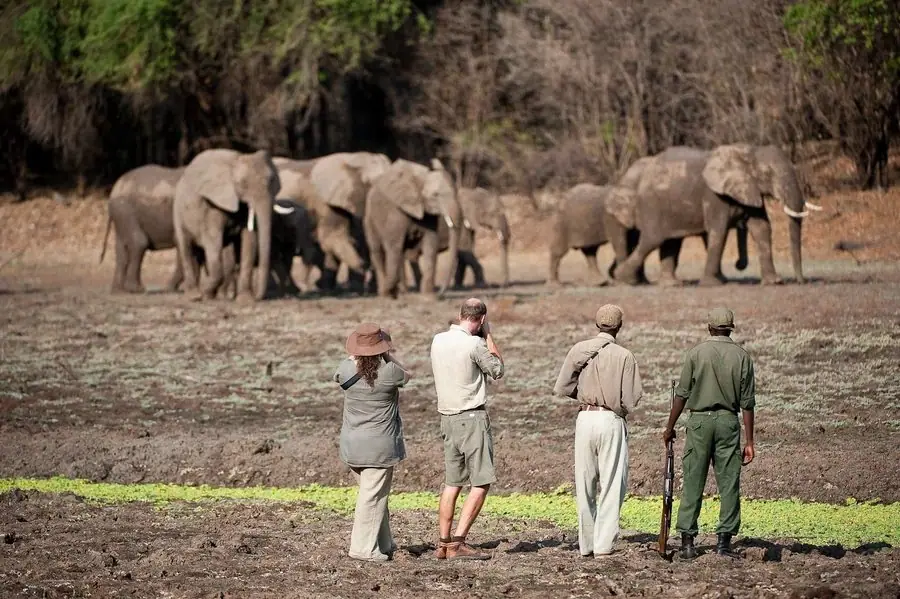 Photo: The Bushcamp Company
Two walking-first parks
South Luangwa and Mana Pools are the two parks in southern Africa where walking is most clearly a way of life rather than an extra. Counted on the same criteria, about half of South Luangwa's commercial camps make walking a daily core activity [1]. In Mana Pools the share is higher, at roughly two-thirds to three-quarters [2].
Scale is the first real difference. South Luangwa has 24 walking-led camps, more than any other park we assess, spread across several operators and several parts of a 9,050 km² (some 2.2 million acres) park [1][4]. Mana Pools has a higher share on a smaller base: about two dozen commercial camps in and around the park, most of which walk [2]. In Luangwa you have more choice of camp and area. In Mana, almost wherever you stay, walking is close to the center of the day.
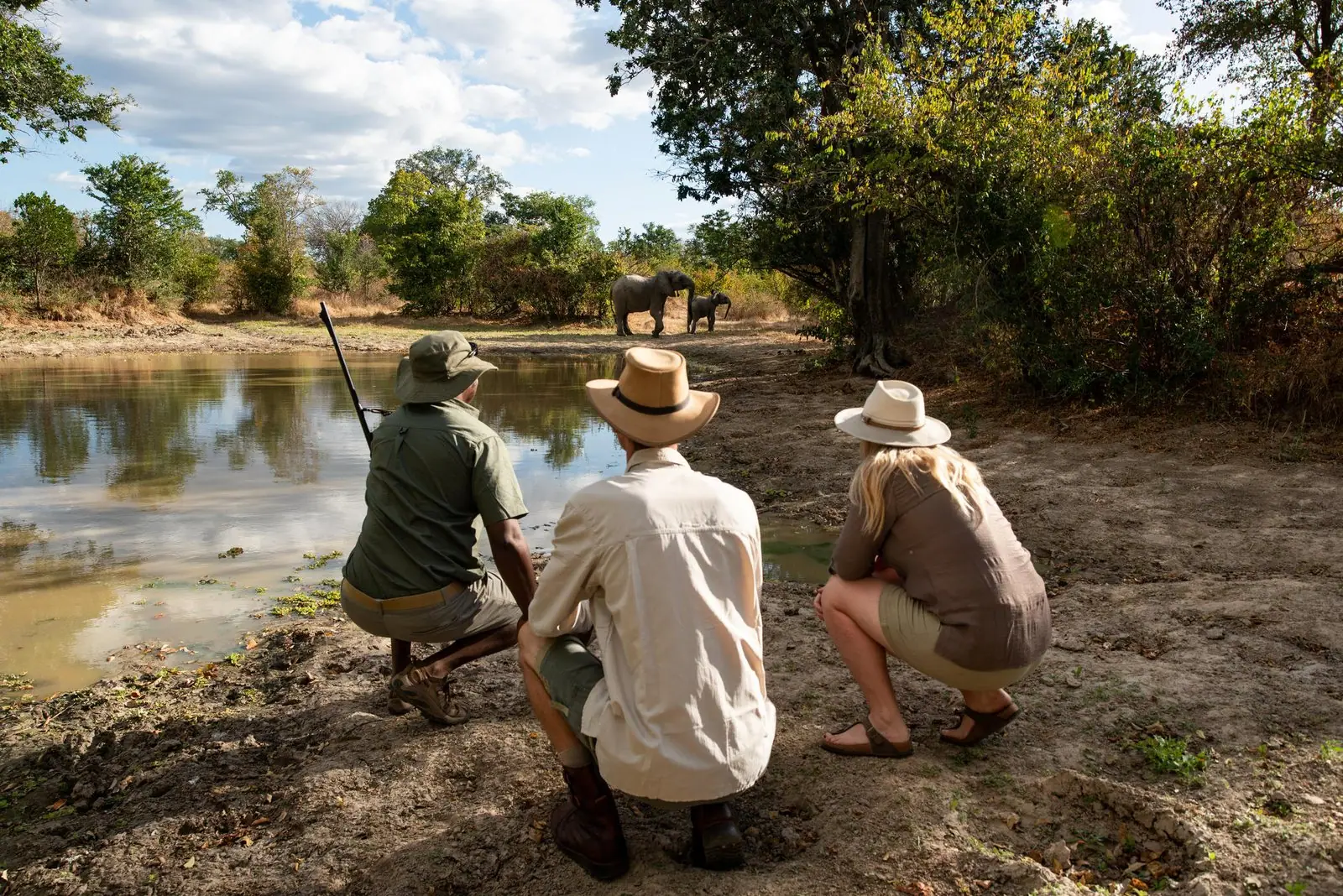 Photo: Mana Pools Expeditions Company
Who leads the walk
The two countries handle safety differently, and both work.
In South Luangwa, every walk inside the national park goes out with a licensed walking guide and an armed scout from the Department of National Parks and Wildlife (DNPW). Zambian guides train for about two years to earn a walking license [5]. The guide interprets; the scout, a government wildlife officer, carries the rifle [5].
In Mana Pools, the guide and the rifle are the same person. Walks from camps are led by an armed Zimbabwe Professional Guide, a license widely regarded as one of the most demanding in Africa. It requires at least two years' apprenticeship, a dangerous-game shooting proficiency test, an oral board and a seven-day practical exam [6][7].
Group sizes are similar in both places: usually six to eight walkers at most.
How the walking feels
The two parks also walk differently, and travelers who have done both often say so.
In Zambia, walks tend to be slower and more interpretive. A walk typically covers about 3–5 km, sometimes a little more, between sunrise and mid-morning, and much of the attention goes to tracks, bones, dung, birds and plants. Approaching big game is not the aim, though it does happen [14]. Because the scout watches for animals, the guide is free to stop and explain as the walk goes.
In Mana Pools, walks are often shorter in distance and more purposeful. A guide who finds fresh lion or wild dog tracks may follow them to get close to the animals, and decades of walking on the floodplain have made many animals relaxed around people on foot [14]. Park rules still apply: no closer than 30 meters to elephants, lions, painted dogs or dens [15]. Guides tend to share more of the interpretation afterward rather than on the move [14].
Neither style is better. Luangwa suits walkers who want to learn to read the bush; Mana suits walkers who want close, quiet encounters with large animals on open ground.
Will you see other people?
Mana Pools' central floodplain is a public park with campsites, self-drive visitors and permitted unguided walkers, so in the busy months you may see vehicles and other walking parties during the day. The park manages this with clear rules: a maximum of five vehicles or twelve people on foot at a sighting, a 20-minute limit when others are waiting, and no tagging onto (shadowing) other walking groups [15]. Camps on private concessions and in the more remote parts of the park see fewer people.
In South Luangwa there is no unguided walking, so every group on foot is a guided party with a scout. Game-drive traffic is busiest in the part of the park nearest the main gate at Mfuwe; walks from camps in the remote north and south of the park meet few other people.
Terrain and visibility
Mana's signature is its floodplain. Old river terraces along the Zambezi carry open woodland of Ana trees (Faidherbia albida), with mahogany, figs and ebony [8]. You can see a long way on foot, and the elephant bulls that feed on fallen Ana pods late in the dry season are a famous sight. Inland, at places such as Chitake Spring, the country is rougher and the walking more intense [9].
South Luangwa is more varied. Mopane woodland covers much of the valley floor, with grassland, floodplain and lagoons near the meandering river [4]. On a walk you may cross dry sandy riverbeds and rocky ground [5]. Sightlines are shorter in woodland than on Mana's open terraces, so the walking tends to be closer and more about tracks, plants and the small life of the bush, with large animals met as the ground allows.
Neither is better. Mana gives you long views and open floodplain walking. Luangwa gives you variety, and more of it.
Night drives
This is the clearest practical difference. Night drives are permitted in South Luangwa and offered at nearly every walking camp there, including all of The Bushcamp Company's camps [10]. Because walks end before dark, the usual Luangwa day is a morning walk and an afternoon drive that runs on into a spotlit night drive. It is one reason walking and driving work as equals there.
In Mana Pools, self-drive visitors may not drive after dark [11]. Night drives run only where camps on private concessions in or around the park offer them, such as Ruckomechi and Chikwenya [3]. If a night drive matters to you, check before you book.
Walking on your own
Mana Pools is one of very few big-game parks in Africa where visitors may walk without a guide. Unguided walking was banned in May 2015, and the ban was lifted that August in favor of a daily walking permit [12]. Most visitors still walk with a Professional Guide, and that is our advice for anyone without long bush experience.
South Luangwa does not allow unguided walking. Every walk is guided and escorted.
Self-guided walking of this kind, and self-catering camping, are not covered here.
Seasons
South Luangwa's walking season runs roughly from June to October. Some camps open in late May and close in November, and walking stops when the rains come [1].
Mana Pools camps generally open from April to November and close from December to March, when the rains make roads and airstrips unreliable [8]. August to October is the peak. October is very good and very hot, often above 40°C (104°F) [8].
For a single trip in the heart of the dry season, both work. Mana opens a little earlier in the year.
Access
South Luangwa is one of the easier remote parks to reach. There are scheduled flights from Lusaka to Mfuwe, near the main park gate [13], and road transfers from there to the camps.
Mana Pools is mostly reached by light aircraft to one of the park's dirt airstrips, usually from Harare, Victoria Falls or another park, with a 4x4 transfer to camp [8]. Overland access is long and rough, and access is limited to the dry season [8].
Choose South Luangwa if…
- You want walking and game drives as equals, with a night drive most evenings.
- You want the widest choice of walking camps, operators and areas in one park.
- You prefer the two-person model of guide and armed government scout.
- You want slow, interpretive walking that teaches you to read tracks and the small life of the bush.
- You want simpler access through scheduled flights.
- You want to combine several small camps in one trip.
- You want to walk with some of Africa's most experienced walking guides, trained in the valley where the walking safari began.
- You want to walk through a variety of habitats in a single morning: floodplains, oxbow lagoons, riverine forest and open grassland.
- You want to see a wide assortment of wildlife, from elephant, buffalo, hippo and Thornicroft's giraffe to puku, zebra and the birds of the lagoons.
Choose Mana Pools if…
- You want walking to be the heart of almost every day, wherever you stay.
- You want open floodplain walking with long sightlines and the Ana-tree elephants.
- You value being led by a Zimbabwe Professional Guide who carries the rifle.
- You want purposeful walking that follows tracks to close, quiet encounters with large animals.
- You can travel in April or May, before most Luangwa bushcamps open.
- You are an experienced walker drawn to intense inland walking such as Chitake.
Many keen walkers end up doing both, in different years. They are complementary, not rivals.
From The Bushcamp Company's Guide to the Luangwa: Where Is the Best Walking Country in South Luangwa?
Publisher's note. WalkingSafaris.com is published by The Safari Heritage Collection, custodians of Chibembe and owners of Lion Camp and The Bushcamp Company. Some of our camps appear in this article, and they are assessed on exactly the same published criteria as every other camp in Africa. Who we are
Sources
- Expert Africa, South Luangwa National Park (lodges and camps) — https://www.expertafrica.com/zambia/south-luangwa-national-park
- Expert Africa, Mana Pools National Park (lodges and camps) — https://www.expertafrica.com/zimbabwe/mana-pools-national-park
- Expert Africa, Ruckomechi — https://www.expertafrica.com/zimbabwe/mana-pools-national-park/ruckomechi-camp ; Go2Africa, Chikwenya — https://www.go2africa.com/accommodation/chikwenya
- Wikipedia, South Luangwa National Park — https://en.wikipedia.org/wiki/South_Luangwa_National_Park
- Kafunta Safaris, Walking safari Zambia: what to know — https://kafuntasafaris.com/walking-safari-zambia-what-to-know/
- Zimbabwe Professional Guides Association, Education — https://zpga.org/areas-of-focus/education/
- Expert Africa, Zimbabwe safari guides — https://www.expertafrica.com/zimbabwe/info/zimbabwe-safari-guides
- Expert Africa, Mana Pools (access, season and climate) — https://www.expertafrica.com/zimbabwe/mana-pools-national-park
- Africa Geographic, Chitake Springs — https://travel.africageographic.com/destinations/zimbabwe/chitake-springs
- The Bushcamp Company, Night Drives — https://bushcampcompany.com/products/night-drives
- Yellow Zebra Safaris, Mana Sands (night-drive rule) — https://yellowzebrasafaris.com/zimbabwe/accommodation/mana-sands/
- Tourism Update, Mana Pools bans unguided walks (2015) — https://www.tourismupdate.com/article/mana-pools-bans-unguided-walks ; Mana Pools Code of Conduct — https://www.manapools.com/wp-content/uploads/2022/04/Mana-Pools-Code-of-Conduct.pdf
- South Luangwa Safaris, Getting to South Luangwa — https://www.southluangwasafaris.com/south-luangwa/directions-south-luangwa/
- Yellow Zebra Safaris, The best walking safaris: Zimbabwe vs. Zambia (2025) — https://yellowzebrasafaris.com/us/inspiration/safari-insights/the-best-walking-safaris-zimbabwe-vs-zambia/
- ZimParks, Mana Pools Code of Conduct for Visitors (revised January 2023) — https://www.zamsoc.org/s/Mana-Pools-Code-of-Conduct-for-Visitors-revised-2023.pdf
Spotted an error? Tell us. How we classify camps: our methodology.