
Why Walk
What Is a Walking Safari?
A walking safari is a guided journey on foot through wild, unfenced country, led by trained and armed professionals, and it shows you Africa at the scale of footprints rather than horizons.
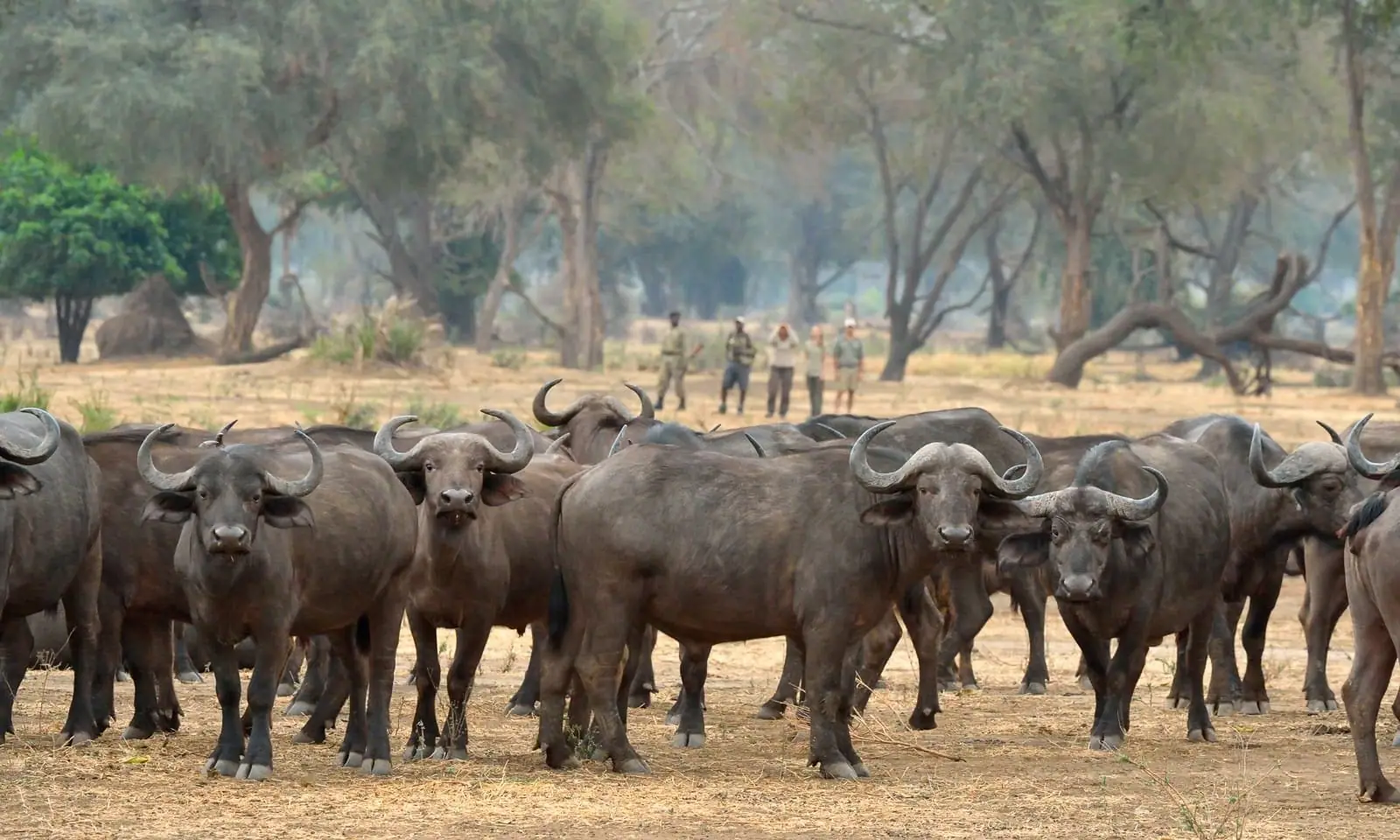 Photo: Chiawa Safaris
The short definition
On a conventional safari you watch from a vehicle. On a walking safari you leave the vehicle behind and move through the bush on foot, at walking pace, with a guide who reads the ground as you go. You are not hiking to a viewpoint. The walk itself is the point: the tracks in the sand, the smell of a recent elephant, the alarm call of a bird that has seen something you have not, and the slow work of piecing together what happened overnight.
A walk is not about getting close to large animals. A good guide keeps a respectful distance and reads the animal's mood. What you gain is attention. On foot, everything is closer to you and nothing is behind glass.
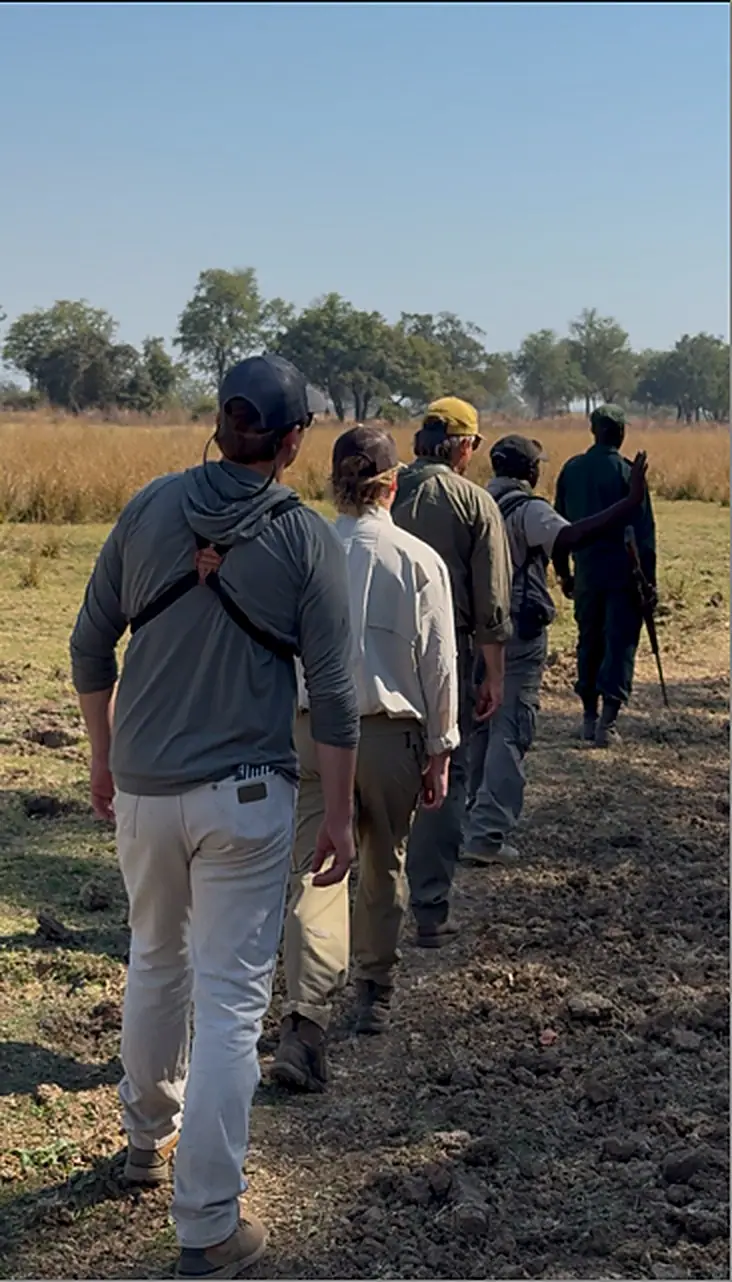 Photo: The Bushcamp Company
How a walk works
Most walks start early, soon after first light, when it is cool and animals are active. Before setting out, the guide gives a safety briefing on how the group moves and what to do if you meet an animal [1][2].
The group walks in single file. The guide leads, and in Zambia an armed government scout from the Department of National Parks and Wildlife (DNPW) walks with the group [1]. Walkers keep quiet and keep together. Guides often teach a few simple hand signals before setting out, so they can direct the group without talking [4].
Much of the time is spent learning as you go. The guide stops to read tracks, to show you dung beetles and ants at work, or to point out the signs left by animals that moved through in the night [1]. Walks move at a deliberately slow pace [1]. In Zambia a tea bearer often walks with the group as well [3].
Most walks in a camp last three to four hours and often end at a vehicle that brings the group back in time for lunch.
The three formats
Not every walking safari is built the same way. This site uses three terms, and they describe how a trip is built, not how good it is.
- Walking Expedition. Walking is the whole trip: mobile walking camps, trails camps and multi-day walks. Vehicles are used only for transfers. This format suits committed walkers.
- Walking Camp. A fixed or seasonal camp offers guided walks every day as an equal choice with game drives, and guests choose each day. Walks end before dark, so evenings are drives. This is the best fit for most travelers.
- Walks Offered. A walk is available on request or is secondary to the drive, and is often short.
Where walking is done well
Walking safaris exist across eastern and southern Africa, but in a handful of places walking is central to how visitors see the park.
- South Luangwa, Zambia. About half of the park's commercial camps make walking a daily core activity, and it has 24 walking-led camps, more than any other park [5]. A licensed guide and an armed DNPW scout go on every walk, and night drives are permitted inside the park.
- Mana Pools, Zimbabwe. Roughly two-thirds to three-quarters of commercial camps here are walking-led [5]. Walks cross open floodplain woodland of Ana trees (Faidherbia albida), which gives walkers unusually good sightlines. Walks are led by armed, licensed Professional Guides [6].
- Kruger, South Africa. SANParks runs seven wilderness trails (Wolhuter, Olifants, Nyalaland, Bushman, Sweni, Napi and Mathikithi). Each is a three-night trail for a maximum of eight walkers aged 12 to 65, with up to 20 km (about 12 miles) of walking a day [7]. These are state-run trails, not commercial camps. In the private reserves around Kruger, walking is usually an optional extra to the drive.
- Hwange, Zimbabwe. A smaller group of Walking Camps operates in the private concessions [5].
- Ruaha and the Serengeti, Tanzania. Walks in national parks go out with an armed national parks (TANAPA) ranger, with a reported cap of six guests [8].
- Kenya. Walking is not allowed in most national parks and reserves, but conservancies and ranches in areas such as Laikipia offer guided walks and multi-day walking trips [9].
A short history
People have always crossed Africa on foot. The walking safari as something visitors could book has a more recent history.
In South Africa, Ian Player and Magqubu Ntombela led the first official wilderness trail in iMfolozi on March 19, 1959 [10]. Player believed that wild country, met on foot, changes the person walking through it.
In Zambia, Norman Carr opened the first public game-viewing camp in what was then Northern Rhodesia around 1950. In 1961 he launched the first commercial walking safari circuit, in the Luangwa Valley [11]. Carr was convinced that wildlife survives only when the people who live alongside it have reason to protect it.
Kruger followed with its first wilderness trail, the Wolhuter, in July 1978 [7].
Is it for you?
If you are reasonably fit, patient and curious, almost certainly. You do not need to be an athlete. Most people who try a walk in a Walking Camp find it becomes the part of the day they look forward to most. If you already know you want to walk all day, look at a Walking Expedition instead.
Sources
- Kafunta Safaris, Walking safari Zambia: what to know — https://kafuntasafaris.com/walking-safari-zambia-what-to-know/
- Responsible Travel, Safety and practicalities on a walking safari — https://www.responsibletravel.com/holidays/walking-safaris/travel-guide/safety-and-practicalities
- Zambia Tourism, Tafika Walking Trails — https://www.zambiatourism.com/listing/tafika-walking-trails
- Rhino Africa, Top 5 questions about walking safaris answered — https://blog.rhinoafrica.com/2024/05/28/5-things-about-walking-safaris-you-should-know/
- walkingsafaris.com research, walking share of commercial camps by park (Oct 2026), compiled from tour operator and agent listings
- Zimbabwe Professional Guides Association, Education — https://zpga.org/areas-of-focus/education/
- SANParks, Kruger Wilderness Trails — https://www.sanparks.org/parks/kruger/what-to-do/activities/wilderness-trails
- Expert Africa, Walking safaris in Tanzania — https://www.expertafrica.com/walking-safaris/tanzania
- Expert Africa, Walking safaris in Kenya — https://www.expertafrica.com/walking-safaris/kenya
- Wilderness Leadership School, About — https://www.wildernesstrails.org.za/about
- Legends & Legacies of Africa, Norman Carr — https://legendsandlegaciesofafrica.org/normancarr.php
Spotted an error? Tell us. How we classify camps: our methodology.