
Stories
Walking Safaris Take You Away from the Crowds
In some of Africa's best-known parks, the hardest thing to find at a sighting is space. On foot, space is the whole point.
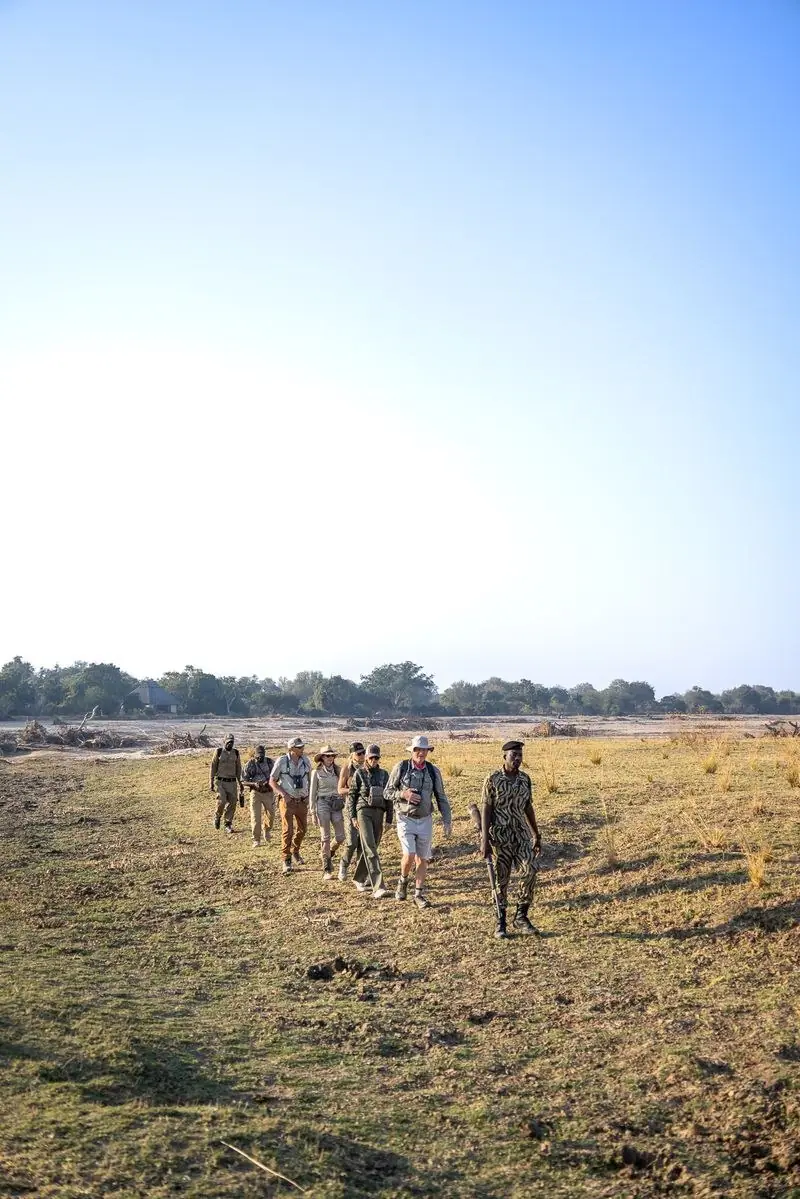 Photo: Chibembe Wildlife Reserve
The crowded side of the safari
There is nothing wrong with a famous park. The Serengeti and the Maasai Mara are famous for good reasons, and millions of people have had the trip of a lifetime there. But their popularity has a cost, and travelers increasingly notice it.
In the Serengeti, visitor numbers keep climbing: close to half a million visitors in the 2024/25 financial year, up from about 430,000 the year before [7]. At peak times, Tanzania's parks authority has had to act on overcrowding, reckless driving and delays at entry points, with plans for booking systems and special fee zones [1].
In the Maasai Mara National Reserve there is no general limit on vehicles at a sighting, and researchers studying cheetahs have documented more than 30 vehicles gathered around a single animal [2]. Their work found that cheetah mothers in high-tourism areas raised fewer cubs to independence than mothers in quieter areas [2]. Kruger, South Africa's flagship park, now sets daily quotas for day visitors during the festive season to keep roads and rest camps from overflowing [3].
None of this means you should skip these places. It means that if what you want is quiet, you need to plan for it.
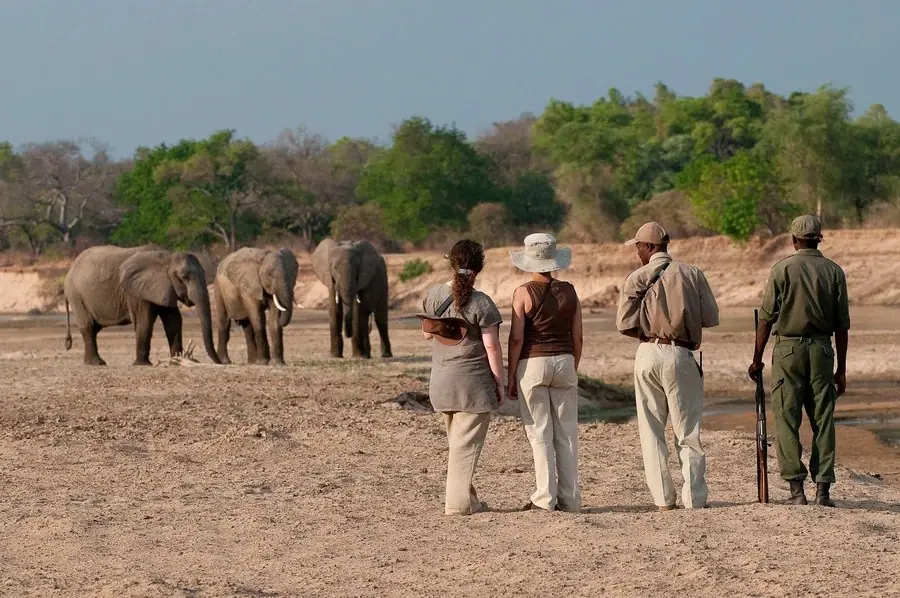 Photo: The Bushcamp Company
Why walking changes the picture
You leave the roads. A vehicle mostly stays on tracks, and the tracks are where everyone else is. On foot, you go where the vehicles cannot: along a dry riverbed, across an open plain, through a grove of ebony trees. The animals you meet are usually going about their day, not waiting out a ring of engines.
The group is small. A walking safari is the opposite of a crowd by design. In Zambia's national parks, walks go out with a licensed guide and an armed scout from the Department of National Parks and Wildlife, with only a handful of guests [8]. Six to eight walkers is a common limit, and many walks are smaller.
The sighting is yours. When you find a herd of buffalo or a family of elephants on foot, there is usually no one else there. You watch quietly, at a respectful distance, for as long as the animals and your guide allow. Then you move on, and the bush closes behind you.
 Photo: The Bushcamp Company
The silence is real. Without an engine and a radio, you notice how quiet the bush is, and how full of small sounds. For many walkers, this is the part of the trip they did not know they were missing.
Where to find the quiet on foot
Some parks are quieter by nature, and walking is part of everyday life in them.
South Luangwa, Zambia covers 9,050 square kilometers (some 2.2 million acres) of unfenced river valley and is known for having few tourists relative to its size [6]. It is where the walking safari began, and it has 24 walking-led camps, the most of any park we track [5]. Many of the smaller bushcamps sit in remote parts of the park, away from the main roads.
Mana Pools, Zimbabwe is remote, seasonal and lightly visited, with open floodplain that is ideal for walking.
North Luangwa, Zambia has only a handful of camps across a vast area. You are unlikely to see another group all week.
Greater Kruger, South Africa is busier overall, but walking-focused private camps and the multi-night wilderness trails take you well away from the roads.
How to find the quiet
- Choose the format first. A Walking Camp or Walking Expedition puts you on foot every day. A lodge that only offers walks as an add-on puts you back on the busy roads most of the time.
- Go to a park that walks. Parks where walking is a core activity, such as South Luangwa, Mana Pools and North Luangwa, give you quiet country to walk in.
- Pick small camps. Bushcamps with a handful of rooms mean small walking groups and fewer vehicles nearby.
- Travel in the shoulder months. Early and late season are quieter everywhere. In South Luangwa, walking runs through the dry season, roughly June to October.
From The Bushcamp Company's Guide to the Luangwa: Why Staying Inside the Park Changes the Safari
 Photo: Chibembe Wildlife Reserve
Publisher's note. WalkingSafaris.com is published by The Safari Heritage Collection, which runs walking camps in South Luangwa, one of the parks discussed here. Every park and camp is assessed on the same published criteria. Who we are
Sources
- ATTA, Tanzania tackles tourist congestion in Serengeti National Park (August 2024) — https://atta.travel/resource/tanzania-tackles-tourist-congestion-in-serengeti-national-park.html
- The Conversation, Why cheetahs in the Maasai Mara need better protection from tourists (2018) — https://theconversation.com/why-cheetahs-in-the-maasai-mara-need-better-protection-from-tourists-101123
- SAnews, Kruger National Park implements gate quotas to avoid overcrowding (December 2025) — https://www.sanews.gov.za/node/78845
- African Safaris, Vehicle congestion on safari in the Masai Mara (November 2022) — https://www.africansafaris.co.nz/blog/vehicle-congestion-on-safari-in-the-masai-mara/
- walkingsafaris.com camp directory (October 2026), compiled from operator websites and Expert Africa's South Luangwa listings — https://www.expertafrica.com/zambia/south-luangwa-national-park
- Zambia Tourism, South Luangwa National Park — https://www.zambiatourism.com/destinations/national-parks/south-luangwa-national-park/
- The Citizen, Serengeti reports increased tourism revenue (December 2025) — https://thecitizen.co.tz/tanzania/news/national/serengeti-reports-increased-tourism-revenue-5301784
- Kafunta Safaris, Walking safari Zambia: what to know — https://kafuntasafaris.com/walking-safari-zambia-what-to-know/
Spotted an error? Tell us. How we classify camps: our methodology.