
Why Walk
Who Leads Your Walk? Guide Licensing and Armed Escorts by Country
Every walking safari is only as good as the people at the front of the line, and each country decides differently who those people must be.
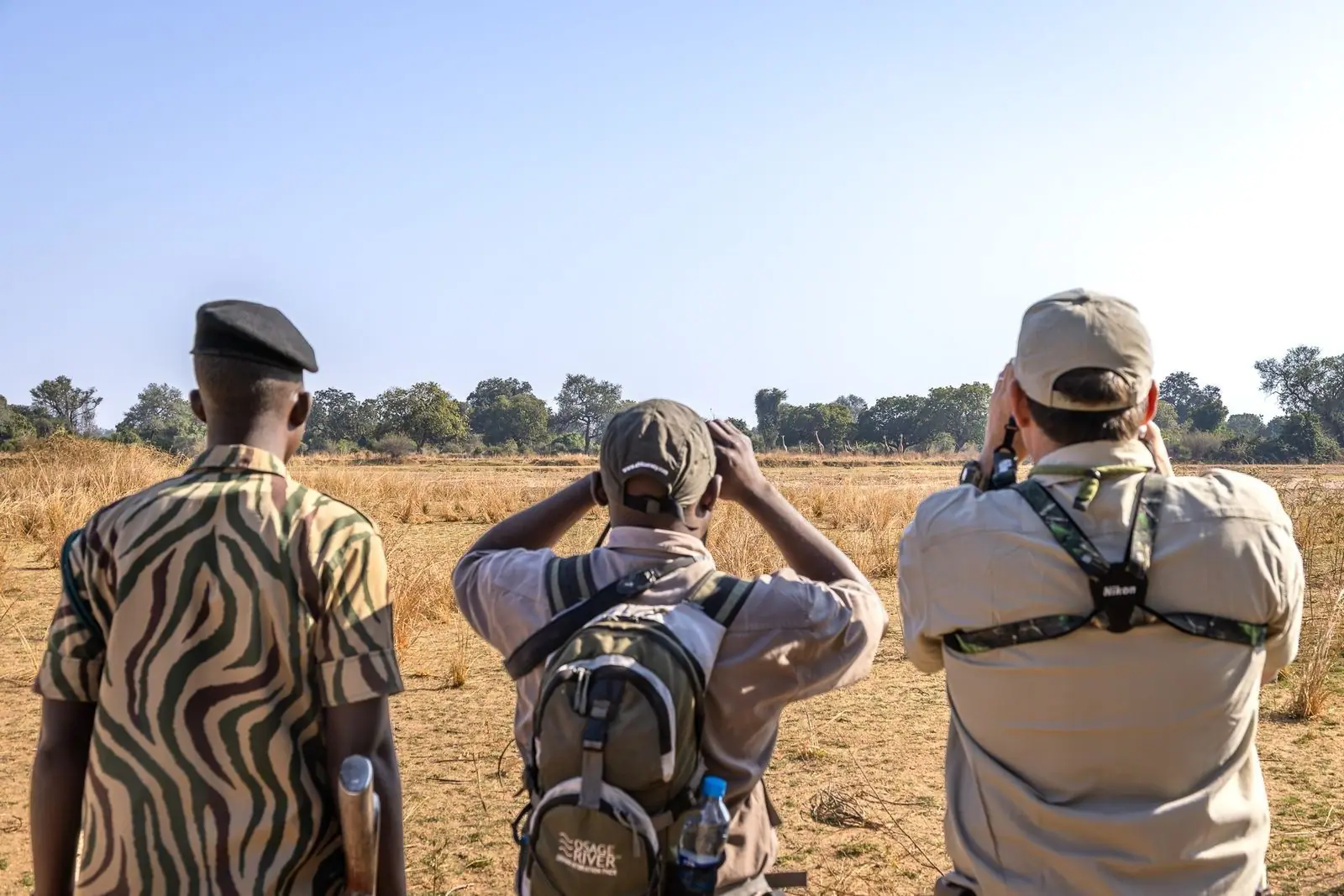 Photo: Chibembe Wildlife Reserve
Why it matters
On a game drive the vehicle does much of the work of keeping you safe. On foot, the guide does. A good walking guide reads the wind, the ground and the behavior of an animal long before you notice it, and keeps the group at a distance the animal will accept. The rifle is a last resort, and a well-led walk should never need it.
That is why walking guides train for years, and why most countries add a second armed person. The details differ by country, and they are worth knowing before you book.
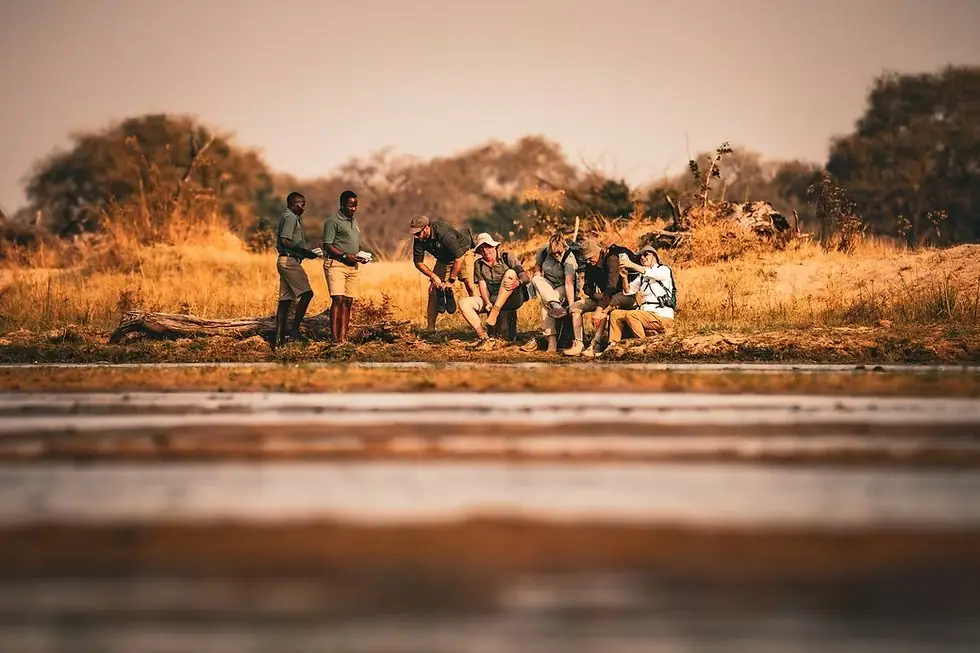 Photo: Classic Zambia
Zambia: a licensed guide plus a DNPW scout
Zambian guiding law sets out a Professional Guide's License and an Apprentice Professional Guide's License. An apprentice may not take clients on walks unless accompanied by a licensed professional guide [1]. The Zambia Wildlife Act of 2015 wound up the former Zambia Wildlife Authority, which issued those licenses, and transferred its functions to the Department of National Parks and Wildlife [2].
In practice, walking competence is tested in park-level guide exams. In the Lower Zambezi, for example, exams cover walking as a separate category, and wildlife scouts assess the walking components [3]. Zambian walking guides are commonly reported to train for about two years before earning a walking license [4].
The second person is the distinctive part. Operators describe an armed DNPW scout on every walk in a Zambian national park as standard practice [4]. The scout usually walks at the front, followed by the guide and then the guests [5]. The guide interprets and leads; the scout is the armed protection.
Zimbabwe: the Professional Guide
Zimbabwe asks one person to do both jobs. To walk guests in dangerous-game areas, a guide needs a full Professional Guide license from the national parks authority [6]. The path is long [7]:
- written learner exams, after which a learner may guide only from a vehicle [8];
- an apprenticeship of at least two years with a recognized safari company, often longer;
- a timed dangerous-game shooting test;
- an oral examination before a panel, with a logbook of experience;
- a seven-day practical proficiency exam, held once a year.
Industry sources describe the license as one of the most demanding in Africa, with high dropout and failure rates [6][9]. A walk at a Zimbabwean camp should therefore be led by a full Professional Guide, who carries the rifle. Mana Pools also allows unguided walking with a permit, which is a different matter covered in our rules guide.
South Africa: FGASA trails guides and armed backup
In South Africa, walking guides qualify through FGASA, the Field Guides Association of Southern Africa. A trainee starts as an Apprentice Trails Guide and logs 200 hours on foot: first as an observer, then walking as second rifle and first rifle, with at least 40 dangerous-game encounters [10]. After a practical assessment, the guide may walk as first rifle, the lead. Guides with the higher field-guide qualification hold Trails Guide status [10].
The senior grade is Professional Trails Guide. It requires at least 600 walking hours and 300 dangerous-game encounters, with at least ten in each of seven categories, from elephant and buffalo to lion or leopard, rhino and hippo out of water [11]. A further grade, SKS Dangerous Game, is recognized as qualified to supervise apprentices in dangerous-game areas [10].
Walks in South Africa usually have two armed people. The guided walks sold at Kruger's rest camps go out with two armed field guides [12], and one private walking camp in Kruger has its walks led by two armed guides [13].
Tanzania: an armed TANAPA ranger
In Tanzania's national parks, walks must include an armed ranger from Tanzania National Parks (TANAPA), and groups are reported to be capped at six guests [14]. In the Serengeti, the armed ranger is "not optional" [15]. Your guide leads and interprets; the ranger provides protection. Some walking specialists also arm their own guides, so a walk may have two rifles [16].
Guides themselves must be licensed, and operators need a TALA license to trade [17].
Kenya: KPSGA grades and armed rangers
Kenya's guiding standard is set by the Kenya Professional Safari Guides Association (KPSGA). Bronze is the entry level; Silver needs three more years as a Bronze member; Gold needs at least six years' practical experience and is rare [17]. These are general guiding grades, not walking certifications.
On a walk, the armed protection usually comes from rangers. Walking is mostly done in conservancies and on private ranches [18]. At one Laikipia conservancy, walking guides are armed conservancy rangers [19]. In the Mara conservancies, walks go out with armed community rangers [20]. In Tsavo East, walks must be accompanied by armed Kenya Wildlife Service rangers [21]. Some private guides hold their own full firearms license [18].
Botswana: armed guides in private concessions
Botswana's Department of Wildlife and National Parks issues a Professional Guide license, renewed annually, after theory and practical exams [22]. Walking is not permitted in Moremi Game Reserve, so walks take place in private concessions "where armed guides are permitted" [23]. At one Okavango walking camp, every walk is led by an armed guide [24].
Questions to ask before you book
- Who leads the walk, and what license does that guide hold?
- Who carries a rifle, and how many armed people walk with the group?
- How many guests walk with each guide?
- Does the same guide lead every walk during your stay?
A good camp will answer all four without hesitation.
From The Bushcamp Company's Guide to the Luangwa: Why South Luangwa's Guides Are Some of the Best in Africa
Sources
- ZambiaLII, Statutory Instrument No. 46 of 2003, Zambia Wildlife (Licences and Fees) Regulations — https://zambialii.org/akn/zm/act/si/2003/46/eng@2003-05-09/source
- UNEP LEAP, Zambia Wildlife Act, 2015 (No. 14 of 2015) — https://leap.unep.org/en/countries/zm/national-legislation/zambia-wildlife-act-2015-no-14-2015
- Zambia Tourism, Lower Zambezi guide exams (Conservation Lower Zambezi, April 2014) — https://www.zambiatourism.com/?p=9968
- Kafunta Safaris, Walking safari Zambia: what to know — https://kafuntasafaris.com/walking-safari-zambia-what-to-know/
- Safarigo, Walking safaris in South Luangwa: before you go — https://safarigo.com/guide/walking-safaris-south-luangwa-before-you-go-431
- Whole Earth Education, Becoming a professional guide in Zimbabwe — https://wholeeartheducation.com/becoming-a-professional-guide-in-zimbabwe/
- ZPGA, Education — https://zpga.org/areas-of-focus/education/
- Safaritalk, Julian Brookstein: Zimbabwe pro guide exam — https://www.safaritalk.net/articles.html/_/articles/julian-brookstein-zimbabwe-pro-guide-camp-hwa-r45
- Journeys by Design, Wildlife guiding in Zimbabwe — https://journeysbydesign.com/dispatch/194-wildlife-guiding-in-zimbabwe-rigorous-tough-inspiring
- FGASA, What do I need to begin my trails guide journey — https://www.fgasa.co.za/?p=1715
- FGASA, Professional Trails Guide (2023) — https://www.fgasa.co.za/wp-content/uploads/2023/11/FGASA-Professional-Trails-Guide-2023.pdf
- SANParks, Kruger guided walks — https://www.sanparks.org/parks/kruger/tourism/activities/walks.php
- Yellow Zebra Safaris, Plains Camp — https://yellowzebrasafaris.com/us/south-africa/accommodation/plains-camp/
- Expert Africa, Walking safaris in Tanzania — https://www.expertafrica.com/walking-safaris/tanzania
- Duma Explorer, Serengeti safari guide — https://www.dumaexplorer.com/blog/serengeti-safari-guide
- Expert Africa, Serengeti Walking Mobile Camp — https://expertafrica.com/tanzania/serengeti-migration-area/serengeti-walking-mobile-camp/in-detail
- Duma Explorer, Safari guide qualifications: FGASA, KPSGA and TALA — https://www.dumaexplorer.com/blog/safari-guide-qualifications-fgasa-kpsga-tala-wfr
- Expert Africa, Walking safaris in Kenya — https://expertafrica.com/walking-safaris/kenya
- Elewana, Lewa Safari Camp activities — https://elewanacollection.com/lewa-safari-camp/activities
- Africa Geographic, Mara conservancy or reserve — https://travel.africageographic.com/destinations/kenya/maasai-mara/mara-conservancy-or-reserve-guide
- Sheldrick Wildlife Trust, Ithumba Camp fact sheet — https://lodges.sheldrickwildlifetrust.org/s/Ithumba-Camp-Fact-Sheet.pdf
- Government of Botswana, Licence for professional guides — https://gov.bw/natural-resources-and-environment/license-professional-guides
- Expert Africa, Moremi Game Reserve — https://www.expertafrica.com/area/Moremi_Game_Reserve.htm
- Expert Africa, Shinde Footsteps — https://www.expertafrica.com/botswana/okavango-delta-safari-reserves/shinde-footsteps
Spotted an error? Tell us. How we classify camps: our methodology.