
Where to Walk
Lower Zambezi Walking Safari Guide
The Lower Zambezi is a river park first: most camps will walk you, but the canoe and the boat set the rhythm of the day.
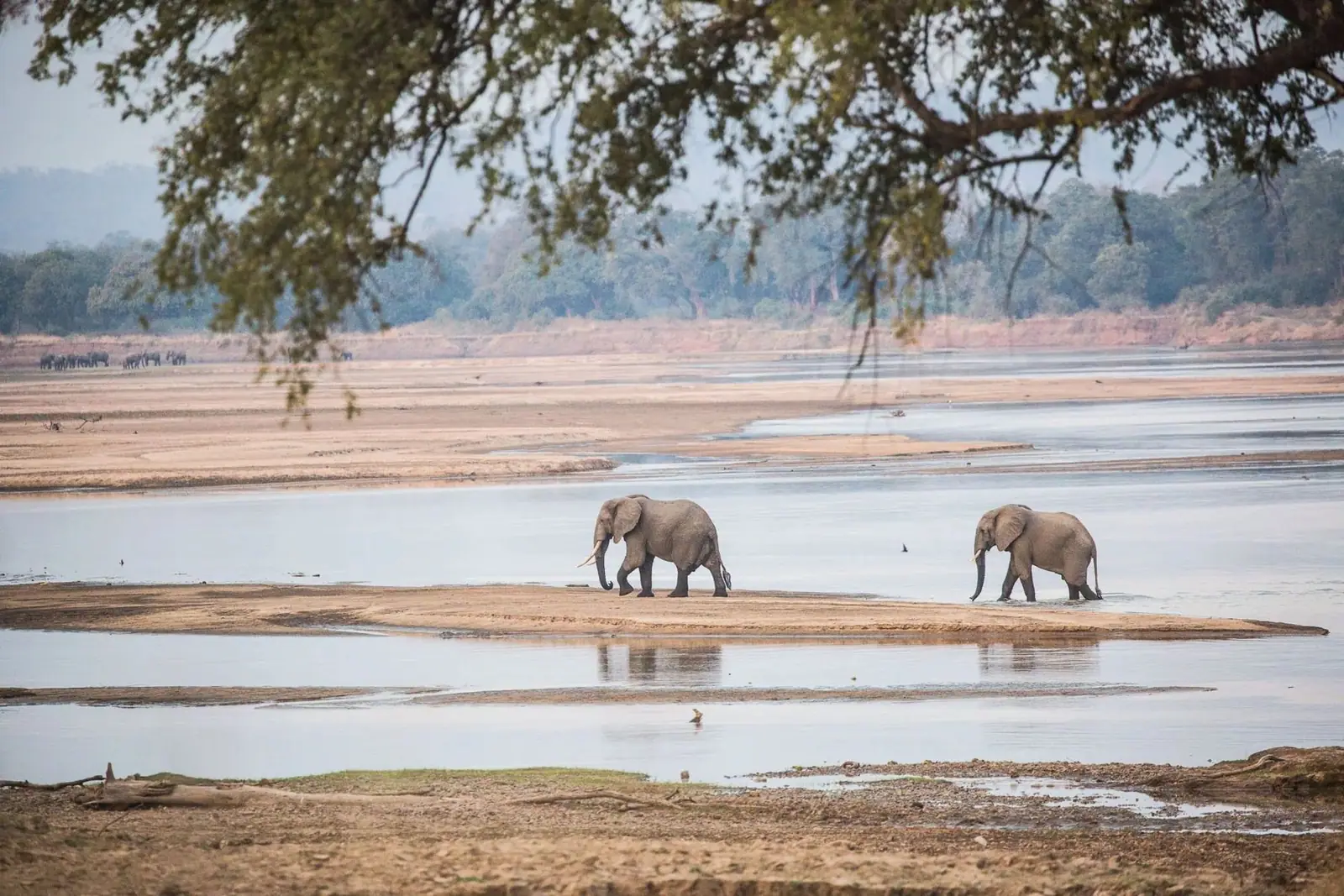 Photo: The Bushcamp Company
What kind of park the Lower Zambezi is
The Lower Zambezi became a national park in 1983. Before that it was the private game reserve of Zambia's president [1]. The park runs along the north bank of the Zambezi, and Mana Pools National Park lies directly across the river in Zimbabwe [1][3]. A much larger Game Management Area surrounds the park, with no fences between them, so wildlife moves freely across the whole area [1].
The park slopes from the Zambezi Escarpment down to the river [1]. Most of it is hilly ground on the escarpment, under thick miombo woodland [2]. The game, though, concentrates on the flat alluvial plain beside the river, especially in the dry season. Here winterthorn woodland lines the bank, and the ground beneath it is often open, with ebony, leadwood and fig in the riverine strip [2]. Most of the large mammals, including buffalo, elephant, lion, leopard and hippo, gather on the floodplain [1].
That shapes the safari. At most camps the program is built around the water: canoeing, boat trips and fishing, alongside drives [2]. Walking is offered at most camps, but it is one activity among several [2][9].
Walking on the floodplain
Under the winterthorn, where the bush beneath is sparse, sightlines on foot can be good [2]. One specialist notes that at Old Mondoro, "forest patches open up for superb visibility on foot" [7].
Walks here can be on the short side. Old Mondoro, which one agent describes as walking-focused, lists its walks at one to three hours, with time given to tracks, birds, plants and insects [6]. That is shorter than the three-to-four-hour, 3–5 km (2–3 mile) morning walk typical of the Luangwa Valley camps [10]. If you want a long walk every day, ask the camp before you book.
Rules and guiding
Walks in the Lower Zambezi go out with a qualified guide and an armed ranger [2]. Time + Tide Chongwe Camp, for example, describes walks led by a safari guide and accompanied by an armed scout [8]. This follows the national pattern of a guide and an armed DNPW scout on walks in Zambia's national parks; see Walking Safaris in Zambia.
Walking also runs at the guide's discretion. At Chiawa Camp, walks and canoe trips are "restricted to 12+ years of age and at the discretion of the guide" [4]. This is one reason we class most Lower Zambezi camps as Walks Offered: our first test asks for walks scheduled every day as standard, not conditions permitting. See How We Classify Walking Safaris.
Age. Children under 12 may not walk or canoe [2]. Some camps set a higher limit for staying at all: Old Mondoro takes children over 14 [5].
Which camps walk
Only one Lower Zambezi camp in our directory makes walking a daily core activity on equal terms with drives: Chula Island, a Walking Camp. The other seven are camps where walking is not a core activity, though at some of them walking is a real strength [9].
Where walking is strongest
- Chula Island. A five-tent camp for up to ten guests, run by the team behind Kafue's Musekese Camp, where guided walks are a particular strength alongside day and night drives, boating and fishing [13]. It is the one Lower Zambezi camp we class as a Walking Camp.
- Old Mondoro. A small seasonal bushcamp of six chalets, inside the park boundary and run by the team behind Chiawa Camp [5][6]. One agent describes walking as "the main focus at this camp" and places it in "the best walking area in the national park" [5]. Canoeing on the channels above camp is the other draw [6]. We list it under Walks Offered because we have not confirmed that walks are scheduled daily as standard. It is the camp to ask first if walking matters most to you.
- Dulini Anabezi. One specialist singles out walks from Anabezi as a chance to see wildlife up close [2].
- Time + Tide Chongwe Camp (formerly Chongwe River Camp). Just outside the park, where the Chongwe meets the Zambezi [11]. Its owners describe "some of the best terrain for exploring on foot in the Lower Zambezi valley" on its doorstep, with walks led by a guide and an armed scout [8].
Where the river leads
- Chiawa Camp. Described as the first camp to settle in the park; walks are offered alongside day and night drives, boating, canoeing and fishing [4].
- Lolebezi. Offers a mix of walking, canoeing and game drives [2].
- Sausage Tree and Kutali. Walks are among several activities, generally secondary to boating and canoeing [2][9].
Two newer camps, Musesenji River Camp (opening in 2026) and Kujana (opened October 2026), are not yet classified [2].
Canoeing: the Lower Zambezi's signature
Specialists call canoeing one of the park's greatest attractions [2]. Canoes are usually two-person, paddled downstream with the current behind a guide, on the main river or on narrower side channels such as the Chifungulu near Sausage Tree Camp [2]. Chongwe paddles both the Zambezi channels and the Chongwe River itself [8]. At Old Mondoro, guests usually set off around 2:30 p.m. and float back before sunset [6].
A canoe trip is not a walking safari, but it shares much of the appeal: no engine, a small group, and wildlife met at eye level. For many visitors the best Lower Zambezi stay is a morning walk and an afternoon on the water.
When to go
Most Lower Zambezi camps open only in the dry season, typically April to November; many close in the rains, when roads become impassable and access is by boat [2]. For walking:
- May and June: quieter, with good game viewing [2].
- July: prime walking time [2].
- Mid-August to mid-October: the best wildlife, and the busiest and most expensive period [2].
- October: walks can be challenging in the heat [2].
- January: thick vegetation limits walking [2].
Getting there
The park is about 127 km (79 miles) from Lusaka as the crow flies [2]. Proflight Zambia flies from Lusaka to Jeki airstrip in about 35 minutes and to Royal airstrip in about 65 minutes, with a direct link to Mfuwe for South Luangwa [12]. Camps meet guests at the airstrip by 4x4. You can also drive in, or combine road and boat; outside the dry season, access is by boat [2].
How the Lower Zambezi compares
Across the river, Mana Pools has one of the highest walking shares we track: about two-thirds to three-quarters of its commercial camps are walking-led [9]. South Luangwa has 24 walking-led camps, about half of its total [9]. The Lower Zambezi, on the same river and with similar floodplain country, has none on our criteria [9]. The difference lies less in the land than in how the camps have built their trips: around the water rather than the walk.
The practical reading: the Lower Zambezi is an excellent choice for a river-based safari with a walk or two. If walking is the reason for your trip, look first at Chula Island, or ask Old Mondoro or Chongwe how often their walks run, or pair the Lower Zambezi with South Luangwa, which the direct Mfuwe flight makes easy [12].
Sources
- Wikipedia, Lower Zambezi National Park — https://en.wikipedia.org/wiki/Lower_Zambezi_National_Park
- Expert Africa, Lower Zambezi National Park — https://expertafrica.com/zambia/lower-zambezi-national-park
- Wikipedia, Mana Pools National Park — https://en.wikipedia.org/wiki/Mana_Pools_National_Park
- Chalo Africa, Chiawa Camp — https://www.chaloafrica.com/accommodation/chiawa-camp-lower-zambezi-zambia/
- Rainbow Tours, Old Mondoro Bushcamp — https://www.rainbowtours.co.uk/zambia/lower-zambezi/hotels/old-mondoro-bushcamp
- Yellow Zebra Safaris, Old Mondoro — https://yellowzebrasafaris.com/zambia/accommodation/old-mondoro/
- Expert Africa, Walking safaris in Zambia — https://www.expertafrica.com/walking-safaris/zambia
- Expert Africa, Chongwe River Camp: information from the owner — https://www.expertafrica.com/zambia/lower-zambezi-national-park/chongwe-river-camp/info-from-owner
- walkingsafaris.com research: camp directory and walking share by park (internal research, 2026 season)
- Yellow Zebra Safaris, The best walking safaris: Zimbabwe vs. Zambia — https://yellowzebrasafaris.com/us/inspiration/safari-insights/the-best-walking-safaris-zimbabwe-vs-zambia/
- Yellow Zebra Safaris, Chongwe River Camp — https://yellowzebrasafaris.com/zambia/accommodation/chongwe-river-camp/
- LowerZambezi.com, Proflight Zambia flights to Lower Zambezi — https://www.lowerzambezi.com/proflight-zambia-lower-zambezi-flights.html
- Expert Africa, Chula Island Camp — https://www.expertafrica.com/zambia/lower-zambezi-national-park/chula-island-camp
Spotted an error? Tell us. How we classify camps: our methodology.